Tag: Romantic Era

  • Paganini Devil’s Violinist or Genius

    Paganini Devil’s Violinist or Genius

    Did Niccolò Paganini sell his soul to the Devil? At the very least, he must have leased it.

    Paganini, born on this date in 1782, is often stated to have been the greatest violinist who ever lived. He took up the mandolin at the age of 5, and was playing his first fiddle by 7. His professional career began at 15, when he embarked on his first solo tour.

    In an era teeming with extraordinary violinists, Paganini transcended them all. In fact, so far did he outstrip his peers, there were rumblings that, if he himself had not bargained his soul, then surely his mother must have.

    At 13, he was sent to study with renowned violinist Alessandro Rolla. Rolla quickly ascertained that there was nothing he could teach this terrifying prodigy. So he referred him to his own teacher, Ferdinando Paer, who in turn handed him up the ladder to his teacher, Gasparo Ghiretti.

    Despite Paganini’s preternatural talent, his early success began to take its toll. Almost immediately, he suffered a nervous breakdown and began drinking heavily. He also became a prodigious gambler and a prolific womanizer.

    Combined with his uncanny abilities as a performer, his flamboyant lifestyle laid the foundation for the Paganini legend. It was said he once murdered a woman and used her intestines to string his violin, so that her imprisoned soul could be heard screaming as he played. Some claimed that sulfur could be smelled during his performances. Another swore that he saw the Devil standing beside him. Yet another, that he was the Devil himself. Paganini doppelgangers began to appear, bearing horns and hooves. Once, lightning struck the end of his bow as he played. Or so the stories went.

    And if you saw Paganini, you’d probably believe it was all true. He was tall and thin, with hollow cheeks and pale skin, thin-lipped and adorned in black. His pallid hand, with unusually long, flashing fingers, raced hypnotically up and down the strings of his violin like an enormous, acrobatic spider. Its unusual span and uncanny flexibility have been attributed in modern times to genetic irregularities, Marfan’s syndrome, and Ehlers-Danlos syndrome. Or perhaps he simply sold his soul to the devil.

    Paganini’s skills on the violin were unparalleled. It’s said that he could play twelve notes per second. He performed without sheet music, contorted, and swung wildly about the stage. His outlandish mannerisms earned him the nickname “Rubber Man.”

    Already sickly for most of his life, he contracted syphilis in 1822. This was treated with mercury, which led to further issues. In 1834, he contracted tuberculosis. He recovered, but retired from the stage later that year, at the age of 54. He spent his last years teaching.

    Shortly before his death, of larynx cancer, at 57 in 1840, a priest arrived to administer last rites, but Paganini turned him away. It might have been because he was convinced he wasn’t going to die. Or it could have been because of… something else.

    Paganini’s final tour was posthumous. When the Church refused to bury his body in consecrated ground, it was sent around Europe for the next four years, where it lay in state. When burial was still denied, it spent a year in a cellar. Then it was taken to a leper house. After that, it was moved to a cement vat in an olive factory. Then to a private house. Finally, Pope Gregory XVI allowed Paganini’s remains to be laid to rest in La Villetta Cemetery in Parma.

    Niccolò Paganini was a Romantic icon, with a capital “R.” Hector Berlioz, himself no slouch in the seething Romantic department, wrote “Harold in Italy” so that Paganini could show off his new viola. Paganini didn’t think the solo part was flashy enough, and though he came eventually to admire the piece, he never actually played it. Even so, he continued to help Berlioz financially during his later years. He also became a good friend of Rossini.

    Numerous other composers were inspired by Paganini’s own music. Liszt, another kindred spirit, who modeled his own concert persona after Paganini’s, wrote a set of “Paganini Etudes.” And how many composers have written sets of variations on Paganini’s famous 24th Caprice? Franz Lehár even wrote an operetta, highly fictionalized, about a romance between the virtuoso and Napoleon’s sister, Princess Anna Elisa.

    Whether or not you believe the legends, Paganini sure could play like the Devil. Happy birthday, Niccolò Paganini, wherever you are!


    Alexander Markov plays Paganini’s 24th Caprice

    Ruggiero Ricci plays all of them

    Claudio Arrau plays Liszt’s “Paganini Etude No. 6”

    Liszt’s “Paganini Etudes,” complete (the only live performance on YouTube)

    Rachmaninoff, “Rhapsody on a Theme of Paganini,” at the Proms, with Stephen Hough the soloist (the famous 18th Variation appears 15 minutes in)

    Brahms, “Variations on a Theme by Paganini,” played by Arturo Benedetti Michelangeli

    https://www.youtube.com/watch?v=uy3miJmU-dk

    Boris Blacher, “Orchestral Variations on a Theme by Paganini”

    Witold Lutoslawski, “Paganini Variations,” with Argerich and Kissin

    From Lehár’s “Paganini”

    Alfredo Casella, “Paganiniana”

    Paganini’s Violin Concerto No. 2 “La campanella” (with its famous “little bell” finale beginning around 19 minutes in)

  • Berlioz: Underappreciated Romantic?

    Berlioz: Underappreciated Romantic?

    Is Hector Berlioz the Rodney Dangerfield of composers? *

    Despite being one of the foremost musical representatives of the Romantic era, let’s face it, Berlioz gets little respect. Or at least that was the case for much of his life and the decades following his death.

    Now he’s about to receive the full treatment from the Bard Music Festival. (More on that below.)

    Before recordings, assessments of Berlioz’s music leaned heavily on hearsay, a game of Whisper Down the Lane, distorted by prejudice, misperception, and so-called received wisdom. Even during his life – ESPECIALLY during his life – his music was met with confusion, opposition, and often outright hostility. So it always is with the new.

    And Berlioz was nothing if not original. If there was ever a composer who was ahead of his time, it was Hector Berlioz.

    Thankfully, this visionary artist has long since been vindicated. Enthusiasts are very enthusiastic indeed. But there remain those who are unconverted among the listening public. Because, let’s be honest, emerging as he did in the Paris of Boieldieu, Auber, and Meyerbeer, Berlioz was just weird. He’s still weird. With his moodiness, quirky orchestration, and willingness to shatter the rules in order to achieve his desired effects, he was a flagrant outcast among French composers. His cause was not helped by inept performances and push-back from the hidebound faculty of the Paris Conservatory (overseen by Luigi Cherubini).

    It’s interesting that this arch-Romantic worshipped at the altars of Gluck and Spontini. He felt everything so very deeply; he experienced everything so keenly, especially music. He was particularly transported by the noble simplicity of his heroes’ operas.

    On the other hand, he was also a champion of Paganini, whom he befriended in the violinist’s retirement, though he never heard him perform. (If only there had been recordings!) Paganini, of course, was legendary for his gymnastic manipulation of his instrument, as was Franz Liszt, of the piano – Liszt also admired by Berlioz. (The admiration was reciprocated.) These gentlemen could be as indulgent as Gluck and Spontini were chaste.

    Berlioz’s reaction when his fiancée broke off their engagement was more Dionysian than Apollonian. He formulated a murder-suicide plot every bit as over-the-top as something out of Alexandre Dumas (also his contemporary). It involved a vertiginous coach ride back from Italy, unlikely disguise – crossdressing, complete with a veil – and a contingency plan to administer poison in the event his pistols jammed or misfired. Thankfully, the composer’s head cooled once he discovered he had forgotten his dress.

    Since performances were scarce and often substandard, Berlioz earned much of his livelihood through his writings. And Berlioz was not one who was bashful about speaking his mind. His amusing and withering assessments, often couched in wry observation and sarcasm, earned him many enemies. He was in no way cut out for what he perceived – often rightly – as the superficiality of Paris, yet he loved and thrived on the city, and he would not leave. He was much better-received in London, and he entertained the idea of moving, but Paris was in his blood.

    Now, of course, we are blessed with recordings and radio broadcasts. Some of Berlioz’s works are standard repertoire. It is now easy to acquaint oneself with his eccentric symphonies – often symphonies, in the classical sense, in name only – his choral works, his songs, and his operas. His greatest hit, the “Symphonie fantastique,” loses some of its punch, unavoidably, through overexposure and the anesthetizing effect of all the developments in music since, but it will never be entirely free of its strangeness, thank goodness.

    “Harold in Italy,” the “Queen Mab Scherzo” (from the “Romeo and Juliet” Symphony), “The Damnation of Faust,” and some of the overtures, especially “Roman Carnival,” are here to stay.

    Lesser known are the cantatas, the songs, and some of the hybrid works, such as the melodrama “Lélio, or The Return to Life,” a sequel of sorts to the “Symphonie fantastique.”

    “Lélio” will receive a rare performance on a double bill with Berlioz’s most famous symphony – which itself concludes with a hair-raising evocation of a witches’ sabbath (that incorporates that horror movie staple, the “Dies Irae”) – to kick off this year’s Bard Music Festival. “Hector Berlioz and His World” will take place at Bard College in Annandale-on-Hudson, NY, August 9-18.

    Rarely-performed is what Bard does best, so there will be ample opportunities to enjoy musical curiosities. Morning and afternoon concerts will feature chamber music and songs; evening concerts will lean into the orchestral and choral works. Berlioz’s song cycles “Irlande” (“Ireland”) and “Les nuits d’’été (“Summer Nights”) will be performed, as will his monumental “Te Deum” and “The Damnation of Faust” (complete).

    The addendum “His World” will encompass music of his contemporaries, but also that of his influences and those he in turn influenced. Pauline Viardot’s opera, “Le dernier sorcier” (“The Last Sorcerer”), will be heard; also Louise Farrenc’s Symphony No. 3, Joachim Raff’s Symphony No. 10 “Autumn,” and Liszt’s transcription of Berlioz’s “Harold in Italy” for viola and piano.

    Bard being Bard, there will also be a concert devoted to “Berlioz’s Transformation of the World of Sound,” the program spiraling off into unsuspected territory, exploring works by Edgard Varèse, Olivier Messiaen, Luciano Berio, Steve Reich, and György Ligeti.

    As always, there will be pre-concert talks, scholarly symposia, and plenty of Berlioz merch for purch (including, but not limited to, the festival t-shirt and a book of critical essays compiled specifically for the occasion).

    The American Symphony Orchestra and The Orchestra Now (TŌN) will perform, under their music director, Leon Botstein (also the president of Bard College). In the afternoons, performers are drawn from Bard’s deep well of faculty, alumni, and visiting artists. This is not just a college music festival. I’ve seen some world-class artists and first-rate chamber ensembles there, including Christine Goerke, Stephanie Blythe, Nicholas Phan, pianists Piers Lane and Danny Driver, the Parker Quartet, and the Horszowski Trio, to name a few), along with the occasional actor, such as Michael York and David Straitharn.

    As always at Bard, you get out of it whatever you put into it. If total immersion is your thing, by all means, go for it. The festival is designed with you in mind. However, not to the exclusion of anyone who just wants to go and enjoy a good concert. Bard satisfies on that level too. Scholars, geeks, and dilettantes come together for two weekends of musical bliss (now bridged by a couple of mid-week concerts held at Church of the Messiah in nearby Rhinebeck).

    No matter how well you think you know a particular composer, I guarantee you will learn a lot. I’ve been boning up for the last month or two with a couple of volumes of Berlioz’s own writings. More about those another time.

    For now, vive le Bard!

    For more information, visit

    https://fishercenter.bard.edu/whats-on/programs/bard-music-festival/

    Fisher Center at Bard


    • Credit where credit is due! The observation was originally made by Facebook follower John M Polhamus.
  • Rediscovering Louise Farrenc & Neglected Romantics

    Rediscovering Louise Farrenc & Neglected Romantics

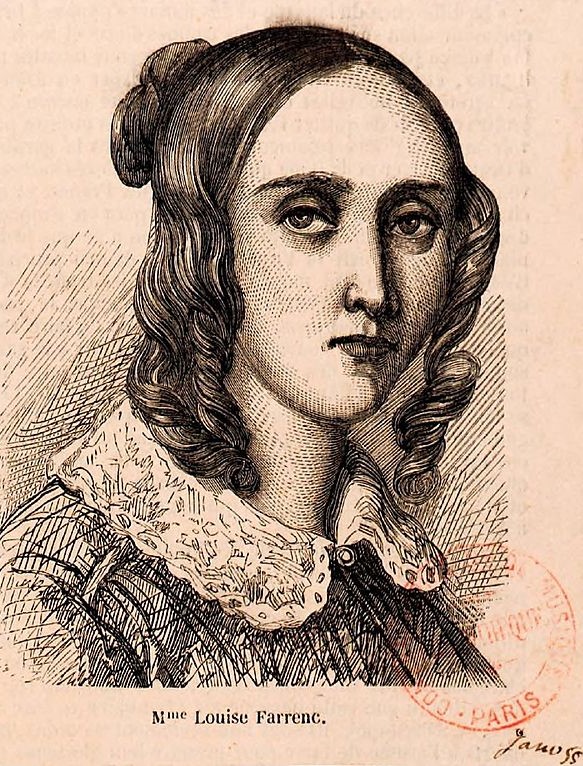
    Nearly 150 years after her death, composer Louise Farrenc is finally coming into her own. Farrenc (1804-1875) was the only female professor at the Paris Conservatory during the whole of the 19th century. Of course, she was only allowed to teach women.

    This Sunday night on “The Lost Chord,” we’ll hear Farrenc’s remarkable Third Symphony, on a program of music by three neglected French Romantics.

    A pupil of Moscheles (teacher of Mendelssohn) and Hummel (who studied with Mozart), Farrenc was a formidable pianist, who also took private lessons with Conservatory professor Anton Reicha. She paused in her career as a performer in order to start a successful publishing house, with her husband, Éditions Farrenc, which flourished for nearly 40 years.

    Beginning in 1842, Farrenc was finally accepted it into the Paris Conservatory, as a professor. There, she taught piano, but not composition. However, her stature was such that she was able to demand – and receive – equal pay.

    We’ll also hear music by Augusta Holmès (1847- 1903), French composer of Irish ancestry. Holmès received encouragement from Liszt and Wagner, as well as multiple marriage proposals from Saint-Saëns (which she declined). She became a pupil of César Franck. It’s said that Franck’s Piano Quintet enshrines the teacher’s ardent longing for his student. Saint-Saëns, who participated in the work’s scandalous premiere, was not amused.

    Holmès will be represented by her symphonic poem “Andromède,” from 1883. Andromeda, you may recall from Greek mythology, is the daughter of Cassiopeia, who incurs the wrath of the gods when she brags of Andromeda’s extraordinary beauty (comparing her favorably to the Nereids). Andromeda is chained to a rock as a sacrifice to a sea serpent, but rescued from her fate by Perseus, who arrives just in the nick of time, astride the winged horse Pegasus and bearing the severed head of the Gorgon Medusa, with which he turns the serpent to stone.

    Finally, Marie Gandval (1830-1907) studied with Flotow, then Chopin, and later Saint-Saëns. Saint-Saëns dedicated his Christmas Oratorio to her. She was the most frequently performed composer on concerts of the Société Nationale de Musique. The Société was founded by Saint-Saëns with an aim to promote orchestral music, which he found underserved in opera-mad France, where orchestras were tied to the theatres. Grandval herself was a composer of opera and choral music, but tonight there will be just enough time for her “Deux pièces” for oboe, cello and piano.

    Look for the women on “Cherchez la Femme,” this Sunday night at 10:00 EST, on WWFM – The Classical Network and wwfm.org.

  • Mendelssohn: Underrated Genius and Musical Revolutionary

    Mendelssohn: Underrated Genius and Musical Revolutionary

    I am starting to get just a little bit tired of hearing that if Felix Mendelssohn had never lived, music history would not have turned out any differently. He’s second-rate, he’s sentimental, he’s an academician, blah blah blah. When are these pompous idiots going to open their ears and acknowledge the fact that he was only one of the most influential composers of the 19th century? Especially in Germany, England and America, did any serious musician escape his sway?

    Mendelssohn was essentially adopted as England’s national composer. Figures from William Sterndale Bennett through Sir Arthur Sullivan gleefully played in his shadow. In fact, Mendelssohn was the hottest composer in England since Handel. Such a stranglehold did Handel and Mendelssohn have on English concertgoers’ affections that, in Germany, England was mocked as “Das Land ohne Musik” – The Land without Music. The best English composers were all German.

    But if the Germans were to be at all honest with themselves, they would have realized that all the best German composers were also followers of Mendelssohn. What about Wagner, you say, surely one of the most progressive composers who ever lived? There’s plenty of Mendelssohn in early Wagner. Ditto for Richard Strauss. As for the “second rank,” the more conservative school, just about everyone emulated Mendelssohn.

    Of himself, of course, Mendelssohn was one of the most astonishing of musical prodigies. He composed two of the most enduring masterpieces in the repertoire, the overture to a “Midsummer Night’s Dream” and the Octet for Strings, at 16 and 17 respectively. In terms of maturity and polish, these were certainly on a par with anything written by the teenaged Mozart.

    Yes, Mendelssohn was a traditionalist. He structured his music on foundations laid in the past. Even so, he cautiously ventured into the mists of Romanticism. Occasionally, he even subverted expectations, in works like his famous Violin Concerto. Furthermore, he was respectful, if not kind, to everyone, even those of whose music he disapproved.

    As a conductor, there’s no question he was one of the most influential musicians in Europe, if not the world. For twelve years, he led the Leipzig Gewandhaus Orchestra, an ensemble full of players who went on to distinction in their own right. He was admired for the precision of his performances. He was also the one who essentially drew up the blueprint for modern orchestras in developing a musical “canon.” He gave important premieres of music by his contemporaries, while also reviving works of Bach, Mozart, and Beethoven.

    In particular, he is credited with resuscitating the reputation of Johann Sebastian Bach, not only through his resurrection of the “St. Matthew Passion,” but in overseeing an edition of Bach’s organ works, along with an edition of Handel’s oratorios, both of which were published in England.

    So music history would have been quite different if not for Mendelssohn, thank you very much. He may not have been the most seismic of innovators, but there’s something to be said for being a master of one’s craft.

    Mendelssohn died in Leipzig, after a series of strokes, at the age of 38. Did he live up to his potential? Who among us is really qualified to judge? How much is one man expected to accomplish, anyway?

    No radio station in the world is going to devote a full day to Mendelssohn’s music. Since the death of Victoria, I don’t think Mendelssohn has ever really been fashionable, except perhaps at weddings. But who doesn’t love the overture to “A Midsummer Night’s Dream,” the Octet for Strings, the “Hebrides Overture,” the “Italian” Symphony, or the Violin Concerto in E minor?

    Morton Feldman once said, “The people you think are radicals might really be conservative. The people who you think are conservative might really be radical.”

    I don’t know that I would ever go so far as to label Mendelssohn a radical, but he most certainly did change the world, and those of us who love music would have been a lot poorer without him.

    Happy birthday, Felix Mendelssohn!


    IMAGE: Another view of Mendelssohn

  • Carl Tausig: Liszt’s Impish Prodigy

    Carl Tausig: Liszt’s Impish Prodigy

    Having had the opportunity to listen to Franz Liszt’s “A Faust Symphony” a couple of times over the past few days, my thoughts lighted on Carl Tausig. Amusingly, now that I think about it, it was during the movement associated with Mephistopheles. And wouldn’t you know it, today is Tausig’s birthday.

    Tausig was Liszt’s supremely talented, though impish protégé. Some say that he was his greatest pupil.

    Tausig joined Liszt in Weimar at the age of 14. Energetic to a fault, he got up to all sorts of mischief, including sawing the ends off piano keys in order to make the instrument more challenging to play. He also hocked the original, unpublished manuscript of “A Faust Symphony,” an entire year’s labor, for a mere pittance. Fortunately, Liszt was able to retrieve it.

    Tausig then joined Richard Wagner in his political exile in Switzerland, where the boy’s boisterous behavior caused the operatic master his own share of distress. There must have been something exceptionally endearing in his personality, since he was always quickly forgiven.

    At a birthday celebration for the young pianist, Liszt predicted, with a twinkle in his eye, that Tausig would become either a great blockhead or a great master.

    Regrettably, his career was cut short. He died of typhoid fever, aged only 29 years.

    Happy birthday, Carl Tausig, scamp to the Romantic masters.


    2 Concert Etudes, Op. 1

    Fantasia on Moniuszko’s “Halka”


    PHOTOS: Carl Tausig (left), with Franz Liszt and Richard Wagner, looking vexed

Tag Cloud

Aaron Copland (92) Beethoven (95) Composer (114) Film Music (120) Film Score (143) Film Scores (255) Halloween (94) John Williams (185) KWAX (229) Leonard Bernstein (100) Marlboro Music Festival (125) Movie Music (135) Opera (198) Philadelphia Orchestra (88) Picture Perfect (174) Princeton Symphony Orchestra (106) Radio (87) Ralph Vaughan Williams (85) Ross Amico (244) Roy's Tie-Dye Sci-Fi Corner (290) The Classical Network (101) The Lost Chord (268) Vaughan Williams (103) WPRB (396) WWFM (881)

DON’T MISS A BEAT

Receive a weekly digest every Sunday at noon by signing up here


RECENT POSTS