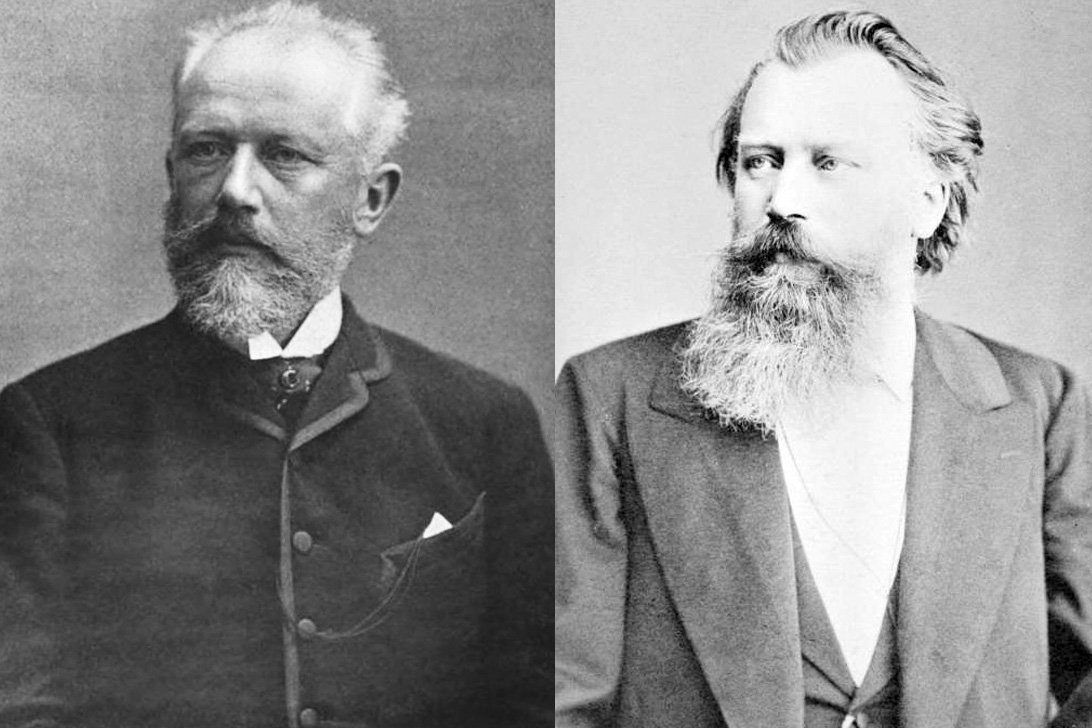
They were like the Felix and Oscar of Romantic music – the high-strung, fastidious Tchaikovsky (1840-1893), and the acerbic, unkempt Brahms (1833-1897). May 7th marks the anniversary of the births of these twin titans of hirsute Romanticism.
I always find it oddly endearing that Brahms and Tchaikovsky were able to look past their personal aversions to one another’s music to actually grow to appreciate their individual qualities as people. There’s a lesson to be learned from that, I think.
Initially, Tchaikovsky might have been right at home posting in a YouTube comments section, confiding to his diary, “I have played over the music of that scoundrel Brahms. What a giftless bastard!”
For his part, Brahms indelicately drifted off to sleep during a rehearsal of Tchaikovsky’s Fifth Symphony – unfortunately, in the presence of the composer.
According to the pianist Zygmunt Stojowski, “Tchaikovsky’s comment to me was that he would have been deeply hurt had he not, himself, frankly hated the Brahms symphonies.”
The two composers met unexpectedly in Leipzig in 1888. They must have been as surprised as anyone to find themselves actually delighting in one another’s company.
“I’ve been on the booze with Brahms,” Tchaikovsky wrote. “He is tremendously nice – not at all proud as I’d expected but remarkably straightforward and entirely without arrogance. He has a very cheerful disposition, and I must say that the hours I spent in his company have left me with nothing but pleasant memories.”
The following year, the two met again in Hamburg. That’s when Brahms slept through the Fifth Symphony. Tchaikovsky bore it lightly and was convivial throughout the meal they shared afterward. Although Brahms was harsh in his assessment of the last movement of the symphony and Tchaikovsky confessed an overall aversion to Brahms’ style, the evening was full of good cheer and ended with Tchaikovsky inviting Brahms to visit him in Russia.
How large a role alcohol may have played in the two men’s warmth for one another we can only guess. It was not just anyone who could be Brahms’ drinking buddy.
Regardless of their mutual affection, the two never could reconcile themselves to one another’s music. When asked what he thought of a piano trio Brahms had been rehearsing (the Trio in C minor), Tchaikovsky was polite but frank: “Don’t be angry with me, my dear friend, but I did not like it.”
Happy birthday, boys.
Brahms, Piano Trio No. 3 in C minor, Op. 101 (disliked by Tchaikovsky)
Tchaikovsky, Symphony No. 5 in E minor (disliked by Brahms)
Did Niccolò Paganini sell his soul to the Devil? At the very least, he must have leased it.
Paganini, born on this date in 1782, is often stated to have been the greatest violinist who ever lived. He took up the mandolin at the age of 5, and was playing his first fiddle by 7. His professional career began at 15, when he embarked on his first solo tour.
In an era full of extraordinary violinists, Paganini left them all behind. In fact, so far did he outstrip his peers, there were rumblings that, if he himself had not bargained his soul, then surely his mother must have.
At 13, he was sent to study with renowned violinist Alessandro Rolla. Rolla quickly ascertained that there was nothing he could teach this terrifying prodigy. So he referred him to his own teacher, Ferdinando Paer, who in turn handed him up the ladder to his teacher, Gasparo Ghiretti.
Despite Paganini’s preternatural talent, his early success began to take its toll. Almost immediately, he suffered a nervous breakdown and began drinking heavily. He also became a prodigious gambler and a prolific womanizer.
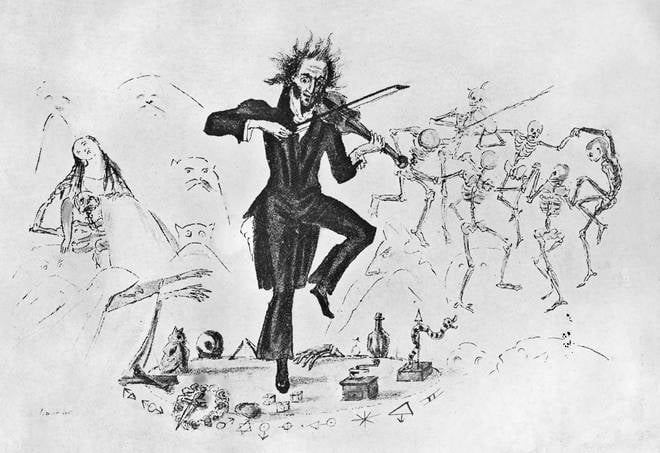
Combined with his uncanny abilities as a performer, his flamboyant lifestyle laid the foundation for the Paganini legend. It was said he once murdered a woman and used her intestines to string his violin, so that her imprisoned soul could be heard screaming as he played. Some claimed that sulfur could be smelled during his performances. Another swore that he saw the Devil standing beside him. Yet another, that he was the Devil himself. Paganini doppelgangers began to appear, bearing horns and hooves. Once, lightning struck the end of his bow as he played. Or so the stories went.
And if you saw Paganini, you’d probably believe it was all true. He was tall and thin, with hollow cheeks and pale skin, thin-lipped and adorned in black. His pallid hand, with unusually long, flashing fingers, raced hypnotically up and down the strings of his violin like an enormous, acrobatic spider. Its unusual span and uncanny flexibility have been attributed in modern times to genetic irregularities, Marfan’s syndrome and Ehlers-Danlos syndrome. Or perhaps he simply sold his soul to the devil.
Paganini’s skills on the violin were unparalleled. It’s said that he could play twelve notes per second. He performed without sheet music, contorted, and swung wildly about the stage. His outlandish mannerisms earned him the nickname “Rubber Man.”
Already sickly for most of his life, he contracted syphilis in 1822. This was treated with mercury, which led to further issues. In 1834, he contracted tuberculosis. He recovered, but retired from the stage later that year, at the age of 54. He spent his last years teaching.
Shortly before his death, of larynx cancer, at 57 in 1840, a priest arrived to administer last rites, but Paganini turned him away. It might have been because he was convinced he wasn’t going to die. Or it could have been because of… something else.
Paganini’s final tour was posthumous. When the Church refused to bury his body in consecrated ground, it was sent around Europe for the next four years, where it lay in state. When burial was still denied, it spent a year in a cellar. Then it was taken to a leper house. After that, it was moved to a cement vat in an olive factory. Then to a private house. Finally, Pope Gregory XVI allowed Paganini’s remains to be laid to rest in La Villetta Cemetery in Parma.
Niccolò Paganini was a Romantic icon, with a capital “R.” Hector Berlioz, himself no slouch in the seething Romantic department, wrote “Harold in Italy” so that Paganini could show off his new viola. Paganini didn’t think the solo part was flashy enough, and though he came eventually to admire the piece, he never actually played it. Even so, he continued to help Berlioz financially during his later years. He also became a good friend of Rossini.
Numerous other composers were inspired by Paganini’s own music. Liszt, another kindred spirit, who modeled his own concert persona after Paganini’s, wrote a set of “Paganini Etudes.” And how many composers have written sets of variations on Paganini’s famous 24th Caprice? Franz Lehár even wrote an operetta, highly fictionalized, about a romance between the virtuoso and Napoleon’s sister, Princess Anna Elisa.
Whether or not you believe the legends, Paganini sure could play like the Devil. Happy birthday, Niccolò Paganini, wherever you are!
Alexander Markov plays Paganini’s 24th Caprice
Arrau plays Liszt’s “Paganini Etude No. 6”
Liszt’s “Paganini Etudes,” complete
Rachmaninoff, “Rhapsody on a Theme of Paganini,” at the Proms, with Stephen Hough the soloist (the famous 18th Variation occurs 15 minutes in)
Brahms, “Variations on a Theme by Paganini,” played by Michelangeli
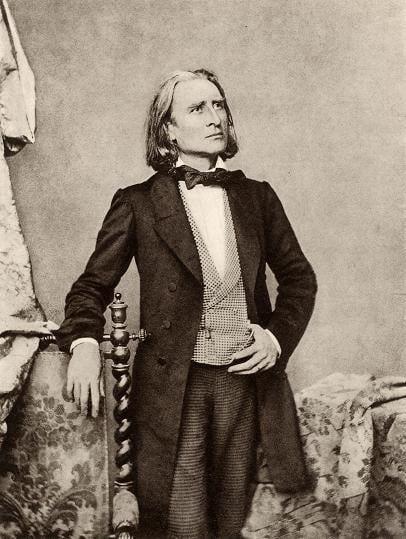
Franz Liszt’s prowess at the keyboard is still spoken of in tones of awe. This inventor of the modern piano recital lent spectacle and showmanship to Orphean musicality and transcendental technique. He tore through pianos as if they were made out of paper and reduced the ladies of Europe to skirmishes over his cigar butts or the calculated neglect of a glove.
He loved the attention. He loved the applause. He loved the women.
Then all at once he stopped. Liszt retired from the concert stage at the age of 35, returning thereafter only for charitable causes – for the relief of victims of fire and flood, in support of political refugees, and to raise money for a Beethoven monument in Bonn.
He may have been a man who savored all the privileges of his celebrity, but he was also an intellectual and an artist of the spirit. He was devoutly religious for his entire life – even taking minor orders and living in a cell in Rome for a few years at middle age – and he was unfailingly generous to others. He never took payment from any of his pupils, and selflessly promoted the work of Grieg, Smetana, Debussy, Saint-Saëns, Fauré, Borodin and many more.
Throughout his career, he was lambasted by critics for pandering to the mob. He was ridiculed as a charlatan and a hypocrite. He was shunned for his long-term relationships with two women who fled troubled marriages, and intrigued against by jealous rivals at the Weimar court for championing the works of Berlioz and Wagner.
He helped the latter, a political fugitive for his role in the 1849 Dresden uprising, to flee the country, and even endorsed Wagner’s marriage to Liszt’s (already married) daughter. Wagner’s “Tristan chord” would send shockwaves throughout Europe, changing music forever, but in actuality it was only one of the many innovations he borrowed from his father-in-law. Wagner may have been the greater composer, but Liszt was the idea man. He was the soil that allowed Wagner’s genius to flower.
Liszt was one of the most original musical thinkers of the 19th century. His influence rippled down the generations to color the thinking also of Ravel, Scriabin, and Schoenberg. “My sole ambition as composer,” he once pronounced, “is to hurl my lance into the infinite space of the future.”
The future is now, as we celebrate this wildly influential, yet still sorely underrated composer on his birthday with an afternoon of his music, including the epic and seasonally appropriate “A Faust Symphony.”
First, on today’s Noontime Concert, Mimi Stillman and Charles Abramovic will enchant in a program presented as part of Penn State Flute Day (January 13, 2019). They’ll share works by Philippe Gaubert, Daniel Dorff, Heidi Jacob (a world premiere), Francis Poulenc, Antonin Dvorak, and Vittorio Monti. Monti’s “Czardas” will act as a bridge to an afternoon of music by one of Hungary’s greatest masters.
We’ll provide an assist for Liszt, prefaced by a recital by stylish Stillman. Join me for music both notable and noble, from 12 to 4 p.m. EDT, on WWFM – The Classical Network and wwfm.org.
Learn more about Stillman and Abramovic’s upcoming concert of Bach masterworks, with the Dolce Suono Ensemble, at Philadelphia’s Old Pine Street Presbyterian Church, this Sunday at 3 p.m.:
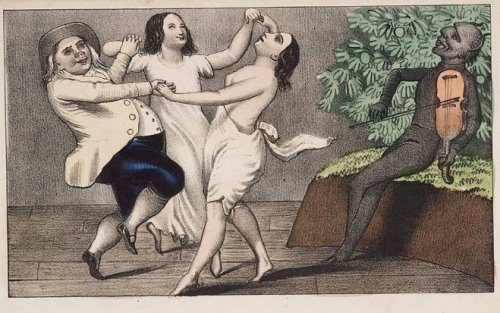
Franz Liszt (1811-1886) was quite the complex personality. He was a devout Catholic his entire life, even taking minor orders and living in a monastery for a few years at middle age. However, as one of the performer-superstars of his youth, he was also frequently tempted by the pleasures of the flesh. And, as Oscar Wilde observed, “The only way to get rid of temptation is to yield to it.”
Like many artists of the Romantic era, Liszt was consumed by the supernatural allure and philosophical wranglings of Goethe’s “Faust.” Perhaps something in the Faustian character appealed to him more than most. In his pursuit of loftier ideals, Liszt was certainly aware of his feet of clay. This Sunday night on “The Lost Chord,” we’ll examine the tension between striving artist and earthly pleasures through an hour of Liszt’s diabolical dances.
We’ll sample from his “Mephisto Waltzes” (all except the first, which is so very well known); also, a “Mephisto Polka,” the “Czardas Macabre,” and a couple of operatic paraphrases, on “Robert le Diable” (treated as a “valse infernale”) and the waltz from Gounod’s “Faust.”
Some of these are straight-ahead knuckle-busters, full of hair-raising keyboard acrobatics; others aim to gently unsettle, employing the interval of a tritone – known for centuries as “the devil in music” – or blurring into a kind of tonal ambiguity that foreshadows some of the experimental music of the 20th century.
Liszt, a profound thinker and a grand provocateur, was always questing. That said, he seldom undersold the visceral thrill of a precipitous piano run or the simple pleasure of a good tune.
Get ready to surrender to temptation with “A Fistful of Mephistos” – an hour diabolical dances by Franz Liszt, on his birthday – this Sunday night at 10:00 EDT, on WWFM – The Classical Network and wwfm.org.
Works by women composers permeate my record collection like so many veins of ore. Women’s History Month provides the perfect excuse to mine some of these and share them with a listening audience, which I will endeavor to do tomorrow morning on WPRB.
However, until the start of the March, I had forgotten all about Marvin Rosen’s annual, month-long “In Praise of Woman” celebration, presented over four Wednesdays on his show Classical Discoveries. In putting together tomorrow’s playlist, I will plan to avoid as much as possible composers from the eras which are Marvin’s principle focus – that is to say, the medieval and Renaissance periods and music of our own time.
All of the composers we’ll hear will have shuffled off this mortal coil, with a great emphasis on artists who lived and worked during the Romantic Era and into the first half of the 20th century. There may be one or two exceptions, but they will all be quite dead.
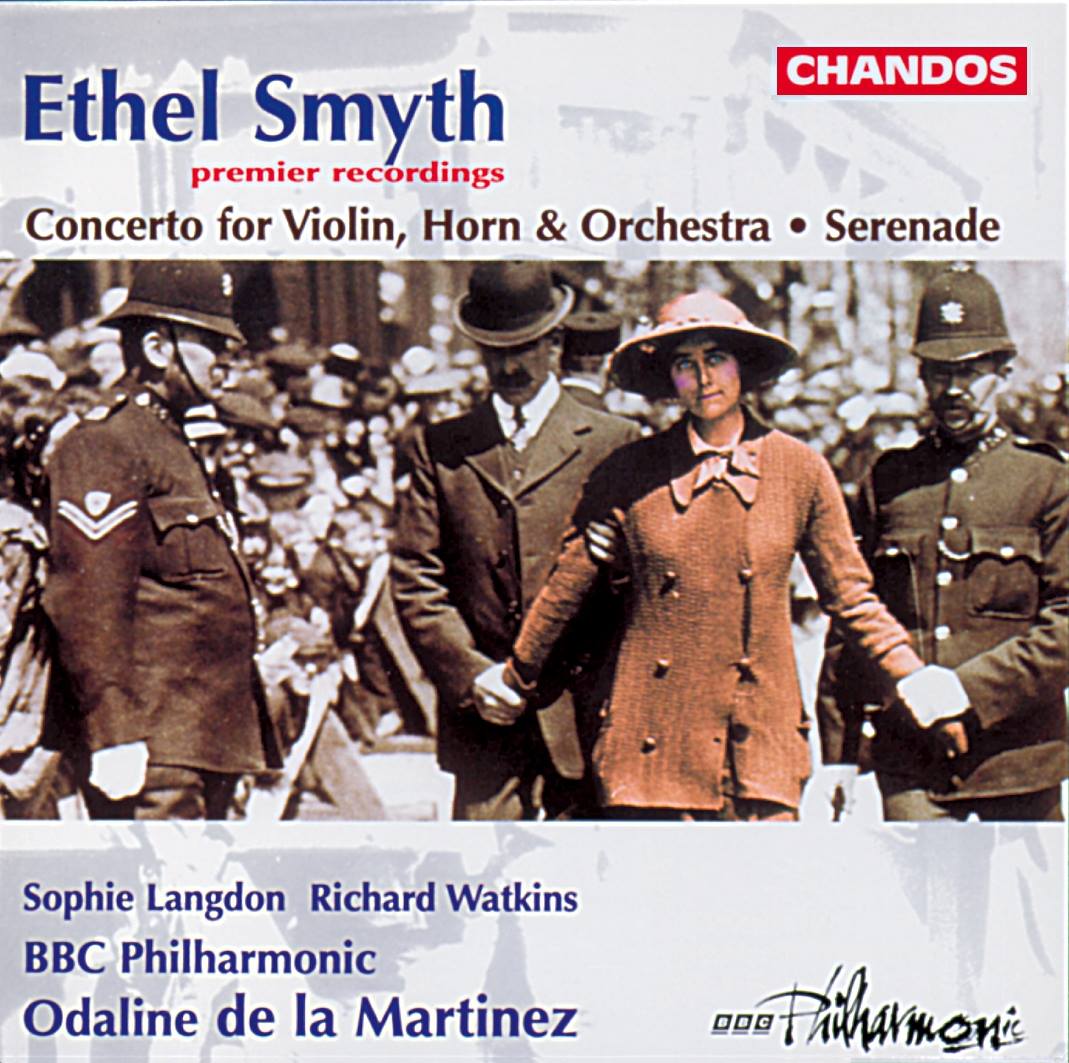
This will allow me to supplement Marvin with music by a broad array of truly talented and neglected figures that have been eclipsed by even third-rate composers among their male contemporaries. For example, I took down from the shelf yesterday an orchestral serenade by Dame Ethel Smyth that knocked me sideways.
Smyth, born in 1858, was a world-class rabble-rouser who became one of the most vocal advocates of the women’s suffrage movement in England. She overcame early opposition to a career in music on the part of her father to receive the praise of George Bernard Shaw, who called her Mass “magnificent.”
However, her works were often better-appreciated abroad. Her operas, in particular, were embraced in Germany. One of them, “Der Wald,” was the only opera by a woman composer mounted by New York’s Metropolitan Opera for over a century! (Next season, the Met has finally decided to take a chance on another, when it will stage Kaija Saariaho’s “L’Amour de loin.”)
Smyth served time in prison for putting out the windows of politicians who opposed a woman’s right to vote. She also wrote for the cause “The March of the Women.” When Sir Thomas Beecham went to visit her in jail, he witnessed her conducting through the bars of her window with a toothbrush as her associates gathered for exercise in the courtyard.
To my ears, her “Serenade in D” is better than just about anything composed by Sir Hubert Parry (whose music I happen to enjoy) and much more compelling than the symphonies of Sir Charles Villiers Stanford.
Tune in tomorrow morning to see if you agree. It’s all music by female composers, from 6 to 11 ET, on WPRB 103.3 FM and at wprb.com. We take a walk on the distaff side, on Classic Ross Amico.