First of all, this is the first opportunity I’ve had to wish all of you who observe Rosh Hashanah a sweet new year!
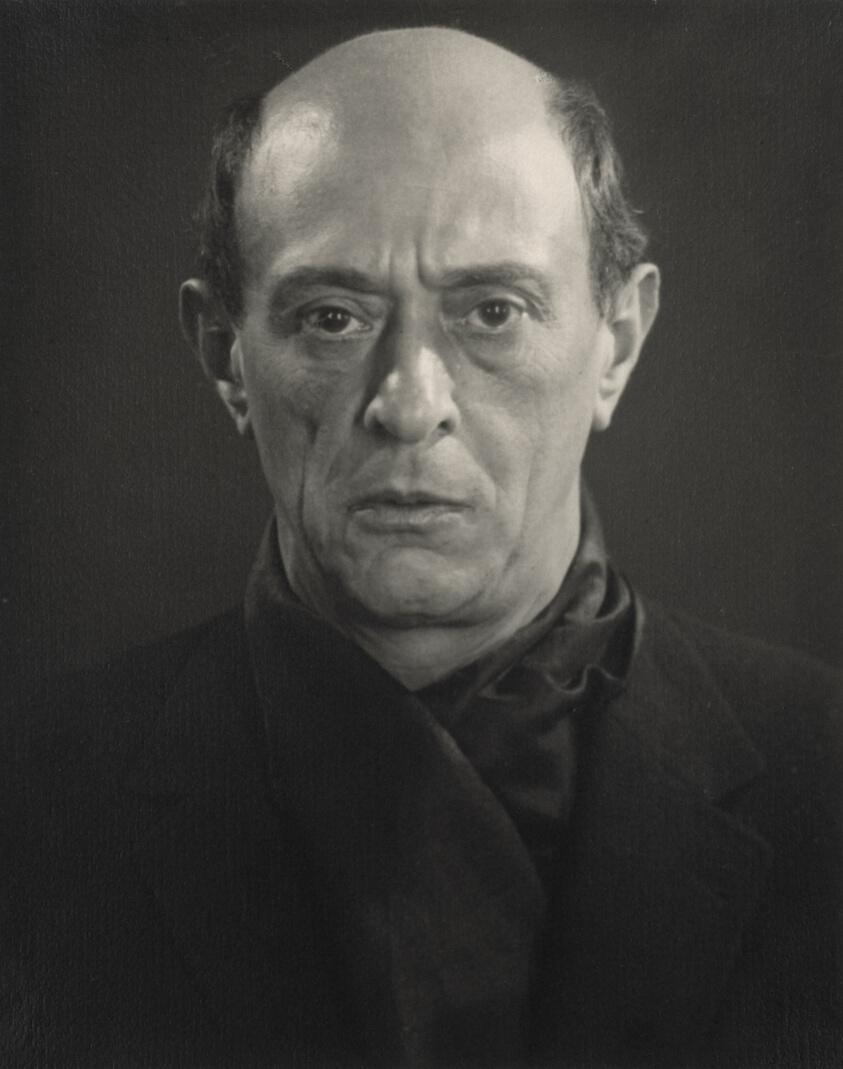
There’s been a lot going on the past couple of days. And now today is the birthday of dodecaphonic icon Arnold Schoenberg (1874-1951).
Schoenberg, who was born Jewish, converted to Lutheranism in 1898 – not, as might be assumed, for professional reasons or in an attempt to assimilate, but because of a nagging spiritual hunger.
He formally converted back to Judaism in defiance of the National Socialists, who came to power in 1933. He was on vacation in France, when he was warned that it would dangerous for him to return to Germany. He reclaimed membership in the Jewish faith in a Paris synagogue. Schoenberg was summarily denounced by the Nazis as a Jew and an exponent of degenerate art. He was dismissed from his post at the Prussian Academy of Letters, where he had taught since 1925.
Unbowed, he drafted a “Four-Point Program for Jewry,” calling for a united Jewish party and the creation of an independent Jewish state. He emigrated to the United States, eventually settling in Los Angeles, where he taught at U.C.L.A.
Throughout his career, Schoenberg produced a number of works on Jewish themes, including his opera “Moses und Aron” (which he worked at between 1930 and 1932, before his second conversion). In 1938, the year of Kristallnacht, he composed a setting of “Kol Nidre.” He also wrote an oratorio, “Die Jakobsleiter,” between 1917 and 1922.
In reputation, in photographs, and in his music, Schoenberg can often come across as a somewhat forbidding figure. But once one learns of his fondness for tennis, his friendship with George Gershwin, his delight in Hopalong Cassidy, and his fear of the number 13, it’s impossible not to grasp his humanity. In home movies, he smiles with friends. In photos, he loves his children. His social circle included Charlie Chaplin and Groucho Marx.
There’s a section in Jeremy Eichler’s book “Time’s Echo” (published by Alfred A. Knopf in fall of 2023) – see the link below to learn more about it – that I guarantee will instill in a reader a greater affection for Schoenberg the man, possibly even a genuine curiosity to revisit his music. Because it turns out the somber godhead of serialism was actually a real mensch, a passionate humanitarian, even if touchingly blinkered by his idealism.
His cantata “A Survivor of Warsaw” proved to be so disturbing in 1947, with its uncompromising text relating the barbarity of a concentration camp, complete with beatings and gas chambers, that nobody knew what to do with it. More disturbing was a willful silence surrounding many of the atrocities committed against Jews, in particular, that was upheld seemingly everywhere.
When the Boston Symphony Orchestra hesitated to program the piece, which it had commissioned, it was picked up by a semi-amateur group, consisting of cowboys and farmhands, who mastered not only the twelve-tone idiom but Hebrew for its first performance – in Albuquerque, New Mexico! – in 1948. Time magazine reported that the work was performed twice, to allow the audience to better absorb what it was listening to, and that it responded with thunderous applause.
With all the division in our country right now, how can this image not charm one’s socks off: Schoenberg, possibly the most divisive composer in the history of classical music, connecting with the salt of the earth.
Happy birthday, Arnold Schoenberg, and shana tova!
———-
More impressions of Jeremy Eichler’s “Time’s Echo”
https://rossamico.com/2024/02/06/times-echo-music-the-holocaust/
Tag: Rosh Hashanah
-
Rosh Hashanah Bernstein & the Shofar
Shana tova! Rosh Hashanah begins at sunset.
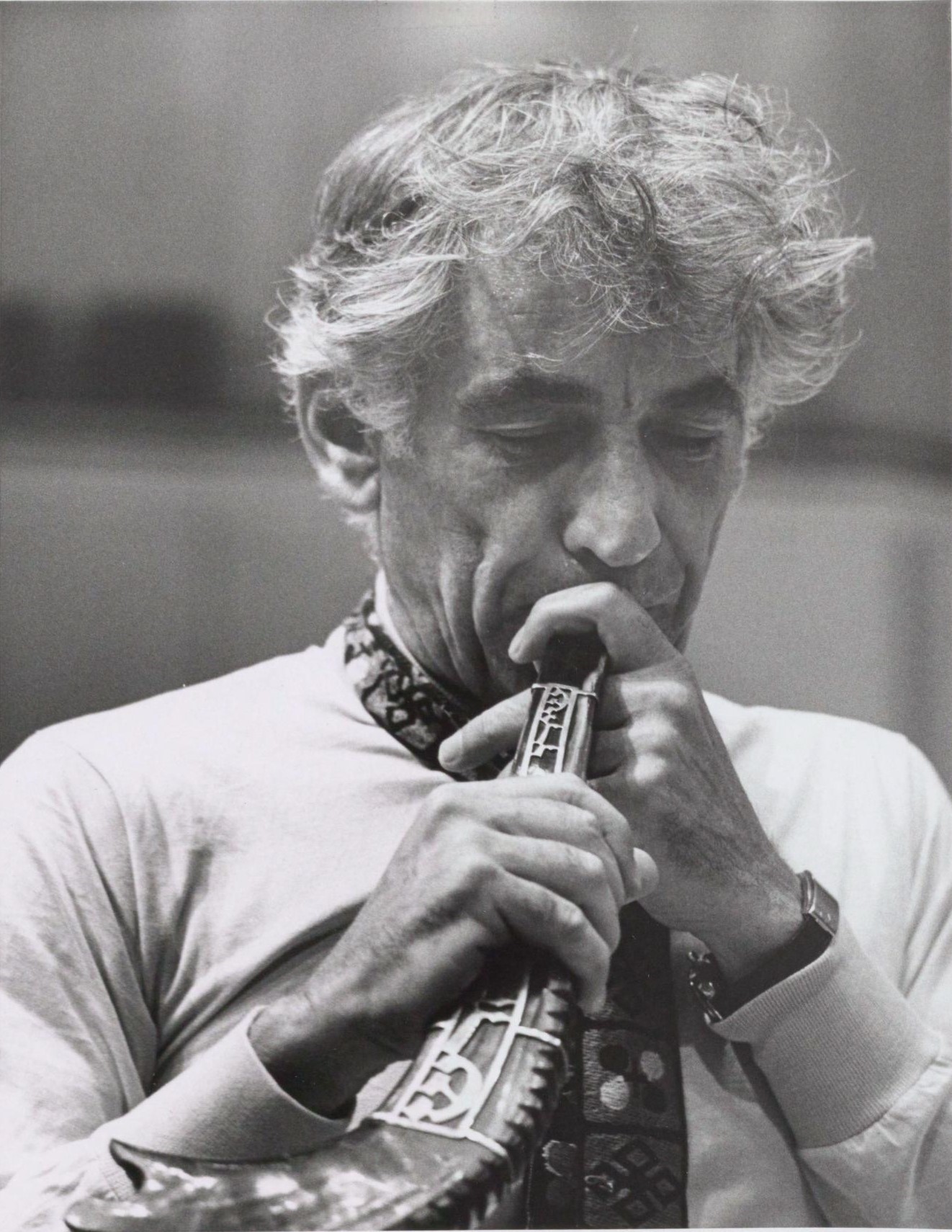
Here’s Leonard Bernstein playing the shofar during a rehearsal for his nonsectarian, humanistic “Mass” at the Kennedy Center in September 1971. It’s been observed that there are echoes of the shofar’s tekiah in both “West Side Story” and “Candide.” Many other classical composers have been influenced by and have emulated this distinctive call on the ram’s horn. Some have even employed the horn itself.
More on this another time. For now, if you observe the holiday, may you be inscribed, and best wishes for a sweet new year!
-

Rosh Hashanah Gershwin’s Jewish Soul
Shana tova! Rosh Hashanah began last night at sundown. To my Jewish friends, best wishes for a good and sweet 5783. Apples and honey all around.
This year’s observance happens to coincide with the birthday of George Gershwin (born Jacob Gershowitz to Jewish immigrant parents who settled on New York City’s Lower East Side).
Many sources claim that Gershwin, while culturally Jewish, was not particularly observant. Nevertheless, Kitty Carlisle recollected a zany Seder at the Gershwin home with Oscar Levant in attendance; Gershwin was an active supporter of Jewish charities; allegedly he wouldn’t marry Kay Swift, his lover of over ten years, because she wasn’t Jewish (Gershwin’s mother disapproved); and following his untimely death at the age of 38, he was remembered in bicoastal Jewish funeral services.
Furthermore, sharp-eared listens with some familiarity with Jewish tradition have identified Jewish themes and motifs in his music. It’s been remarked that you could keep Gershwin out of shul, but you couldn’t keep shul out of Gershwin. Here’s an interesting article on the subject.
Sadly, we’ll never know what an abandoned opera on Szymon Ansky’s “The Dybbuk” would have sounded like. (It was scrapped because of copyright issues.)
Early on, Gershwin expressed interest in writing for the Yiddish theater. He even made some piano rolls of Yiddish songs. Here’s one from 1917, a rendition of a 1903 Yiddish theater tune by Meyerowitz titled “Gott un Sein Mishpet Is Gerecht.”
Happy birthday, George Gershwin, and have a sweet New Year!
-

Shofar Concerto for a Sweet New Year
The Jewish High Holy Days snuck up on me this year. As the sun set on Labor Day, Rosh Hashanah was only just getting underway, kicking off the Jewish new year. 5782! How time flies. I hope it’s a happy, healthy, and sweet one for all of you who observe it.
In searching for something unusual to share, I happened across this Concerto for Violin, Horn, Shofar and Orchestra by Brazilian-born, Vienna-based composer Miguel Kertsman. Kertsman is a multidisciplinary musician. He founded the Amazonica Universal Orchestra, a Brazilian jazz ensemble, in 1989. He’s also interested in progressive rock, electronica, theater, film, and interactive video games. And of course, classical concert music. One thing’s for sure, he knows how to call up some colorful orchestrations.
I wouldn’t say the concerto is a festive-sounding one, necessarily, but it is romantic and evocative, incorporating plaintive tekiot on the ram’s horn (or perhaps the antelope’s), heard so prevalently on Rosh Hashanah and at the close of Yom Kippur. Three tuned shofarot are played during the course of the concerto.
Enjoy the music, and L’shana tova!
The composer’s website:
By merest coincidence, today is also Brazilian Independence Day!
PHOTO: Soloist Gergely Sugar sounds the shofar
At his home in Budapest:
-

Rosh Hashanah 5781 Music for the High Holy Days
Shana tova! Rosh Hashanah, the Jewish New Year, begins at sunset. The two-day observance commences ten Days of Awe, concluding with Yom Kippur, the holiest day on the Jewish calendar.
I hope you’ll be able to join me this Sunday night at 10:00 EDT, as I’ll be presenting music for the High Holy Days – including Herman Berlinski’s “Shofar Service,” David Stock’s “Yizkor,” and John McCabe’s “The Chagall Windows” – on “The Lost Chord,” on WWFM – The Classical Network and wwfm.org.
Of course, I’ll be posting more about it on Sunday. In the meantime, I am wishing everyone a sweet, happy, and healthy 5781!
Tag Cloud
Aaron Copland (94) Beethoven (95) Composer (114) Film Music (149) Film Score (143) Film Scores (255) Halloween (97) John Williams (197) KWAX (232) Leonard Bernstein (105) Marlboro Music Festival (125) Movie Music (164) Mozart (91) Opera (215) Philadelphia Orchestra (90) Picture Perfect (174) Princeton Symphony Orchestra (110) Radio (90) Ross Amico (244) Roy's Tie-Dye Sci-Fi Corner (290) The Classical Network (101) The Lost Chord (269) Vaughan Williams (107) WPRB (397) WWFM (881)