Favorite Tchaikovsky symphony? In my teens it was the “Pathétique,” easily. I was emotionally aligned with it, as I was with most Romantic music. I never much cared for the 5th, with its annoying recurring motto, except perhaps for the overheated slow movement. The 4th at the moment seems to be enjoying a bit of a vogue – as if it were ever out of style – as seemingly everyone has been programming it for the past season or two. Those are the three most popular.
But for several decades now my personal favorite must be the 2nd, the one that’s traditionally been identified as the “Little Russian.” The nickname stems from the fact that the work employs Ukrainian folksong. Certainly, the composer had a great deal of affection for Ukraine, though I’m guessing the combined implications in the subtitle of diminution and ownership might annoy present-day Ukrainians. Since the Russian invasion, I’ve seen it referred to several times as “Tchaikovsky’s Symphony No. 2, ‘Ukrainian.’” Will the new name stick? Only time will tell.
It wasn’t Tchaikovsky who subtitled the work anyway, but rather a friend, the critic Nikolay Kashkin. There was a big nationalist push in Russian music at the time, so Tchaikovsky’s folksong approach was embraced by his peers of the Mighty Handful, or the Russian Five (consisting of Balakirev and his disciples, Rimsky-Korsakov, Mussorgsky, Borodin, and Cui).
The symphony scored a resounding success when the finale was first played at the home of Rimsky-Korsakov on this date 150 years ago. Tchaikovsky wrote to his brother, Modest, that “the whole company almost tore me to pieces with rapture.”
The public loved it too. Conductors were eager to program it and critics were enthusiastic. It seems that only Cui, who later trashed Rachmaninoff’s 1st Symphony, disliked it.
Ultimately, Tchaikovsky would follow a different course and come to be viewed with suspicion by The Five, who looked upon his music as less Russo-centric and more cosmopolitan. But of course, Tchaikovsky would always be Russian to his core.
That said, the composer genuinely loved Ukraine. He wrote most of the symphony during a summer holiday with his sister’s family in Kamianka. He joked that he should dedicate the work to their elderly butler, who first sang him the folksong “The Crane” that would form the basis for the symphony’s finale.
Tchaikovsky nearly lost the manuscript on his return to Moscow, when he passed himself off as royalty in order to convince an uncooperative postmaster to hitch up his coach. It was only when he reached his next stop that he realized he had left his luggage behind. Full of nerves that the postmaster would have opened it and discovered his true identity, he sent back an intermediary to retrieve it, but the postmaster would not hand it over. He said he would only release it to the “prince” himself. So Tchaikovsky had to go back.
Much to his relief, the postmaster seemed to behave normally, so that the composer began to think he had not been caught in his lie. But as he was about to leave, he asked the postmaster’s name, and he replied, “Tchaikovsky!” It was only later that he learned that Tchaikovsky really was the postmaster’s name.
Despite its immediate success, somehow the composer was not entirely satisfied with the symphony and revised it extensively in 1879-80. Mostly, he rewrote the first movement and tightened up the last. His pupil, Sergei Taneyev, was not alone in the opinion that these changes weakened the work, rather than strengthened it. Even so, it is the revised version we usually hear today.
In whatever form, the work makes me happy, having heard memorable performances of it with Mstislav Rostropovich on the podium and at an outdoor concert from a makeshift stage in Philadelphia’s Rittenhouse Square. You might say, I have always had great affection for this “Little” symphony.
A brisk performance of the revised version (1879-80)
The rarely-heard original version (1872)
Tchaikovsky’s house, yet another casualty of the war in Ukraine
https://www.classicfm.com/composers/tchaikovsky/trostyanets-destroyed-russian-army-ukraine/
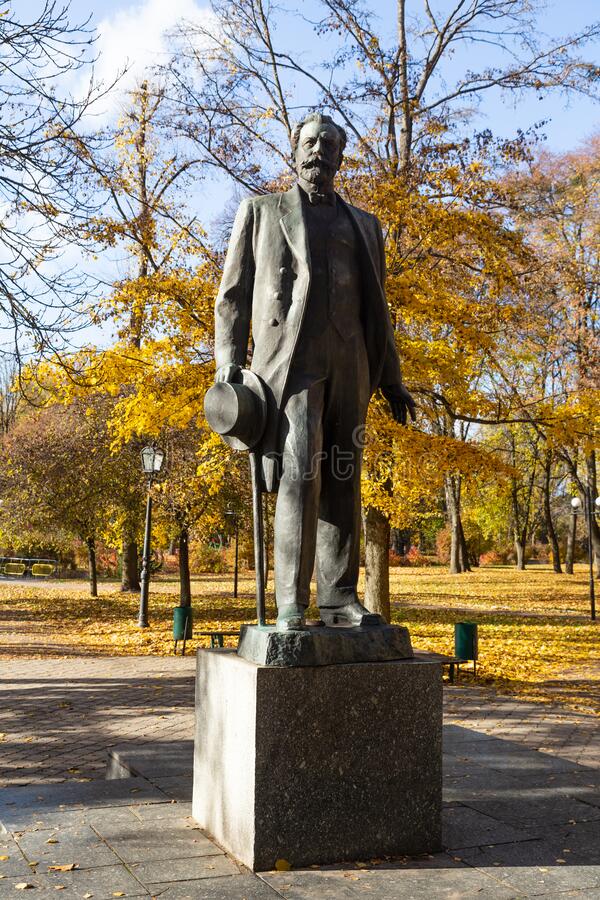
PHOTO: Tchaikovsky statue in Trostyanets, Sumy Oblast, Ukraine
