Tag: RVW

  • Vaughan Williams at 150 A Master’s Vision

    Vaughan Williams at 150 A Master’s Vision

    One of England’s greatest composers, Ralph Vaughan Williams looked back to his country’s agrarian roots as a roundabout way of securing the future of its cultural identity. On the 150th anniversary of his birth, I salute him in all his rumpled glory.

    As did so many composers who were caught in the wildfire of nationalism that swept across Europe, beginning in the middle of the 19th century, Vaughan Williams rebelled against the prevailing academicism that reached its tendrils from the capitals of German music to choke the “provincial” hinterlands. He emerged from an environment that had produced far too many knock-offs of Mendelssohn and Brahms. Vaughan Williams would revolutionize his compatriots’ perception of art music by embracing the sounds of the English countryside.

    However, like Béla Bartók, he was no simplistic, twee purveyor of folk music. On the contrary, the rhythms and inflections of his native land were already part of his DNA. The songs he documented while roaming the fields and fens with his colleague, Gustav Holst, merely brought to the surface what was already innate. What he expressed in his original music was thoroughly digested and deeply personal.

    Some of Vaughan Williams’ best loved works are imbued with nostalgia for a faded world, but the composer pushed forward also, through two world wars and into the Great Beyond. He was not a conventionally religious man, but mysticism seems to color a fair amount of his music. He was also unafraid, in works like his Sixth Symphony, to stare desolation unflinchingly in the face. Technically, his lessons with Maurice Ravel made him a thoughtful orchestrator, so that throughout his life he deployed his instrumental forces with considerable craft and creativity. Given the proper attention, there is much to engage on all levels of his music.

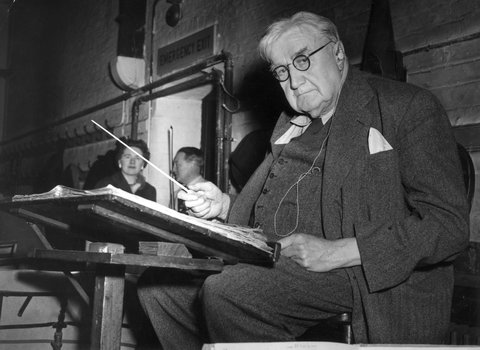
    While you might not want to take his advice on the best way to tie a tie, musically, with Vaughan Williams, you are always in the hands of a master. Put your faith in Ralph (pronounced “Rafe”) for the Vaughan Williams sesquicentenary.

    Thank you, RVW, for a lifetime of enrichment, and happy birthday!
  • Vaughan Williams Rare Recordings

    Vaughan Williams Rare Recordings

    Unlike Sir Edward Elgar, who was given the opportunity to record most of his major output, Ralph Vaughan Williams was generally overlooked as a conductor by the major labels – which is a shame, because the few recordings he did make are superb.

    This Sunday night on “The Lost Chord,” we’ll anticipate the 150th anniversary of the birth of one of England’s finest composers (October 12, 1872) by way of three rare recordings he made of his own music.

    Among the acoustical documents, none match the hilarity of RVW’s 1925 performance of “The Wasps” overture. Vaughan Williams’ recording is by far the fastest – and jauntiest – “Wasps” on record, although I’m unsure whether it is due to the composer’s own preference, or because of the limitations of the technology. It’s hard not to smile at such manic high spirits.

    By contrast, his 1937 recording of the Symphony No. 4 is a masterpiece of temperament and ferocity – all the more jarring in that the turbulence evoked in the work is not at all what most people associate with this composer. The urgency of the music is captured, eerily, at a time when the ink was still fresh on the page and the world was on the brink of chaos. It certainly belies the snide dismissal of much of the composer’s output as languid “cow-pat” music.

    In all, Vaughan Willliams’ meager commercial discography as a conductor wouldn’t even fill two hours. It is most fortunate, then, that a few concert recordings have emerged over the years. We’ll conclude with of one of RVW’s loveliest pieces, the “Serenade to Music,” a work which, at its first performance, actually brought tears to the eyes of Sergei Rachmaninoff. (On the first half of the concert, Rachmaninoff was soloist in his own Piano Concerto No. 2.) The text is taken from Act V, Scene I, of Shakespeare’s “The Merchant of Venice.”

    “How sweet the moonlight sleeps upon this bank!
    Here will we sit and let the sounds of music
    Creep in our ears: soft stillness and the night,
    Become the touches of sweet harmony.”

    The recorded performance was captured at Royal Festival Hall on November 22, 1951. Vaughan Williams was 79 years old. What’s especially remarkable is that the recording features 11 of the 16 soloists who sang in the work’s 1938 premiere. We’ll hear it from a compact disc issued on Albion Records, the official label of the Ralph Vaughan Williams Society.

    Vaughan Williams’ ashes are interred in Westminster Abbey alongside some of the nation’s greatest artists – yet, in some measure, the composer is still underestimated, especially by those outside the British Isles. I hope you’ll join me as we celebrate RVW for his sesquicentenary. That’s “Vaughan, But Not Forgotten,” this Sunday night at 10:00 EDT, on WWFM – The Classical Network and wwfm.org.

Tag Cloud

Aaron Copland (93) Beethoven (95) Composer (114) Film Music (126) Film Score (143) Film Scores (255) Halloween (94) John Williams (189) KWAX (229) Leonard Bernstein (101) Marlboro Music Festival (125) Movie Music (141) Mozart (87) Opera (203) Philadelphia Orchestra (89) Picture Perfect (174) Princeton Symphony Orchestra (107) Radio (87) Ross Amico (244) Roy's Tie-Dye Sci-Fi Corner (290) The Classical Network (101) The Lost Chord (268) Vaughan Williams (103) WPRB (396) WWFM (881)

DON’T MISS A BEAT

Receive a weekly digest every Sunday at noon by signing up here


RECENT POSTS