Tag: Schoenberg

  • Shilkret’s Genesis Suite Schoenberg Stravinsky

    Shilkret’s Genesis Suite Schoenberg Stravinsky

    The creation of the heavens and the earth may have taken six days, but Nathaniel Shilkret and I only have one hour.

    This week on “The Lost Chord,” I hope you’ll join me for a true curiosity, a collaborative effort organized by Shilkret – a child prodigy from Queens who was associated with the New York Philharmonic, the Metropolitan Opera, the Victor Herbert Orchestra, the Sousa Band, the Victor Talking Machine Company (later RCA Victor), NBC Radio, the RKO and M-G-M movie studios, and concerts and recordings featuring many of the starriest jazz and classical artists of his time – who managed to cajole a number of the day’s greatest composers, then living in California, into contributing to a seven-movement piece for narrator, chorus and orchestra.

    Take a gander at the layout for the “Genesis Suite” (1943):

    “Prelude (The earth was without form),” composed by Arnold Schoenberg;

    “Creation,” by Shilkret;

    “Adam and Eve,” by Alexandre Tansman;

    “Cain and Abel,” by Darius Milhaud;

    “Noah’s Ark,” by Mario Castelnuovo-Tedesco;

    “Babel,” by Igor Stravinsky;

    and “The Covenant,” by Ernst Toch.

    No one can accuse the project of a lack of ambition!

    The “Genesis Suite” is the only time the twin titans of twentieth century music, Schoenberg and Stravinsky, were to collaborate on the same piece – though they never actually worked together. The two men were highly suspicious of one another, to put it mildly, and rehearsals had to be carefully calibrated so as to keep both composers from showing up at the same time. On the one occasion when they did, they remained aloof on opposite ends of the hall.

    I give more background on the show – probably more than is necessary – but it’s all very interesting, I hope. That’s “First Among Equals” – Nathaniel Shilkret and the “Genesis Suite” – on “The Lost Chord,” now in syndication on KWAX, the radio station of the University of Oregon!


    Clip and save the start times for all three of my recorded shows:

    PICTURE PERFECT, the movie music show – Friday at 8:00 PM EDT/5:00 PM PDT

    SWEETNESS AND LIGHT, the light music program – Saturday at 11:00 AM EDT/8:00 AM PDT

    THE LOST CHORD, unusual and neglected rep – Saturday at 7:00 PM EDT/4:00 PM PDT

    Stream them, wherever you are, at the link!

    https://kwax.uoregon.edu/


    IMAGE: Adam and Eve (1526) by Lucas Cranach the Elder

  • Schoenberg’s Gurre-Lieder at Carnegie Hall

    Schoenberg’s Gurre-Lieder at Carnegie Hall

    On Friday, I attended an all-too-rare performance of Arnold Schoenberg’s “Gurre-Lieder” at Carnegie Hall. I confess, I prefer the alternate spelling, without the hyphen, but since everything about “Gurre-Lieder” screams excess, I might as well swing for the fences. The American Symphony Orchestra was led by the indefatigable Leon Botstein, always one of my heroes for resurrecting underperformed repertoire and presenting it in a scholarly context. (Unfortunately, I missed the pre-concert talk.) Ostensibly, the Carnegie performance was planned to honor Schoenberg’s 150th birthday, the actual anniversary of which will fall in September. But any performance of “Gurre-Lieder” requires no excuse.

    This is not your grandpa’s Schoenberg – the high priest of dodecaphony who changed music forever and scared your grandma off buying tickets – but rather your great-grandpa’s Schoenberg – young, passionate, and all juiced up on Romanticism. Take Wagner, Strauss, and Mahler, toss them in a blender, and turn it up to 11. The composer embarked on the piece between 1900 and 1903 and completed it, after the interval of a few years, in 1911. The result is monumental post-Romanticism in its full flowering. The scoring itself is colossal, with vocal soloists, speaker, and three choruses. Its two-hour running time is epic and absorbing.

    “Gurre-Lieder” (“Songs of Gurre”) weaves texts by Jens Peter Jacobsen into a tapestry of doomed love, blasphemy, and damnation, unfurled at Castle Gurre in medieval Denmark. But it is a Middle Ages steeped in myth and legend. The work climaxes with a harrowing evocation of the Wild Hunt, with ghostly and supernatural beings roaring across the night sky, and concludes with an opulent sunrise.

    For all his laudable achievements, Botstein often takes heat for not being the most inspiring of conductors. It’s true, I didn’t feel quite as much juice radiating from the stage as I did the last time I heard the piece, with Simon Rattle, at Philadelphia’s Academy of Music in 2000. But Carnegie is a much larger hall. Acoustically, the vocalists were difficult to hear, from my vantage in the Dress Circle; but one would have to be the most reckless of heldentenors even to attempt to pierce the sonic blast of a 150-piece orchestra.

    Even so, all of the singers had their moments. The efforts of Dominic Armstrong to convey the ardor, brooding, and bitterness of King Waldemar were often frustrated by being swallowed up by his instrumental neighbors. He was best heard in the second half as, bereft at the murder of his mistress, Tove, by his wife, Queen Helvig, Waldemar essentially shakes an angry fist at God. For this, the king is condemned for all eternity to lead a pack of ghosts and reanimated skeletons on a nightly, hell-for-leather tour about the gloomy castle and its environs.

    The fearful sight is recounted by a pious Peasant, sung on Friday by bass-baritone Alan Held. Held was easier to make out, since Schoenberg’s orchestration of the latter half of the oratorio is more forgiving, in some regards, the composer having returned to complete the work after a hiatus, during which he obviously learned a thing or two about transparency.

    Carsten Wittmoser, as the speaker, supplied the uncanny narration in sprechstimme, an eerie netherworld of blended speech and song, which Schoenberg would explore more fully in “Pierrot Lunaire.”

    In one of those grotesque comic interludes of a kind seemingly so popular among Central European post-Romantics, tenor Brenton Ryan came across best among the male soloists, as he went the furthest to inhabit his part as Klaus the Fool. You really could imagine this jester being swept along against his will, face-to-tail, on horseback.

    Of the women, the palm went to Krysty Swann as the melancholy Wood Dove, who delivers the news of Tove’s death. Felicia Moore, as Tove, again had to push against the orchestra, though she seemed to be a good choice for the role. Both successfully landed their high notes.

    The chorus – though it seemed smaller than what I am accustomed to seeing in this work (I count 80 singers in the program; Schoenberg called for 200) – was appropriately rowdy and powerful when needed.

    No team of unamplified singers is ever going to go up against “Gurre-Lieder” in a hall of that size and be heard by everyone. Under the circumstances, supertitles would have been a great help and a sensible choice. Instead, the audience muddled through the old-fashioned way, with the very wordy text reproduced in the program in microscopic font to be discerned in semi-darkness.

    By coincidence, Friday also happened to be the anniversary of the birth of Werner Klemperer, son of conductor Otto Klemperer and two-time Emmy Award winner for his memorable turn as Colonel Klink on “Hogan’s Heroes.”

    Klemperer provided the sprechstimme as the Speaker on the late Seiji Ozawa’s recording of “Gurre-Lieder,” appearing alongside James McCracken, Jessye Norman, and Tatiana Troyanos. The recording was taken from a live performance, so it may well be the same as the one on this video, or at the very least it was taken from the same series of concerts. Klemperer makes his entrance at around 1 hour and 34 minutes in. And yes, he speaks fluent German.

    What you see in the video is wonderful, of course, but it is but a pale reflection of the visceral impact of experiencing the work live.

    I saw Klemperer (the son, not the father, alas) in person several times, narrating Beethoven’s “Egmont” with the Philadelphia Orchestra, playing the Majordomo (another speaking role) in a concert performance of Strauss’ “Ariadne auf Naxos,” again with the Philadelphia Orchestra, and as emcee for a starry gala for the Opera Company of Philadelphia – all at the old Academy of Music. I missed him in his Tony-nominated turn as Herr Schultz in the 1987 Broadway revival of “Cabaret” – which my parents attended – because I chose to hear the New York Philharmonic that night. (Kent Nagano conducted George Benjamin’s “Ringed by the Flat Horizon” and Béla Bartók’s “The Wooden Prince,” and Bella Davidovich was the soloist in Chopin’s Piano Concerto No. 2.)

    As I said, the last time I heard “Gurre-Lieder” live was in Philadelphia in 2000, with Simon Rattle conducting. The audience was whipped into ecstasies with that one. Most memorably, in the moment’s silence following the last decay of the music, and just before the explosion of frenzied applause, there came from somewhere in the balcony a deeply satisfied “YEEEEEEEEEEEEAAAAAAAAAAAAAAAAAHHHHHHHHHHHH!”

    The Philadelphia Orchestra gave the work its first American performance under Leopold Stokowski in 1932. Needless to say, because of the forces involved, and the expense in mounting it, it is seldom done, but when it is, it pleases the crowd mightily.

    Happy belated birthday, Werner Klemperer (1920-2000), and thank you, Leon Botstein and the ASO!

    Werner’s dad conducting Schumann in Philadelphia

    I’ve written about Otto Klemperer many times on this site, as here:

    https://www.facebook.com/photo?fbid=1844909085676373&set=basw.AbpuDWzgKAkm3TnfgzQN9VOGciZh068VBmrEC7s6TZuOvY0sWP2WF65SWXdWvtPNl6UCFpVXon4JgBoPB7u-aMAhzDmHFuyeybByVgYBV44emn5MDHkc4woxlj1YKmzdbQVSErSOVvES01qL7mMlKN60pXCUOh8qZzl4h6trZoBN-n2-RxSWtACCnjor6Bv0KGg&opaqueCursor=AboKz2dejQ1QKxjJ3ZL-8qoWhLQ-ztweo9I-KkJj8ZokdKTf_ZpMGRNjk4oVHO2y2CcfPTdhpZyU1ieD1Z0xsw8x-9YsfVFb62KvmZRCm-VoaJogaKSEBfghzlZgXU_uaSA1EM5PsPr5Ahf_nUgzcj8EjKJSTgLhieT1O7OYp-tV8ieRxXXvOKZEgz6TFmFWxr5HZIvbablb42PklPcJeLJ4hfMRfKdWRJkeRBES69EBxIMGR41oUMFkmvEwxY2tnWP8rHj-RSNB_Oeml7DG_trUqiOWZ-hRS-2xjYlX4LUfX6wWfZYFQKHJHAeJF2sX95lHDtHFtCJcyM2g3gDHnnP2tzmsUt-55Cu393Naddj9TI5bX5vx159UKm7mfcuRZl00ycfyLW6KXwZxuCgoj9XHcc0KRpLnvw2QAmfuEBAxq_xx7zSL-PjxOvvhZlY3FBt88o9l5a5Xs2KSQuX2Q8Yb3xo9x-IW1KsSUL_Qpo_pjXQ8Uwsq1uysmCK0_DB2LmL06WcYWJT0MPhOeUZV6slrKVF3fe2S2c2TPgLGfpqLBk84t_yTR2QpjFf4Fk4HNCt871ShxLTxYDBTPN_c4WmAxi5ZysTxnV85RlHiDJB0Yp7pAiHl3LWjuVTPzRj1JTJ3kcXg1ML4e5fLwKCF4qR64sY7AuN4eblsnwn4rR7psQfLWXx_n60KORyc5jAirsse7eqy95OGaunXQK4pVsfc

  • Time’s Echo: Music as Living History

    Time’s Echo: Music as Living History

    Whenever I’m ambling around a bookstore, especially one that deals exclusively in new books (as opposed to used bookshops, which are always my preference), I’ll come to the music section and be reminded of the impoverished state of our culture, as I stare into a wall full of glossy flip-books about vapid pop stars. If I’m lucky, there will be perhaps one shelf devoted to classical music, and on that shelf perhaps one or two volumes worth my while, and I’ve usually already read them.

    Thankfully, and I don’t know how, the tradition of writing and publishing thoughtful, carefully researched music books persists, even if they are seldom stocked or displayed at the local sausage factory. In fairness, I did see a copy of Jeremy Eichler’s “Time’s Echo” at the area Barnes & Noble. But I had already received it as a surprise Christmas gift after having first encountered it at the local independent shop, Labyrinth Books Princeton.

    When I first read the subtitle, “The Second World War, the Holocaust, and the Music of Remembrance,” I totally expected it to be a book about music written in the concentration camps or by composers who were interned there. But I was way off the mark.

    Opening it at random and simply dipping into a passage about Mendelssohn’s standing in the hearts of the German public, even after a commemorative statue was melted down for munitions by the Nazis in accordance with their racial laws – Mendelssohn, raised without religion, was descended from the Jewish philosopher Moses Mendelssohn, though he himself was baptized into the Reformed Christian church – was enough to make me realize the broader scope of Eichler’s intent. (The statue, it turns out, returns in the book’s epilogue.)

    Among other things, the book traces the idealistic history of “Bildung,” in which we learn, during a century or so of liberalization, Jews were permitted to leave the ghettos to assimilate, flourish, and enrich German society and culture in a spirit of universal brotherhood. According to Eichler, “‘Bildung’ signifies the ideal of personal ennoblement through humanistic education, a faith in the ability of literature, music, philosophy, and poetry to renovate the self, to shape one’s moral sensibilities, and to guide one toward a life of aesthetic grace. …The life of dignity implicitly promised by ‘Bildung’ was open to all, regardless of one’s origins (that is, of course, as long as one was male).” Progress comes incrementally. But that’s the thing. Society claws its way slowly, slowly toward the light, and then come the hammer blows of war and hatred and fascism to knock it all down. The quashing of hope is heartbreaking.

    The narrative begins with the indelible image of “Goethe’s Oak,” the tree under which tradition holds the great German poet once gazed out over a lush valley of promise and declared, “Here a person feels great and free… the way he should always be.” Ironically, a little over a century later, the oak is the only living thing to have been spared in clearing a forest to make way for the Buchenwald concentration camp.

    In a later chapter, Eichler relates the chilling history of Babi Yar, the site of a former ravine in Kyiv used as an execution site and mass grave by the Nazis. 30,000 Jews were killed there, the body count swollen to 100,000, when the remains of murdered Jews and other undesirables were transported from other parts of the Soviet Union – the site then obliterated by the Soviet authorities, whose policy it was to obfuscate, distort, and deny history. In the end, they could change the landscape, but they couldn’t kill the memory.

    However, as Eichler reminds us, with the passage of time, atrocities like Babi Yar and the wider suffering of two World Wars will no longer be the stuff of lived experience. The sense of immediacy will inevitably fade into the past, distilled into so many dates and statistics on a dry page. Even memoirs are experienced at a remove. We can read about the horrors and the misery, and we may empathize, but necessarily it will always be at a distance.

    “Time’s Echo” discusses four composers who actually lived through the era and specific examples from their work that stand as enduringly vibrant monuments to those dark times. Eichler argues that close listening to these musical memorials can provide an aural and emotional record of the horrors of war and the Holocaust, with an immediacy that allows the listener a greater comprehension of the enormity of the world’s turmoil and its emotional toll.

    I hasten to add, in case I give the impression that the book dwells in darkness, there is also plenty of hope and humanity on display.

    Eichler writes of the touching friendship between Dmitri Shostakovich and Benjamin Britten, separated by some 1700 miles, and an Iron Curtain, but who bonded over music – Shostakovich declaring Britten’s “War Requiem” the greatest work of the 20th century and Britten returning Shostakovich’s admiration, most recently for the latter’s Symphony No. 13 (subtitled “Babi Yar”).

    Shostakovich composed “Babi Yar” on texts of Yevgeny Yevtushenko, who dared to speak truth to power – for a time, anyway; the poems were soon toned down, but Shostakovich held fast to the originals. The work stirred great controversy with the authorities (by then under Krushchev), who tried to intimidate everyone involved with the work’s first performance. There are plenty of anecdotes in the book to illustrate the constant terror artists experienced living in the Soviet Union, especially under Stalin. Shostakovich dedicated his next symphony, the Symphony No. 14, another work for vocal soloists and orchestra, to Britten, who conducted the work’s UK premiere.

    Shostakovich, who was not Jewish, nevertheless possessed a vast well of empathy for the oppressed. As one who was frequently targeted himself, he knew a thing or two about terror and suffering. He closely identified with the Jewish people, had many Jewish friends and associates, and stuck out his neck time and again in advocating for them in his music, both implicitly and explicitly, assimilating Jewish folk tunes and poems into his works. He also did what he could to shield composer Mieczyslaw Weinberg from official persecution. Weinberg’s father-in-law, actor Solomon Mikhoels, who was enlisted to help disseminate the truth about Babi Yar, was lured into an alley and assassinated; his death was ruled a traffic accident.

    It’s easy to see how Britten, as a pacifist and a homosexual – either “offense” which could have landed him in jail – would have found further sympathy with Shostakovich. Both men were outsiders and both had to be very careful in their dealings with the system. Conversely, both connected profoundly with the wider public. It’s hard to imagine any composer’s death today inspiring the kind of turnout or displays of respect both received at their funerals. (Shostakovich died in 1975 and Britten died in 1976.) Britten, who was granted conscientious objector status in 1943, gained first-hand experience of the camps when he insisted on accompanying violinist Yehudi Menuhin as pianist in a recital for displaced survivors at the liberated Bergen-Belsen. It was an experience that would stay with him for the rest of his life.

    You will also emerge from the book with a greater affection for Arnold Schoenberg. The dour high priest of dodecaphonic music was actually a real mensch, a passionate humanitarian, even if touchingly blinkered by his idealism. His cantata “A Survivor of Warsaw” proved so disturbing in 1947, with its uncompromising text relating the barbarity of a concentration camp, complete with beatings and gas chambers, that nobody knew what to do with it. More disturbing was a willful silence surrounding many of the atrocities committed against Jews, in particular, that was upheld seemingly everywhere. Incredibly, the work was first performed by a company of cowboys and farmhands, who mastered not only the twelve-tone idiom but Hebrew for its first performance – in Albuquerque, New Mexico! – in 1948. It’s a great story, and a welcome human interlude, well-related in the book.

    Schoenberg was the polar opposite of Richard Strauss, who could be calculated and cynical, but nonetheless loved the arts and believed in tradition, to the extent that he thought he could uphold and preserve Germany’s proud cultural history by tacitly playing ball with the Nazis. All too soon, he realized he was in over his head. Strauss was no Nazi himself, but in convincing himself he was above politics and that the current regime would surely pass, he made unfortunate decisions that left him morally compromised. He was also politically compromised, as he quietly continued to collaborate with Jewish librettist Stefan Zweig, and he did not suffer fools quietly. His intercepted correspondence, full of acid remarks about the idiots in charge, put him on the outs with Hitler, even as he was held up to the world as a paragon of German superiority. In the end, it was all he could do to keep his Jewish daughter-in-law and grandchildren out of the camps. He could not save the rest of his daughter-in-law’s family. (He tried; he went so far as to visit the camp himself, but was turned away.)

    “Metamorphosen,” composed in 1945, has long been understood as Strauss’ elegy to bombed out Munich, its opera house, a symbol of German art, the site of so many formative cultural experiences and later personal successes, now in ruins. Eichler delves into the work’s deeper significance and enigmas, even as he runs up against resistance from an uncooperative Strauss estate.

    The book is built on a foundation of scholarship (with ample pages of notes and attributions listed in an appendix), but is by no means a dry, academic treatise. It is not crammed with impenetrable jargon. This is a book written with the general reader in mind. It’s an engrossing piece of history rendered in absorbing prose. If you are familiar with and enjoy the books of Alex Ross, you will find this at least as rewarding. (Ross is the music critic for the New Yorker; Eichler is chief classical music critic for the Boston Globe.)

    The book is certainly thought-provoking, even if a lot of the philosophical meditations the author inspires have been churning around my head at least since the time I became conscious of having an intellect. That’s not to say Eichler doesn’t provide fresh perspectives. Nor is it to say I agree with all of his conclusions. I do believe it’s possible to listen to music composed before the horrors of the 20th century and to be able to meet it on its own terms, and that in so doing a work such as Beethoven’s 9th Symphony is still more than simply “freedom kitsch.” Music from the past still has plenty to offer us in the considerable enrichment of our lives, and from many perspectives.

    But I also believe that not only do great works of art “change” over the course of the life of anyone who experiences them (how could we not view the world differently as we learn more and continue to evolve as people?), I agree with Eichler that they can also be viewed differently as a result of their continued and inexorable progress through the creep of history.

    Eichler is at his best when he characterizes music as aural history, with the experiences and emotions of an artist and an era frozen in amber, and demonstrates how careful listening allows us to experience these sensations anew. While the author scores point after point, he feeds us no pat answers. He provokes thought and inspires conversation, right up to the sense of ambiguity he leaves us with as he encounters the reconstituted Mendelssohn statue at the end of the book.

    “Time’s Echo” is highly recommended for anyone who’s bothered to wade through this post to this point – especially so if you happen to be interested in four masters of 20th century music, WWII history, the Holocaust, how the past continues to inform the present, and how music parallels and supplements the written word as a vessel of history and persists as a living document of the human experience. Read it now, and thank me later.

    [Published by Alfred A. Knopf, Fall 2023]

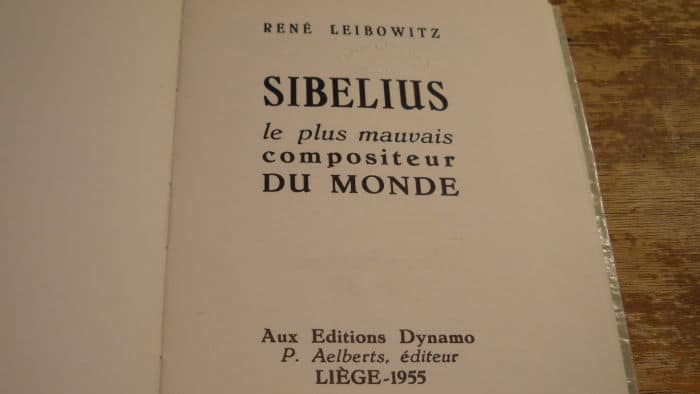
  • Sibelius Last Laugh: A Composer’s Revenge

    Sibelius Last Laugh: A Composer’s Revenge

    I don’t know how good your French is, but it’s obvious René Leibowitz wasn’t as much of a Sibelius fan as I am. Tell us what you really think, René! For the record, Leibowitz, a Schoenberg disciple, also dismissed Béla Bartók for pandering to popular taste with works like his Concerto for Orchestra. I haven’t read Leibowitz’s monograph, but I have to hand it to him, it’s got one of the great titles. Sibelius was still alive, by the way. He died in 1957 at the age of 91. But it’s Sibelius who had the last laugh. Royalties earned from his compositions continue to be among the highest of all classical music composers currently within copyright.

    https://www.classicalmusicguide.com/viewtopic.php?t=9340

    Happy birthday, Jean Sibelius!


    “Sibelius: The Worst Composer in the World”

  • Schoenberg’s “Gurrelieder” A Halloween Ride

    Schoenberg’s “Gurrelieder” A Halloween Ride

    With Halloween only days away, take a wild ride with the undead in Arnold Schoenberg’s opulent masterpiece “Gurrelieder.”

    Jens Peter Jacobsen’s dramatic poem synthesizes Danish legends concerning the illicit love of King Waldemar for a beautiful maiden, Tove, and the vengeance of his wife, Queen Helwig. The King curses God for the loss of his beloved and is condemned to gallop, night after night, alongside a terrifying cohort of gibbering spirits.

    The orchestra is enormous – with 25 woodwinds, 25 brass instruments, four harps, a celesta, and 16 different percussion instruments, including an iron chain – larger even than those of Gustav Mahler. The work sports no less than 35 major leitmotifs, and the length is comparable to Mahler’s Third Symphony.

    Schoenberg conceived of “Gurrelieder” at the age of 26, in advance of Mahler’s Eighth Symphony and “Das Lied von der Erde.” The composer claims to have finished it, at least in short score, in 1901. However, financial need prevented him from completing the orchestration for Parts II & III until after Part I proved to be a mega-hit. It wasn’t until 1911 that “Gurrelieder” reached its final form.

    By then, Schoenberg was over it. Like something a doomed king himself, already he was hurtling into freely atonal territory. Success had come too late for an artist who had suffered a decade’s worth of critical brickbats. He didn’t give a damn, even as Waldemar received one.

    Prior to “Gurrelieder,” on today’s Noontime Concert, we’ll have chamber works by Ottorino Respighi and Ernest Chausson, as performed at the Lake George Music Festival. Enjoy Respighi’s rarely-heard Piano Quintet in F minor and Chausson’s Concert for Violin, Piano and String Quartet.

    Then it’s a tale of love and death – and death and love – in 14th century Denmark. We’ll hear the whole damned thing, between 12 and 4 p.m. EDT, on WWFM – The Classical Network and wwfm.org.

Tag Cloud

Aaron Copland (92) Beethoven (95) Composer (114) Film Music (120) Film Score (143) Film Scores (255) Halloween (94) John Williams (185) KWAX (229) Leonard Bernstein (100) Marlboro Music Festival (125) Movie Music (135) Opera (198) Philadelphia Orchestra (88) Picture Perfect (174) Princeton Symphony Orchestra (106) Radio (87) Ralph Vaughan Williams (85) Ross Amico (244) Roy's Tie-Dye Sci-Fi Corner (290) The Classical Network (101) The Lost Chord (268) Vaughan Williams (103) WPRB (396) WWFM (881)

DON’T MISS A BEAT

Receive a weekly digest every Sunday at noon by signing up here


RECENT POSTS