Ingrid Haebler has died. A pianist who excelled especially in the core repertoire of the Classical and early Romantic Eras, Haebler recorded all of the Mozart piano concertos, his piano sonatas, and with Henryk Szeryng, his sonatas for piano and violin. She also recorded the sonatas of Franz Schubert.
A little more off the beaten path, Haebler blazed a trail for Johann Christian Bach, recording his concertos on a fortepiano at a time when performances on period instruments were far from the norm.
Never a flashy pianist, she was widely respected for her exquisite musicianship. She was at her best, arguably, as a collaborative pianist. By herself, she risked fading into her own humility.
Philips Records acknowledged her greatness by including her recordings in its Great Pianists of the 20th Century Series.
The Princeton Festival continues, as commentator Rob Kapilow, host of the popular radio show “What Makes It Great?,” explores Franz Schubert’s String Quartet in D minor, “Death and the Maiden.” Kapilow will deconstruct key passages from the piece with live musical illustrations, to reveal what makes the music so extraordinary. On the second half of the program will be a complete performance of the work by the Signum Quartett. Tonight’s event is presented in partnership with WWFM – The Classical Network, and will be broadcast live at 89.1 FM and wwfm.org.
“Death of the Maiden” stands near the pinnacle of the Romantic string quartet repertoire. If you’re an ardent Schubertophile, you’ll also want to be on hand for tomorrow evening’s concert, which will round out a complete cycle of the composer’s late quartets, with the Signum playing both the “Rosamunde” and the monumental Quartet in G major. Both concerts, tonight and tomorrow, will begin at 7 pm.
This year, nearly all festival events take place in a specially-constructed outdoor 10,000 square foot state-of-the-art performance tent on the grounds of Morven Museum & Garden on Route 206 (55 Stockton Street), not far from the Princeton Battle Monument.
Drop by early, before this evening’s concert to enjoy empanadas, available for purchase from the Hotpanada truck. Tables and chairs will be available for picnicking, or bring your own blanket.
Tomorrow, enjoy a preconcert talk by Schubert scholar Charles Fisk of Wellesley College, who will chat about Schubert’s later years, with a special emphasis on the final quartets. The talk will take place at Morven’s Stockton Education Center, located on the grounds, at 5 pm.
For Schubert, of course, “late” came early, as he died in 1828 at the age of 31. His productivity, and the depth and range of his music, is staggering.
The Princeton Festival runs through June 25, with musical events in a variety of genres presented every evening: opera, jazz, cabaret, musical theater, chamber music, classical and Broadway pops. Baroque music concerts will be presented across the street at Trinity Episcopal Church.
Indulge in free pre-concert talks, a poetry workshop, an on-site bar, and abundant lawn space at Morven for picnicking prior to the concerts. For a complete schedule, visit princetonsymphony.org/festival.
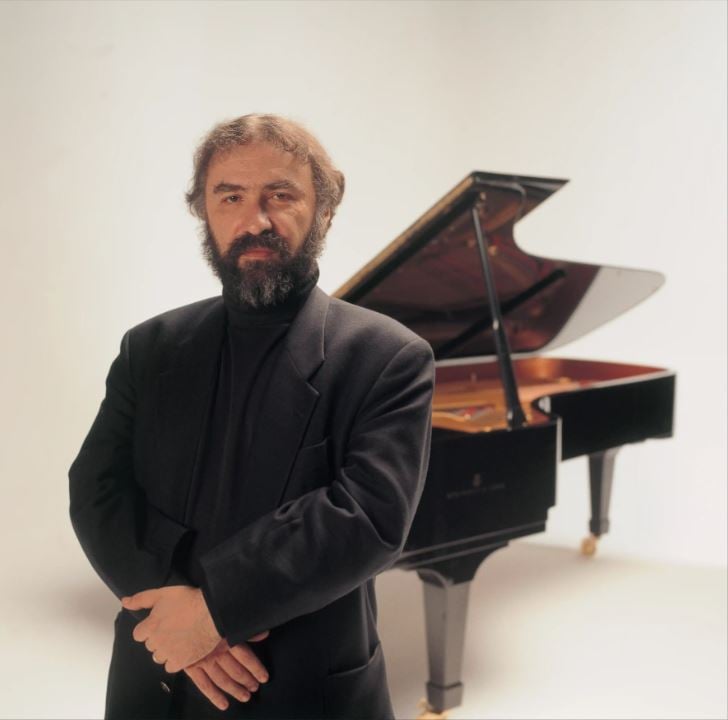
It was all I could do to whip together a post about the passing of Harrison Birtwistle last night; but we also lost another major musician yesterday – the reclusive Romanian pianist Radu Lupu.
Lupu is still a frequent presence on classical radio playlists, despite the fact that he hasn’t made a commercial recording since the mid-‘90s. Most of those performances are from his years as a Decca recording artist. Lupu continued to appear in concert, though he shunned publicity, denying interview requests and, when possible, permission for his concerts to be broadcast.
He retired in 2019, after a long period of ill health, during which he frequently wound up canceling his engagements. He was a widely-respected interpreter of the core repertoire, especially fine in music of Mozart, Beethoven, Schubert, Schumann, and Brahms, among others.
Radu Lupu was 76 years-old.
As soloist in Mozart’s Piano Concerto No. 19
Joined by Murray Perahia in a superb performance of Schubert’s Fantasia in F minor
From a Carnegie Hall recital in 1994, Schumann’s Fantasy in C
Mozart’s birthday is always a signal to me that we are entering a season of great composer birthdays.
Perhaps it is all coincidence, but for whatever reason, music history has arrayed itself in such a way that larger patterns can be discerned. Autumn is heavy with birthdays of significant American composers (Gershwin, Ives, Hanson, Copland, and Virgil Thomson, to name a few). Revered violinists Fritz Kreisler and Jascha Heifetz were born on the same day (February 2), as were venerated pianists Sergei Rachmaninoff and Ferruccio Busoni (April 1). Brahms and Tchaikovsky share a birthdate (May 7). So do two of the most prominent film composers, Max Steiner and Dimitri Tiomkin (May 10). After 34 years in radio, these natal serendipities are etched in my memory like tablets carved on Mount Sinai.
Nonetheless, even as I anticipated the birthday of Franz Schubert (January 31), in my eagerness to pay tribute to Mario Lanza on the occasion of his centenary, I inadvertently let it slip by. Please forgive me, Schwammerl. Today, on the anniversary of the birth of Felix Mendelssohn (1809-1847), I hope to make amends.
Mendelssohn, of course, was one of the most astonishing of musical prodigies. He composed his earliest masterpieces, the overture to “A Midsummer Night’s Dream” and the Octet for Strings in E-flat major, at the ages of 16 and 17 respectively. This is some of the “youngest” music in the entire repertoire. In their precocity and polish, both pieces are on a par with anything written by the teenaged Mozart.
Of course, by then, Mendelssohn had already generated piles of manuscripts – dozens of works, including three piano quartets, a violin sonata, a piano sonata, a singspiel, songs and “Songs without Words,” twelve symphonies for strings, and his first symphony for full orchestra.
And he would go on to write his “Italian” Symphony, his “Scottish” Symphony, the “Hebrides Overture,” the Violin Concerto in E minor, and the oratorio “Elijah,” all of which are still played in heavy rotation, both on radio and in the concert hall.
As a conductor, there’s no question he was one of the most influential musicians in Europe, if not the world. For twelve years, he directed the Leipzig Gewandhaus Orchestra, many of whose players went on to distinction in their own right. His performances were especially admired for their precision. He also laid the groundwork for modern concerts in developing a musical “canon.”
He gave important premieres of music by his contemporaries, while also reviving works of Mozart, Beethoven, and of course Johann Sebastian Bach. It was Mendelssohn who famously dusted off the “St. Matthew Passion,” reinvigorating Bach’s reputation.
Another composer who benefited from Mendelssohn’s advocacy was Franz Schubert. In 1838, ten year’s after Schubert’s death, his brother, Ferdinand, shared an unpublished manuscript with Robert Schumann, during one of the latter’s visits to Vienna. Schumann returned to Leipzig with a copy of the piece, a Symphony in C major. Mendelssohn gave the symphony its first public performance in 1839.
Schumann reviewed the concert in the Neue Zeitschrift für Musik, famously praising the work for its “heavenly length.” For this reason, and to distinguish it from an earlier, shorter Schubert symphony composed in the same key, it is usually identified as the “Great” C major.
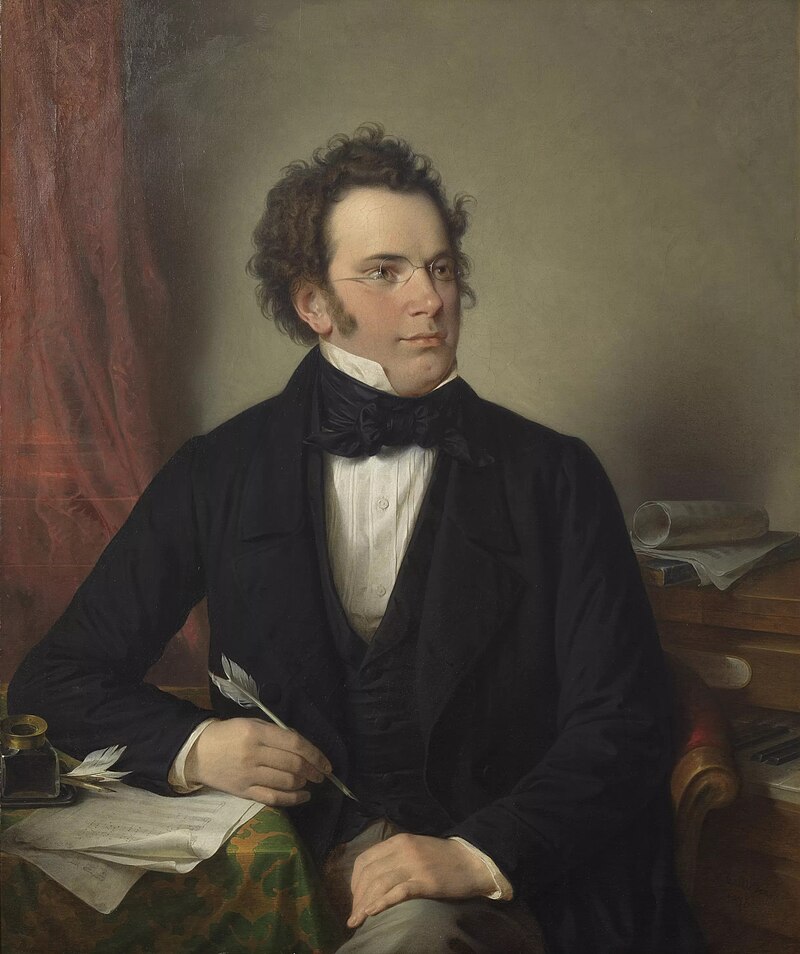
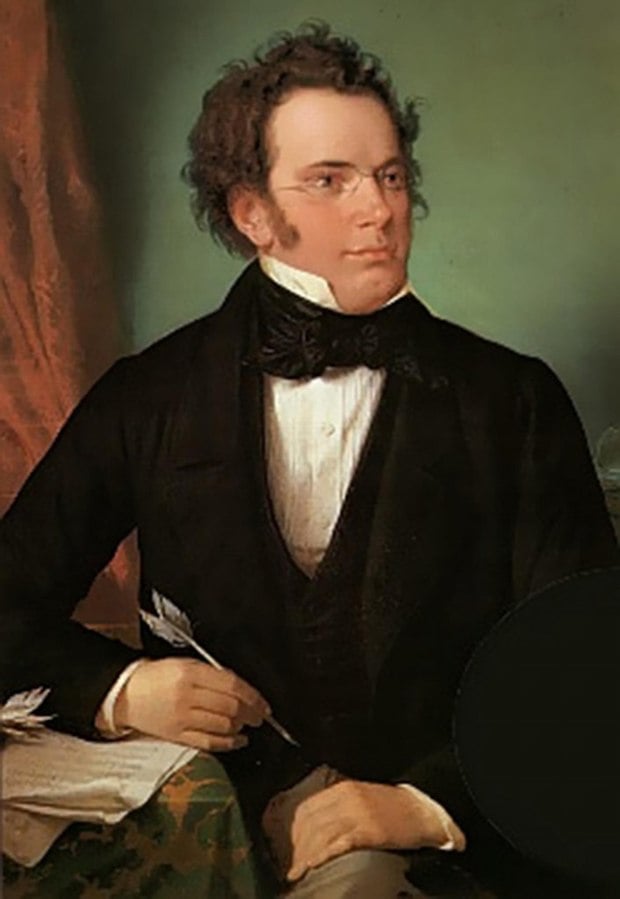
Standing only five-foot-one, Schubert himself bore the nickname “Schwammerl” (“Little Mushroom”), bestowed upon him by his friends. Even a minute fungus, it would seem, is more than capable of creating something “Great.”
Happy birthday, Felix Mendelssohn, and happy belated birthday, Franz Schubert.
Mendelssohn, “Hebrides Overture”
His first masterpiece, the Octet in E-flat major, composed at the age of 16:
Live performance of Leonard Bernstein conducting Schubert’s Symphony No. 9 “Great”