When Walt Disney let the cork out of the bottle on “20,000 Leagues Under the Sea” (1954), he inadvertently launched the “Decade of Verne” – a notion bolstered by Michael Todd’s star-studded “Around the World in 80 Days” (1956). “Around the World” was recognized with a shelf-full of Academy Awards, including one for Best Picture, and the luster of prestige was added to the glitter of box office gold.
The rest of ‘50s and early ‘60s were punctuated by big screen adaptations of Jules Verne’s novels of adventure and scientific speculation. Verne was the very thing to lure viewers out of their living rooms, away from their television sets and back into theaters, as production designers and effects artists were given carte blanche to fill their canvases with eyepopping visuals.
One of the more successful of these cinematic translations is “Journey to the Center of the Earth” (1959), inspired by Verne’s 1864 novel. Captain Nemo himself, James Mason, heads a ragtag scientific expedition – including a bumbling pupil, the widow of his scientific rival, a Norse giant and his pet goose – to the earth’s core, his observations alternating between wonder and Henry Higgins-like exasperation, as he ponders why a woman can’t be more like a man.
Though the movie is absorbing and entertaining in a way that few spectacles are today, it requires an extra leap of imagination to comprehend what it would have been like to experience it for the first time in a movie palace, in Cinemascope, with Bernard Herrmann’s alternately ominous and thunderous score.
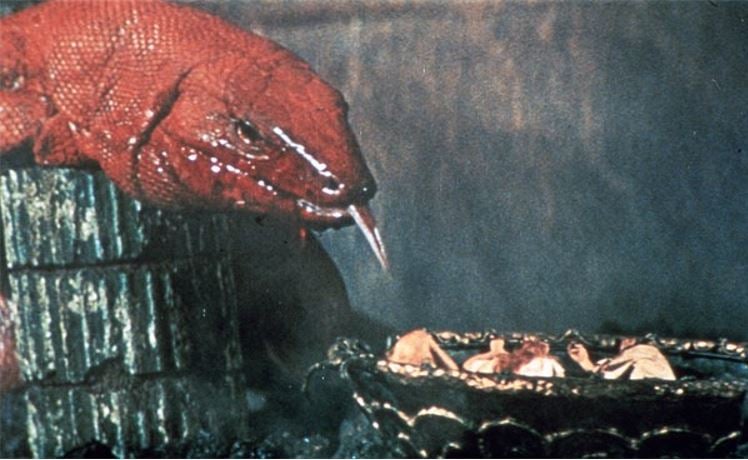
Our discussion of the film is bound to be a rather thin substitute, but preparations are underway for Roy and I to go spelunking on the next Roy’s Tie-Dye Sci-Fi Corner. We’ll be skirting phosphorescent pools and fleeing giant lizards. Keep feeding us rope in the comments section, as we livestream on Facebook, this Friday evening at 7:00 EST!
