Tag: Science Fiction

  • Theremin in Film Spooky Sounds for Halloween

    Theremin in Film Spooky Sounds for Halloween

    You all know the sound. That crazy, trilled electronic whistle that dips into a whoop. Or it starts in a trough and shoots up into the super stratosphere. It’s the sound of UFOs and mad science. It’s the sound of the theremin.

    The electronic instrument, invented by Leon Theremin in 1928, is played without physical contact. The proximity of the hands to two antennae determines volume and pitch.

    This week on “Picture Perfect,” we’ll hear music from four films which feature the instrument’s distinctive, extraterrestrial timbre.

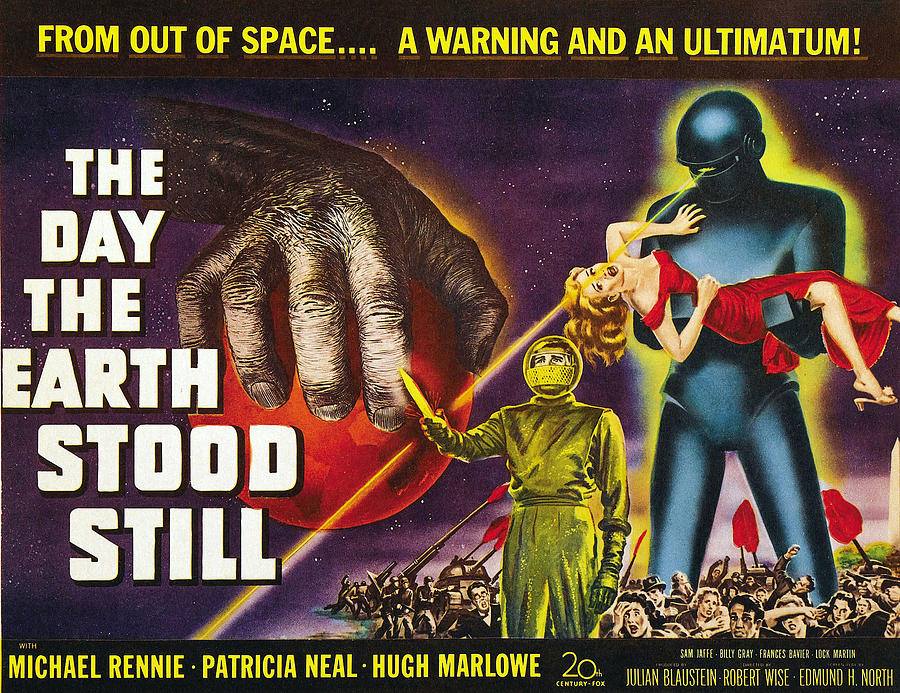
    “The Thing from Another World” was one of two seminal science fiction scores written in 1951. (The other was Bernard Herrmann’s “The Day the Earth Stood Still.”) On the soundtrack, the theremin acts as a musical counterpart to James Arness’ rampaging humanoid carrot. This was unquestionably composer Dimitri Tiomkin’s wildest hour; he never wrote anything like it again.

    “The Thing” and “The Day the Earth Stood Still” may have been the most influential, but “Rocketship X-M” was the first. The film was rushed into production in 1950 to beat George Pal’s “Destination Moon” to theaters. It was shot in just 18 days! The unlikely plot has the crew of a moon expedition blown off course to Mars. Interestingly, the composer was none other than Ferde Grofé – he of the “Grand Canyon Suite” fame.

    Far more reputable, but still not wholly comfortable with its science, is Alfred Hitchcock’s “Spellbound,” from 1945. Gregory Peck plays an amnesiac, who may or may not have committed murder, and Ingrid Bergman plays the psychoanalyst who falls in love with him. The film is of greatest interest for its production design, which features dream sequences conceived by Salvador Dali, and for its music, by Miklós Rózsa.

    Hitchcock disliked the score – he thought it got in the way of his direction – but the Academy disagreed, and the music earned Rózsa the first of his three Academy Awards.

    Closer to our own time, Howard Shore incorporated the theremin into his Mancini-esque score to “Ed Wood,” released in 1991, Tim Burton’s love letter to the grade-Z director of “Plan 9 from Outer Space,” which is widely regarded as the worst movie ever made (worse even than “Rocketship X-M”).

    Join me for an hour of theremins for Hallowe’en this week, on “Picture Perfect,” music for the movies – this Friday evening at 6 EDT, on WWFM – The Classical Network and at wwfm.org.

    FUN FACT: On three of the four movies from which scores we’ll be sampling (“Spellbound,” “Rocketship X-M,” and “The Thing”), the original thereminist was Samuel Hoffman. Hoffman played in dozens of Hollywood films in the 1940s and ‘50s. By day, he worked as a podiatrist!


    PHOTO: Hoffman (right) looks on as Cary Grant tries his hand at the theremin
  • Mars Movies: War of the Worlds & John Carter

    Mars Movies: War of the Worlds & John Carter

    This week on “Picture Perfect,” it’s an interplanetary exchange program (though, granted, not always a peaceful one), with music from movies about visitors to and from Mars.

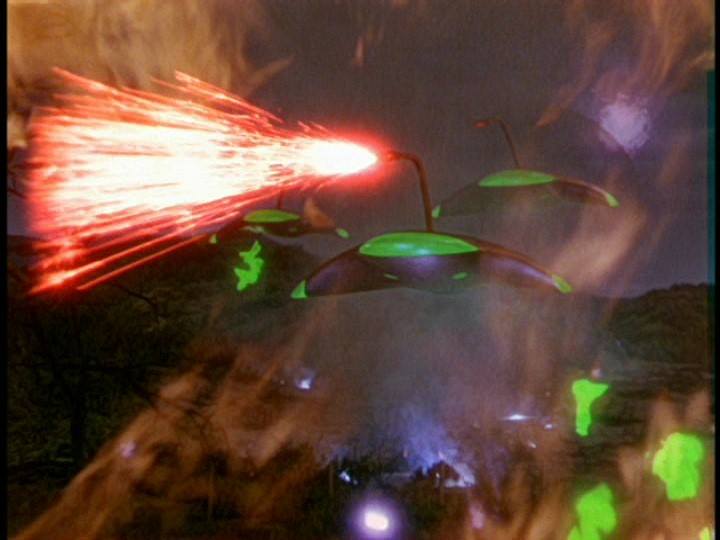
    The first half of the show will compare and contrast selections from two film adaptations of H.G. Wells’ Martian invasion novel, “The War of the Worlds” – the classic 1953 version, produced by George Pal, with music by Leith Stevens, and the Steven Spielberg blockbuster, from 2005 (titled, simply, “War of the Worlds”), with music by John Williams.

    Then we’ll take it to the Red Planet, when an American astronaut is stranded with his test monkey, in 1964’s “Robinson Crusoe on Mars,” with music by Van Cleave.

    And finally, Edgar Rice Burroughs’ John Carter gets the big screen treatment, in 2012, a hundred years after the fact, in… well, “John Carter.” (Why Disney dropped “of Mars” from the title – something that would have actually said something about the subject matter – is anybody’s guess.)

    Unfortunately the intervening decades robbed Burroughs’ creation of much of its freshness, with dozens, if not hundreds, of science fiction novels and movies having raided the author’s pulp treasure trove, making “John Carter” less striking than it might have been.

    And I’m sure you already know where I stand on CGI. I would have loved this film had it been made in the ‘70s or ‘80s, using miniatures and matte paintings. Don’t get me wrong, I still enjoyed it, but it didn’t give me a lift, as few movies do these days. That said, it certainly wasn’t the train wreck the press made it out to be.

    The music was by Michael Giacchino, who thankfully uses an orchestra and employs leitmotif, though perhaps doesn’t weave so rich a tapestry as might have some of his forebearers. It certainly ends the hour on a romantic note, a welcome relief after dodging so many Martian heat rays.

    I hope you’ll accompany me to and from Mars, on “Picture Perfect,” music for the movies, this Friday evening at 6 ET, with a repeat Saturday morning at 6, or that you’ll partake of the webcast (once it’s posted), at http://www.wwfm.org.

    PHOTO: Pal’s enemies

  • Friendly Alien Film Scores E.T. & Beyond

    Friendly Alien Film Scores E.T. & Beyond

    People of Earth! We come in peace!

    This week on “Picture Perfect,” we listen to scores from films about benevolent extra-terrestrials. Friendly E.T.’s have been out of fashion now for quite some time. We seem to be mired in some neo-‘50s zeitgeist, as far as paranoia and invaders are concerned. But that certainly wasn’t the case back in 1982, when Steven Spielberg’s “E.T. The Extra-Terrestrial” almost singlehandedly turned everything on its head.

    No more invaders from Mars. Spielberg would get to that a couple of decades later, when he remade H.G. Wells’ “The War of the Worlds.” No, during the Reagan Era, with the Cold War winding down and terrorism not yet so much in the news, cinematic E.T.’s were benevolent at best, or at worst, just trying to do their thing. They were there to be misunderstood and even imperiled by man until the warm, fuzzy, often poignant finale.

    Spielberg had already explored the concept of the benevolent visitor from space, of course, with 1977’s “Close Encounters of the Third Kind.” But there was an ambiguity for much of the film as to what exactly the aliens’ intentions were. In fact, there is at least one sequence that would give a child nightmares (at least by 1977 standards). Whatever tension is generated dissolves in a euphoric finale, centered around the communicative power of music. Like so many films back then and so few now, “Close Encounters” doesn’t so much exhaust the viewer as leave him or her with a feeling of hope.

    John Williams wrote the music for both “Close Encounters” and “E.T.” (winning his fourth Academy Award for the latter), and the two scores couldn’t be more different. In particular, he absorbs the avant garde syntax of composers like Gyorgy Ligeti and Krzysztof Penderecki for the eerier sequences of “CE3K” before reverting to unabashed lyricism for the transcendent finale. For “E.T.,” he takes a much more intimate approach for a moving story of friendship between a boy and a stranded space botanist. I admit to feeling mild dread when first seeing the trailer for “E.T.,” already thinking Spielberg had traveled this route before. Little did I realize that within a few weeks I would assess it as his masterpiece (John Williams’, too), as I still do today.

    The “friendly” alien of “The Day the Earth Stood Still,” Klaatu, may come in peace, but it is a message delivered with tough love. If mankind refuses to abide, his robot Gort will destroy the planet. At a time when Martians invariably meant trouble (1951), this was actually progressive. Bernard Herrmann’s score is one of his best, and certainly one of his most interesting. Always an eccentric orchestrator, Herrmann’s concept of extra-terrestrial music incorporates violin, cello, electric bass, two theremins, two Hammond organs, a large studio electric organ, three vibraphones, two glockenspiels, two pianos, two harps, three trumpets, three trombones and four tubas. Overdubbing and tape-reversal techniques were also employed. Now this guy was a composer!

    Finally, Ron Howard’s “Cocoon” is one of the more worthwhile of the seemingly endless procession of extra-terrestrial films to be released in the wake of “E.T.” At least this one took a different approach by bringing alien forces into contact with a Florida retirement community with the unexpected result of rejuvenating its inhabitants. A modern take on the fabled Fountain of Youth, the film is a showcase for veteran actors Hume Cronyn, Jessica Tandy, Jack Gilford and Don Ameche (who won an Academy Award). James Horner’s score is much sought after by collectors.

    People of Earth! Be there for the touchdown of friendly alien films, on “Picture Perfect” – music for the movies – this Friday evening at 6 ET. Or listen to it later as a webcast at http://www.wwfm.org.

    Klaatu barada nikto!

Tag Cloud

Aaron Copland (93) Beethoven (95) Composer (114) Film Music (133) Film Score (143) Film Scores (255) Halloween (94) John Williams (193) KWAX (229) Leonard Bernstein (103) Marlboro Music Festival (125) Movie Music (148) Mozart (88) Opera (206) Philadelphia Orchestra (89) Picture Perfect (174) Princeton Symphony Orchestra (108) Radio (88) Ross Amico (244) Roy's Tie-Dye Sci-Fi Corner (290) The Classical Network (101) The Lost Chord (268) Vaughan Williams (103) WPRB (396) WWFM (881)

DON’T MISS A BEAT

Receive a weekly digest every Sunday at noon by signing up here


RECENT POSTS