Tag: Sergei Lyapunov

  • Mily Balakirev Russian Musical Kingmaker

    Mily Balakirev Russian Musical Kingmaker

    Mily Balakirev was Russia’s musical kingmaker.

    Balakirev, of course, was the founder of the “Mighty Handful,” or “The Russian Five,” that collective of Russian nationalist composers that also included Nikolai Rimsky-Korsakov, Modest Mussorgsky, Alexander Borodin, and Cesar Cui.

    He had very strong ideas about what Russian music should be, and he was not at all bashful about telling other composers what to do. He essentially micromanaged the early careers of his acolytes, which included not only “The Five,” but on several occasions Peter Ilych Tchaikovsky.

    In his later years, though Balakirev’s influence was on the wane, he made two final, important contributions. He was responsible for introducing the prodigy Alexander Glazunov to Rimsky-Korsakov, and he was blessed with one last, very talented disciple, Sergei Lyapunov.

    I hope you’ll join me later today, as we listen to music by this last of the Russian nationalists, who was as much influenced by the keyboard prowess of Liszt as he was the patriotic zeal of his mentor. Among our featured works will be his “Solemn Overture on Russian Themes” and “Rhapsody on Ukrainian Themes.” He also wrote the music that became “The Lost Chord” signature tune. This will be included, without my voice, for a change, with selections from his “Transcendental Etudes.”

    That’s “One Past Five,” music by Sergei Lyapunov, on “The Lost Chord,” now in syndication on KWAX, the radio station of the University of Oregon!


    Remember, KWAX is on the West Coast, so there’s a three-hour difference for those of you listening in the East. Here are the respective air-times for all three of my recorded shows (with East Coast conversions in parentheses):

    PICTURE PERFECT, the movie music show – Friday on KWAX at 5:00 PM PACIFIC TIME (8:00 PM EASTERN)

    SWEETNESS AND LIGHT, the light music program – ALL NEW! – Saturday on KWAX at 8:00 AM PACIFIC TIME (11:00 AM EASTERN)

    THE LOST CHORD, unusual and neglected rep – Saturday on KWAX at 4:00 PM PACIFIC TIME (7:00 PM EASTERN)

    Stream all three, at the times indicated, by following the link!

    https://kwax.uoregon.edu/


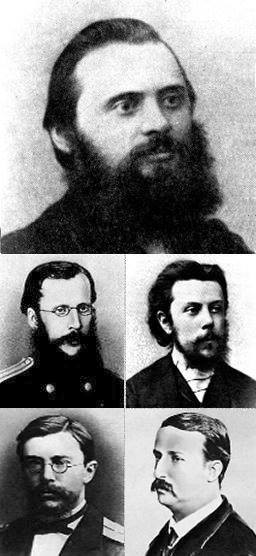
    WHEN BEARDS WERE IN: Top left, Mily Balakirev; bottom left (clockwise), Cesar Cui, Modest Mussorgsky, Alexander Borodin, Nikolai Rimsky-Korsakov; right, Sergei Lyapunov

  • Mily Balakirev and Russia’s Mighty Five

    Mily Balakirev and Russia’s Mighty Five

    Mily Balakirev was Russia’s musical kingmaker.

    Balakirev, of course, was the founder of the “Mighty Handful,” or “The Russian Five,” that collective of Russian nationalist composers that also included Nikolai Rimsky-Korsakov, Modest Mussorgsky, Alexander Borodin, and Cesar Cui.

    He had very strong ideas about what Russian music should be, and he was not at all bashful about telling other composers what to do. He essentially micromanaged the early careers of his acolytes, which included not only “The Five,” but on several occasions Peter Ilych Tchaikovsky.

    In his later years, though Balakirev’s influence was on the wane, he made two final, important contributions. He was responsible for introducing the prodigy Alexander Glazunov to Rimsky-Korsakov, and he was blessed with one last, very talented disciple, Sergei Lyapunov.

    This Sunday night on “The Lost Chord,” we’ll hear music by this last of the Russian nationalists, who was as much influenced by the keyboard prowess of Liszt as he was the patriotic zeal of his mentor. He also happens to be the composer of “The Lost Chord” signature music.

    I hope you’ll join me for “One Past Five,” music of Sergei Lyapunov – one hour later than usual, due to the length of today’s opera broadcast – this Sunday night at 11:00 EDT, on WWFM – The Classical Network and wwfm.org.


    WHEN BEARDS WERE IN: Top left, Mily Balakirev; bottom left (clockwise), Cesar Cui, Modest Mussorgsky, Alexander Borodin, Nikolai Rimsky-Korsakov; right, Sergei Lyapunov
  • Louis Kentner Warsaw Concerto Fame

    Louis Kentner Warsaw Concerto Fame

    When he was hired to play the piano in a World War II potboiler, he asked that he not receive credit, for fear that it would damage his integrity as a concert artist. But when the spin-off record sold millions, he wisely changed his tune.

    Today is the birthday of Louis Kentner (1905-1987). The pianist went by several names. He was born Lajos Kentner to Hungarian parents in the present-day Czech Republic (then Austrian Silesia). Among his teachers at the Royal Academy of Music in Budapest were Arnold Székely (piano), Leó Weiner (chamber music) and Zoltán Kodály (composition). He began performing in public at the age of 15. Until 1931, he was known professionally as Ludwig Kentner. He settled in England in 1935 and became a naturalized citizen in 1946.

    Kentner excelled in the works of Franz Liszt. He founded the British Liszt Society. The sprawling “Years of Pilgrimage” was among the works he tackled complete. He also gave radio broadcasts of the complete sonatas of Beethoven and Schubert, and Bach’s “The Well-Tempered Clavier.” He was the pianist of choice for Béla Bartók, who requested him as soloist for the Hungarian premiere of his Piano Concerto No. 2 and the first European performance of the Concerto No. 3. Later, Kentner gave the British premiere of Bartók’s Scherzo for Piano and Orchestra.

    Also in England, he gave first performances of works by Sir Arthur Bliss, Sir Michael Tippett, and Sir William Walton (Walton’s Violin Sonata, played with his brother-in-law, the violinist Yehudi Menuhin).

    Nothing he played, however, touched so many as Richard Addinsell’s “Warsaw Concerto,” which became world-famous following its use in the 1941 film “Dangerous Moonlight” (known in the U.S. by the more lurid title, “Suicide Squadron”). The piece, never heard complete in the film, took on a life of its own when arranged as a mini Rachmaninoff-style concerto by Addinsell’s frequent collaborator, Roy Douglas. The eight-minute playing time ensured that it would fit perfectly on two sides of a 78 rpm disc. Its sheet music sales went through the roof, and the “Warsaw Concerto” was a smash. It was not the first spin-off concerto from the movies, but it did spark an unlikely rage for concertos at the movies.

    Kentner’s legacy has been tied very closely to my own radio work, since it is he who performs the theme to my weekly show, “The Lost Chord” (which is, for the record, the “Berceuse” from Kentner’s 1972 recording of the “Transcendental Etudes” of Sergei Lyapunov).

    So it is with gratitude, as well as with admiration, that I offer this remembrance of Louis Kentner on his birthday!


    Kentner’s recording of the “Warsaw Concerto:”

    His first of three recordings of the “Berceuse” from Lyapunov’s “Transcendental Etudes” (this one made in 1939):

  • Mily Balakirev Russian Music’s Kingmaker

    Mily Balakirev Russian Music’s Kingmaker

    Mily Balakirev was Russia’s musical kingmaker.

    Balakirev, of course, was the founder of the “Mighty Handful,” or “The Russian Five,” that collective of Russian nationalist composers that also included Nikolai Rimsky-Korsakov, Modest Mussorgsky, Alexander Borodin, and Cesar Cui.

    He had very strong ideas about what Russian music should be, and he was not at all bashful about telling other composers what to do. He essentially micromanaged the early careers of his acolytes, which included not only “The Five,” but on several occasions Peter Ilych Tchaikovsky.

    In his later years, though Balakirev’s influence was on the wane, he made two final, important contributions. He was responsible for introducing the prodigy Alexander Glazunov to Rimsky-Korsakov, and he was blessed with one last, very talented disciple, Sergei Lyapunov.

    This Sunday night on “The Lost Chord,” we’ll hear music by this last of the Russian nationalists, who was as much influenced by the keyboard prowess of Liszt as he was the patriotic zeal of his mentor. He also happens to be the composer of “The Lost Chord” signature music.

    I hope you’ll join me for “One Past Five” – music of Sergei Lyapunov – this Sunday night at 10:00 EDT, on WWFM – The Classical Network and wwfm.org.


    WHEN BEARDS WERE IN: Top left, Mily Balakirev; bottom left (clockwise), Cesar Cui, Modest Mussorgsky, Alexander Borodin, Nikolai Rimsky-Korsakov; right, Sergei Lyapunov

  • Lyapunov The Lost Chord Composer Birthday

    Lyapunov The Lost Chord Composer Birthday

    As a longtime listener to “The Lost Chord,” perhaps you recognize this music:

    The composer is Sergei Lyapunov. The first of Lyapunov’s “Transcendental Etudes,” the “Berceuse,” has served as the theme music for “The Lost Chord,” since the program’s debut in January of 2003. The pianist, as in the clip, is Louis Kenter, though I use a later recording, the one that was once available on Turnabout. Kenter recorded the work on at least two previous occasions.

    Lyapunov was born on this date in 1859. He enrolled in the Moscow Conservatory at the personal invitation of its director, Nikolai Rubinstein. There he studied with Karl Klindworth (a pupil of Liszt) and Sergei Taneyev (a pupil of Tchaikovsky).

    Since Lyapunov gravitated more toward the Russian Nationalist movement than to the more cosmopolitan approach of Tchaikovsky and his followers, he made it his mission to set out in search of Mily Balakirev, who had been the guiding force behind the group known as “The Mighty Handful,” or “The Russian Five” (which, with Balakirev, consisted of Rimsky-Korsakov, Mussorgsky, Borodin, and César Cui).

    Lyapunov became the most important of Balakirev’s latter-day disciples, with master overseeing pupil as diligently as he had the composers of the 1860s. Together, Lyapunov and Balakirev went on folksong collecting expeditions, amassing some 300 songs.

    Lyapunov succeeded Rimsky-Korsakov as the assistant director of the Imperial Chapel. He became head of the Free School and a professor of music at the St. Petersburg Conservatory. After the Revolution, he emigrated to Paris in 1923, where he directed a school for Russian émigrés. He died of a heart attack the following year, in 1924.

    Lyapunov enjoyed a successful career as a touring pianist. The “Transcendental Etudes” are central to his output for the keyboard. He modeled the collection of 24 major and minor key movements on a plan devised by Liszt (though Liszt never completed his). He concluded the cycle with an elegy in memory of Liszt, and in fact dedicated the whole to the legendary keyboard master.

    Each etude bears a descriptive title:

    “Berceuse” (”Lullaby”) in F♯ Major;

    “Ronde des Fantômes” (“Ghosts’ dance”) in D♯ Minor;

    “Carillon” in B Major; “Térek” (“The River Terek”) in G♯ Minor;

    “Nuit d’été” (“Summer Night”) in E Major;

    Tempête (“Tempest”) in C♯ Minor;

    “Idylle” in A Major;

    “Chant épique” (“Epic Song”) in F♯ Minor;

    “Harpes éoliennes”(“Aeolian Harps”) in D Major;

    “Lesghinka” in B Minor;

    “Ronde des sylphs” (“Dance of the Sylphs”) in G Major;

    and “Elégie en mémoire de François Liszt” (“Elegy in Memory of Liszt”) in E Minor.

    Happy Birthday, Sergei Lyapunov. Thanks for the great theme music!

    As a bonus, here’s his beautiful “Rhapsody on Ukrainian Themes:

    PHOTOS: Sergei Lyapunov, pioneer of the chia beard

Tag Cloud

Aaron Copland (92) Beethoven (94) Composer (114) Film Music (116) Film Score (143) Film Scores (255) Halloween (94) John Williams (185) KWAX (228) Leonard Bernstein (99) Marlboro Music Festival (125) Movie Music (131) Opera (197) Philadelphia Orchestra (86) Picture Perfect (174) Princeton Symphony Orchestra (106) Radio (86) Ralph Vaughan Williams (85) Ross Amico (244) Roy's Tie-Dye Sci-Fi Corner (290) The Classical Network (101) The Lost Chord (268) Vaughan Williams (99) WPRB (396) WWFM (881)

DON’T MISS A BEAT

Receive a weekly digest every Sunday at noon by signing up here


RECENT POSTS