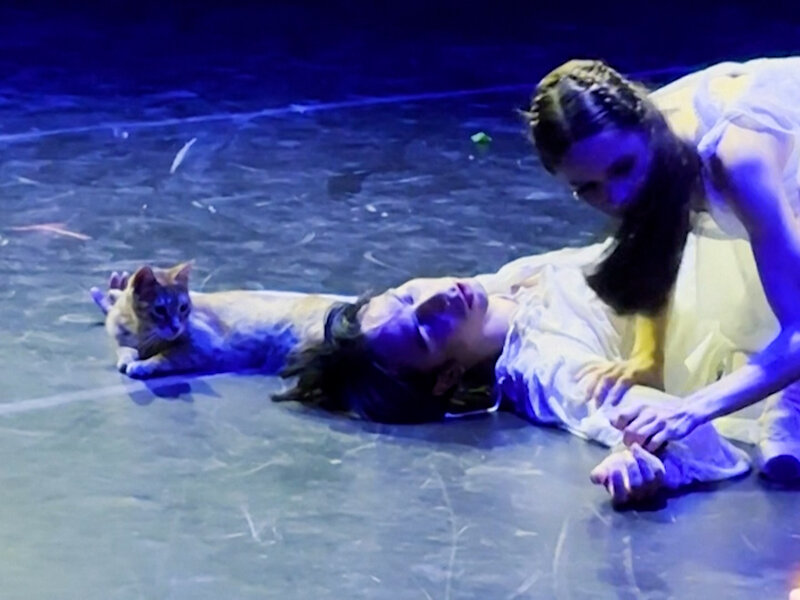
I guess Tybalt wasn’t the only rat-catcher in this production of “Romeo and Juliet.”
A stray cat brought unexpected levity to Prokofiev’s “Romeo and Juliet” during a performance by the Imperial Russian Ballet in Izmir, Turkey. Far from being upset by the four-legged interloper, the dancers evidently took to the feline balletomane, as he or she was brought out a few minutes later to share in the final bow. Later, it was shown that the ginger started turning up at rehearsals.
Scroll down to watch all three videos at the link.
https://slippedisc.com/2026/06/cat-steals-the-scene-in-ro-meouw-and-juliet-ballet/
Isn’t the Imperial Russian Ballet now properly identified as the Mariinsky?
Or hereafter, the Meow-riinsky?
Tag: Sergei Prokofiev
-
Romeo and Juliet Ends in Cat-astrophe
-

Sergei Prokofiev Offers Three Times Your Daily Allowance of Vitamin C
On Sergei Prokofiev’s birthday, I’ve got a love for…
I’ve also got a newspaper article due.
Ever wonder about the rest of the opera? I thought the production at the link below was the same as the one I caught in Philadelphia. However, as I remember it, the Philly production was not quite so dark. Turns out, that one was conceived by Alessandro Talevi. The one at the link was designed by the Brothers Quay – who also have a Philadelphia connection, as graduates of the late, lamented University of the Arts. Both productions employ an English translation by David Lloyd-Jones, who conducts the performance here – but if you still can’t understand it, use the closed captioning.Prokofiev wrote his own libretto, in French, after a play by Carlo Gozzi. The work was given its first performance in Chicago, with the composer conducting, in 1921. None of the critics liked it, except Ben Hecht, a newspaper man who also wrote novels and was soon to became one of Hollywood’s most-valuable screenwriters. When he completed a last-minute, uncredited rewrite of “Gone with the Wind,” he was dubbed the “Shakespeare of Hollywood,” which the cynical Hecht dismissed as proof of just bad Hollywood movies really are.
It didn’t stop him from accepting assignments, though. It’s true that Ben liked “Oranges,” but what he really loved was green.
——-
Played in transcription by Jascha Heifetz
And Emil Gilels -
Feline Affection and Frivolity on “Sweetness and Light”
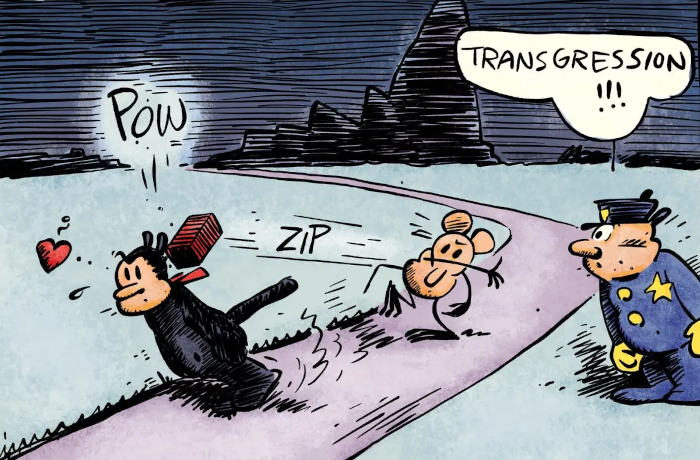
This week on “Sweetness and Light,” the cat’s out of the bag. It’s an hour of felicitous feline music!
On the 150th anniversary of the birth of American composer John Alden Carpenter, we’ll hear the ballet “Krazy Kat,” inspired by George Herriman’s cult comic strip. Carpenter characterized it as a “jazz pantomime”, but if there’s any jazz in it, it’s “white man” jazz of the 1920s (i.e. less jazz than “Rhapsody in Blue”). Believe it or not, I’ve actually seen this performed – twice! If memory serves, Sergei Prokofiev, in the U.S. for the debut of his opera “The Love for Three Oranges” and to perform his Piano Concerto No. 3 with the Chicago Symphony Orchestra, was present at the work’s premiere. I can’t find anything on the internet to back it up right now, so it looks like I’ll be sleuthing around my library.
Carpenter’s music will headline a meow mix of melodies by Leroy Anderson, Ernst von Dohnányi, Richard Rodney Bennett, Gioachino Rossini, Nino Rota, Samuel Barber, and Zez Confrey.
It will be programming you can sink your claws into, on “Sweetness and Light.” The music, like your host, will be the cat’s pajamas, this Saturday morning at 11:00 EST/8:00 PST, exclusively on KWAX Classical Oregon!
Stream it, wherever you are, at the link:
https://kwax.uoregon.edu/ -

The Prodigal Sons Return
When I was in college, I was a Prokofiev nut. To the point that I would say he was probably my favorite composer. I was astonished by his melodic fecundity, and his language was just modern enough to lend a little tang.
And thanks to my love of film scores, it was comfortingly familiar, as movie composers have made frequent restorative journeys to the Russian master’s well of inspiration to lend some zing to their own compositions. Listen to “The Battle on the Ice” from “Alexander Nevsky,” the March from “The Love for Three Oranges,” and perhaps “The Death of Tybalt” from “Romeo and Juliet,” and you pretty much have yourself a film music Rosetta Stone.
During the period when I was first really getting to know this composer, beyond a childhood familiarity with “Peter and the Wolf,” I snapped up any recording of a Prokofiev piece I didn’t already own. Of course, being a student, this often involved a degree of deferred gratification.
I got around that by getting a job as a record clerk at Sam Goody’s, then (before the arrival of Tower Records) sporting the largest classical music section in Philadelphia. There, I basically signed my paycheck back over to the company, as I acquired (piecemeal) my first cycles of the symphonies of Vaughan Williams (Boult), Shostakovich (Haitink), and Prokofiev (Järvi).
After Prokofiev’s Symphony No. 1 (a.k.a. the “Classical Symphony”), No. 5 is the most popular. No. 6 also makes a great effect in concert. But I also felt an instant affinity with No. 4, which is tied up with Prokofiev’s ballet “The Prodigal Son” (choreographed by Balanchine and performed by the Ballets Russes). Prokofiev took some of the themes and episodes from the dance work and developed them into a symphony. And then he returned to it to revise it. I don’t know that it’s the strongest symphony, necessarily, but I found the music strangely compelling. And it wound up having a transformative effect on my life.
It was my whim in those days, when returning to the ancestral home (not too much a prodigal son myself, I hope) to periodically scan the radio frequencies to check if there were any classical music options I may not have known about. On one such occasion, I happened across a classical music broadcast from Allentown, PA. WMUH, based at Muhlenberg College, as a matter of fact. It was a request show, and the host put out the telephone number, so I called in and asked if I could hear Prokofiev’s Symphony No. 4.
A short while later, she came back on the air and said, “To the person who phoned in and requested the Prokofiev symphony, we don’t have it in the library, but if you want to call back, you can ask for something else.”
So I did. They didn’t have that either.
It was then that I learned that the person I was speaking with was not only the host, she was the classical director, and she said, “Look, you know more about this stuff than I do. How would you like to come in and do a show?” That’s how I fell in with the Lehigh Valley Community Broadcasters Association and came to helm my first broadcast in the summer of 1986. Little did I realize the ramifications it would have on the rest of my life.
It stuns me to consider that I have been doing radio now for 40 years. Professionally, for the past 31. I mean, I’m not that old, am I?
It helps that I got an early start. I was only 19 at the time. And it turned out I had a knack for it. Knowledge and enthusiasm can take you a long way. In my experience, they have spackled over many imperfections.
By now, I have strayed very far from my objective, which is to let you know that the New York Repertory Orchestra will be performing Prokofiev’s Symphony No. 4 this weekend. I’m not sure which version. Does it matter? It’s hardly ever done.
At some point I figured out that the Prokofiev works that communicated most directly were from a certain period of his artistic development. The earlier stuff could be a little more acerbic. Not just for the purposes of tang.
You see, Prokofiev was bit of prodigal son himself, an enfant terrible who drank deeply of the decadent West, before returning to Soviet Russia and all that would entail.
So the program, cleverly conceived by the music director David Leibowitz, works on multiple levels.
You see, you get not only Prokofiev’s “Prodigal Son” symphony, but also, by way of introduction, Claude Debussy’s early Prix de Rome winner, “L’enfant prodigue” (“The Prodigal Son”). When’s the last time you heard THAT?
Debussy originally scored the work for soprano, baritone, tenor, and piano. It was his friend, André Caplet, who provided the orchestration. (Caplet also orchestrated Debussy’s “Clair de lune” and “Children’s Corner,” among others.)
This Saturday at 8:00, both prodigals will be revived in performance by the New York Repertory Orchestra, conducted by Leibowitz, at the Church of St. Mary the Virgin, 145 West 46th Street, between 6th & 7th Avenues. Soloists in the Debussy will include soprano Sarah Cambridge, baritone Kyle Oliver, and tenor Kyle van Schoonhoven.
If you’re not enticed at the prospect, probably nothing will sway you, not even the fact that ADMISSION IS FREE (with a recommended donation of $15).
Seriously? What are you waiting for?
Of course, I’ve got a conflict this weekend (again)… But I vow, one of these days, New York Repertory Orchestra, I am coming for you!
For more information, visit https://www.nyro.org/
Clip of the orchestra rehearsing Prokofiev’s Symphony No. 4
https://www.facebook.com/reel/830354070051178——
PHOTO: Prodigal Prokofiev
-

Armchair Travel Winter Films Classic Cinema
With the hustle and bustle of the holidays for the most part behind us and temperatures plummeting, January is a great time of year for armchair travel.
This week on “Picture Perfect,” cozy in, but get a world view, as we drift beyond our shores for an hour of wintry scenes from world cinema, with entries from England, Finland, the Soviet Union, and Japan.
Akira Kurosawa’s “Dersu Uzala” (1975) is one of the best of his later films, although it seems to have faded into the shadows of “Kagemusha” and “Ran.” The plot centers on an early 20th century friendship between a Russian explorer and an East Asian trapper and hunter, who acts as his guide. This would be the last of Kurosawa’s works to be recognized with an Academy Award for Best Foreign Language Film. The music is by Isaac Schwartz.
Snow again is in abundance in Finland’s “The White Reindeer” (1952). Set in Lapland, it tells the tale of a lonely herder’s wife, who visits a local shaman and is transformed into a shapeshifting, vampiric hind. The film was honored at the Cannes Film Festival with a special award for Best Fairy Tale Film, and at the Golden Globes as Best Foreign Film. Einar Englund wrote the music.
Sergei Prokofiev’s concert suite from “Lieutenant Kijé” (1934) is very well known, but for some reason the film is not. In fact, it has been widely circulated in program notes that the film was never actually completed, which is false. It has not been available for purchase in the U.S. for as long as I can remember, but you can watch it here:
Why The Criterion Collection has never gotten around to this one, I don’t know, but I’m sure there must be an explanation. The famous sleigh-ride, the “Troika,” begins just before the 45-minute mark. Note that the baritone on the soundtrack is none other than the composer himself, who thought the original singer employed for the purpose too refined.
Finally, we head to the South Pole with Robert Falcon Scott, for “Scott of the Antarctic” (1948). England’s Ealing Studios is probably best recognized for its classic comedies of the 1950s, many of them starring Alec Guinness. There’s not much funny about this harrowing true story, with John Mills as Scott and the most celebrated film score by Ralph Vaughan Williams. Vaughan Williams’ music perfectly reflects the sublime, austere beauty of an impenetrable wilderness. Material from the score was later reworked and incorporated into his Symphony No. 7, the “Sinfonia Antartica” (using the Italian spelling.)
Don’t forget your gloves and a hat! It’s a small world of cold this week, on “Picture Perfect,” music for the movies, now in syndication on KWAX, the radio station of the University of Oregon!
Clip and save the start times for all three of my recorded shows:
PICTURE PERFECT, the movie music show – Friday at 8:00 PM EST/5:00 PM PST
SWEETNESS AND LIGHT, the light music program – ALL NEW! – Saturday at 11:00 AM EST/8:00 AM PST
THE LOST CHORD, unusual and neglected rep – Saturday at 7:00 PM EST/4:00 PM PST
Stream them, wherever you are, at the link!
Tag Cloud
Aaron Copland (93) Beethoven (95) Composer (114) Film Music (144) Film Score (143) Film Scores (255) Halloween (94) John Williams (195) KWAX (229) Leonard Bernstein (104) Marlboro Music Festival (125) Movie Music (159) Mozart (90) Opera (212) Philadelphia Orchestra (89) Picture Perfect (174) Princeton Symphony Orchestra (109) Radio (88) Ross Amico (244) Roy's Tie-Dye Sci-Fi Corner (290) The Classical Network (101) The Lost Chord (269) Vaughan Williams (105) WPRB (397) WWFM (881)