Tag: Sergei Prokofiev

  • Prodigal Son Ballet Father’s Day

    Prodigal Son Ballet Father’s Day

    Nothing is guaranteed to get Dad out on the dance floor faster than ballet music inspired by the Prodigal Son.

    As related in the Gospel of Luke, a young wastrel burns through his family fortune, then returns home to the arms of a forgiving father. The son’s elder, more responsible brother is none too pleased, but the father explains that since the younger son has repented and returned, as if from the dead – in essence, was lost, and is now found – it is cause for celebration.

    This Sunday night on “The Lost Chord,” it’s an off-center Father’s Day tribute, as we listen to ballet music inspired by the Parable of the Prodigal Son.

    We’ll hear a late, folk-inspired score by the Swedish composer Hugo Alfvén, staged in honor of his 85th birthday in 1957, and Sergei Prokofiev’s alternately pungent and transcendentally lyrical opus, written for the Ballets Russes in 1928. The latter was developed simultaneously with Prokofiev’s Symphony No. 4 and shares much of the same thematic material.

    Father knows best. Celebrate the Day of the Dad with “Son Dance,” ballet music inspired by the Prodigal Son, this Sunday night at 10:00 EDT, on WWFM – The Classical Network and wwfm.org.

  • Armchair Travel Winter Films & Music

    Armchair Travel Winter Films & Music

    Baby, it’s cold outside! The best time for armchair travel.

    This week on “Picture Perfect,” cozy in, but get a world view, as we drift beyond our shores for an hour of wintry scenes from world cinema, with entries from England, Finland, the Soviet Union, and Japan.

    Akira Kurosawa’s “Dersu Uzala” (1975) is one of the best of his later films, although it seems to have faded into the shadows of “Kagemusha” and “Ran.” The plot centers on an early 20th century friendship between a Russian explorer and an East Asian trapper and hunter, who acts as his guide. This would be the last of Kurosawa’s works to be recognized with an Academy Award for Best Foreign Language Film. The music is by Isaac Schwartz.

    Snow again is in abundance in Finland’s “The White Reindeer” (1952). Set in Lapland, it tells the tale of a lonely herder’s wife, who visits a local shaman and is transformed into a shapeshifting, vampiric hind. The film was honored at the Cannes Film Festival with a special award for Best Fairy Tale Film, and at the Golden Globes as Best Foreign Film. Einar Englund wrote the music.

    Sergei Prokofiev’s concert suite from “Lieutenant Kijé” (1934) is very well known, but for some reason the film is not. In fact, it has been widely circulated in program notes that the film was never actually completed, which is false. It has not been available for purchase in the U.S. for as long as I can remember, but you can watch it here:

    Why The Criterion Collection has never gotten around to this one, I don’t know, but I’m sure there must be an explanation. The famous sleigh-ride, the “Troika,” begins just before the 45-minute mark. Note that the baritone on the soundtrack is none other than the composer himself, who thought the original singer employed for the purpose too refined.

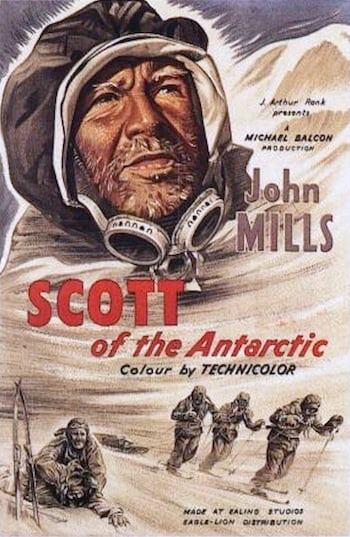
    Finally, we head to the South Pole with Robert Falcon Scott, for “Scott of the Antarctic” (1948). England’s Ealing Studios is probably best recognized for its classic comedies of the 1950s, many of them starring Alec Guinness. There’s not much funny about this harrowing true story, with John Mills as Scott and the most celebrated film score by Ralph Vaughan Williams. Vaughan Williams’ music perfectly reflects the sublime, austere beauty of an impenetrable wilderness. Material from the score was later reworked and incorporated into his Symphony No. 7, the “Sinfonia Antartica” (using the Italian spelling.)

    Don’t forget your gloves and a hat! It’s a small world of cold this week, on “Picture Perfect,” music for the movies, this Saturday evening at 6:00 EST, on WWFM – The Classical Network and wwfm.org.

  • Soviet Cinema’s Musical Masterpieces

    Soviet Cinema’s Musical Masterpieces

    This week on “Picture Perfect,” peek behind the Curtain for music by notable composers for Soviet cinema.

    Alfred Schnittke, a name usually associated with the avant-garde, actually composed over 60 film scores. One of these was for “Agony” (1974), about Rasputin, his influence over the Tsar, and the conspiracy to murder him.

    Georgy Sviridov, a pupil of Shostakovich, wrote the music for “Time, Forward!” (1962), based on the novel of Valentin Kataev. Set in the 1930s, the film describes a day of construction work at the Magnitogorsk Iron and Steel Works. Some of the music was used during the opening ceremonies of the 2014 Winter Olympics in Sochi.

    Dmitri Shostakovich, of course, is celebrated for his symphonies and string quartets, which are regarded as some of the most important of the 20th century. He also happened to write some 30 film scores, beginning all the way back in the silent era. Far and away his greatest hit composed for film, at least in the West, is the Romance from “The Gadfly” (1955), based on the novel of Ethel Lillian Voynich. The music gained broader exposure as the theme to “Reilly, Ace of Spies.”

    Sergei Eisenstein’s “Alexander Nevsky” (1938) invariably turns up on lists of the greatest films ever made. Nevsky, the 13th century Russian prince, military leader, and saint, thwarts the attempted invasion of Novgorod by Teutonic Knights of the Holy Roman Empire.

    Sergei Prokofiev arranged his masterful score into a concert piece, a cantata. However, these days, orchestras seem to be performing it more and more often as it was originally heard, with the film. The synthesis of music and visuals for the climactic Battle on the Ice is one of its indelible highlights.

    Say “da” to classic music for Soviet cinema, on “Picture Perfect,” music for the movies, this Saturday evening at 6:00 EST, on WWFM – The Classical Network and wwfm.org.

  • Prodigal Son Ballet A Father’s Day Dance

    Prodigal Son Ballet A Father’s Day Dance

    As related in the Gospel of Luke, a young wastrel burns through his family fortune, then returns home to the arms of his forgiving father. The son’s more responsible, elder brother is none too happy, but the father explains that since the younger son has repented and returned, as if from the dead – in essence, was lost, and is now found – there is cause for celebration.

    This Sunday night on “The Lost Chord,” it’s an off-center Father’s Day tribute, as we listen to ballet music inspired by the Parable of the Prodigal Son.

    We’ll hear a late, folk-inspired score by the Swedish composer Hugo Alfvén, staged in honor of his 85th birthday in 1957, and Sergei Prokofiev’s alternately pungent and transcendentally lyrical opus, written for the Ballets Russes in 1928. The latter was developed simultaneously with Prokofiev’s Symphony No. 4 and shares much of the same thematic material.

    Father knows best. I hope you’ll join me for “Son Dance,” ballet music inspired by the Prodigal Son for Father’s Day, this Sunday night at 10:00 EDT, on WWFM – The Classical Network and wwfm.org.

  • Soviet Cinema Scores A Winter Escape

    Soviet Cinema Scores A Winter Escape

    In the wake of yesterday’s “bomb cyclone,” we turn our thoughts to someplace you really don’t want to be in the winter – Russia.

    This week on “Picture Perfect,” we’ll have an hour of music from classic Soviet cinema. Alfred Schnittke, a name usually associated with the avant-garde, actually composed over 60 film scores. One of these was for “Agony” (1974) about Rasputin, his influence over the Tsar, and the conspiracy to murder him.

    Georgy Sviridov, a pupil of Shostakovich, wrote the music for “Time, Forward!” (1962), based on the novel of Valentin Kataev. Set in the 1930s, the film describes a day in the construction work of Magnitogorsk Iron and Steel Works. Some of the music was used during the opening ceremonies of the 2014 Winter Olympics in Sochi.

    Shostakovich, of course, is celebrated for his symphonies and string quartets, which are regarded as some of the most important of the 20th century. He also happened to write some 30 film scores, beginning all the way back in the silent era. Far and away his “greatest hit” composed for film, at least in the West, is the romance from “The Gadfly” (1955), based on the novel of Ethel Lillian Voynich.

    Sergei Eisenstein’s “Alexander Nevsky” (1938) invariably turns up on lists of the greatest films ever made. Nevsky, the 13th century Russian prince, military leader and saint, thwarts the attempted invasion of Novgorod by Teutonic Knights of the Holy Roman Empire.

    Sergei Prokofiev arranged his masterful score into a concert piece, a cantata. However, these days, orchestras seem to be performing it more and more as it was originally heard, with the film. It’s a powerful piece of work. The marriage of music and visuals for the famous Battle on the Ice is one of the film’s great highlights.

    If you think we’ve got it bad, try facing down a patriotic Nevsky on a frozen lake! I hope you’ll join me for music from these classics of Soviet cinema, this Friday evening at 6:00 EST, on WWFM – The Classical Network and wwfm.org.

Tag Cloud

Aaron Copland (92) Beethoven (95) Composer (114) Film Music (120) Film Score (143) Film Scores (255) Halloween (94) John Williams (185) KWAX (229) Leonard Bernstein (100) Marlboro Music Festival (125) Movie Music (135) Opera (198) Philadelphia Orchestra (88) Picture Perfect (174) Princeton Symphony Orchestra (106) Radio (87) Ralph Vaughan Williams (85) Ross Amico (244) Roy's Tie-Dye Sci-Fi Corner (290) The Classical Network (101) The Lost Chord (268) Vaughan Williams (103) WPRB (396) WWFM (881)

DON’T MISS A BEAT

Receive a weekly digest every Sunday at noon by signing up here


RECENT POSTS