In the wake of yesterday’s “bomb cyclone,” we turn our thoughts to someplace you really don’t want to be in the winter – Russia.
This week on “Picture Perfect,” we’ll have an hour of music from classic Soviet cinema. Alfred Schnittke, a name usually associated with the avant-garde, actually composed over 60 film scores. One of these was for “Agony” (1974) about Rasputin, his influence over the Tsar, and the conspiracy to murder him.
Georgy Sviridov, a pupil of Shostakovich, wrote the music for “Time, Forward!” (1962), based on the novel of Valentin Kataev. Set in the 1930s, the film describes a day in the construction work of Magnitogorsk Iron and Steel Works. Some of the music was used during the opening ceremonies of the 2014 Winter Olympics in Sochi.
Shostakovich, of course, is celebrated for his symphonies and string quartets, which are regarded as some of the most important of the 20th century. He also happened to write some 30 film scores, beginning all the way back in the silent era. Far and away his “greatest hit” composed for film, at least in the West, is the romance from “The Gadfly” (1955), based on the novel of Ethel Lillian Voynich.
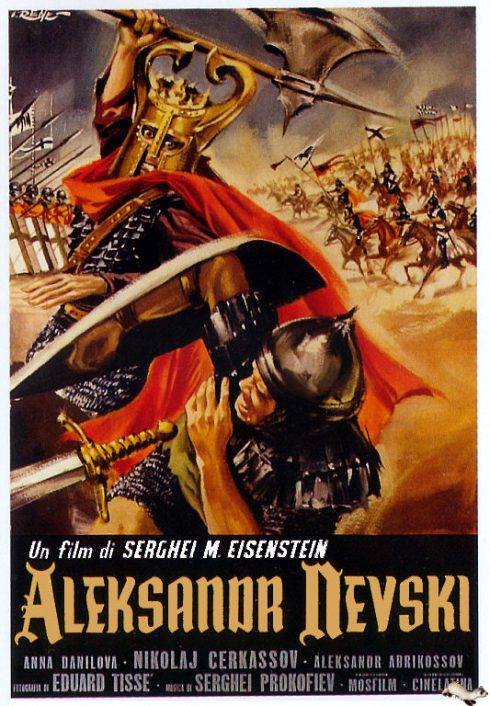
Sergei Eisenstein’s “Alexander Nevsky” (1938) invariably turns up on lists of the greatest films ever made. Nevsky, the 13th century Russian prince, military leader and saint, thwarts the attempted invasion of Novgorod by Teutonic Knights of the Holy Roman Empire.
Sergei Prokofiev arranged his masterful score into a concert piece, a cantata. However, these days, orchestras seem to be performing it more and more as it was originally heard, with the film. It’s a powerful piece of work. The marriage of music and visuals for the famous Battle on the Ice is one of the film’s great highlights.
If you think we’ve got it bad, try facing down a patriotic Nevsky on a frozen lake! I hope you’ll join me for music from these classics of Soviet cinema, this Friday evening at 6:00 EST, on WWFM – The Classical Network and wwfm.org.
Leave a Reply