Tag: Shostakovich

  • Shostakovich, Grief and Jewish Song

    Shostakovich, Grief and Jewish Song

    When Shostakovich’s birthday elides with Yom Kippur, you get a very somber post indeed.

    Shostakovich always felt a special kinship with the Jewish people and, while he himself was not of the faith, he pushed back against antisemitism, either overtly, defending friends and colleagues, such as the composer Mieczyslaw Weinberg, from persecution, or more stealthily, by embracing Jewish influences in his own music.

    This took real courage, as Shostakovich’s own standing with the Soviet authorities was a precarious one. He would be condemned several times over the course of his career for “formalism,” an amorphous term that could be molded to suit anything that might be described as Western, modernist, or otherwise subversive to the cause of Socialist Realism – uncomplicated art of direct and inspirational nature, easily digestible to the proletariat.

    In 1943, having scored a great patriotic success with his Symphony No. 7, the “Leningrad Symphony,” performed in the city during the actual siege, Shostakovich set to work on the more profoundly introspective Piano Trio No. 2. This he dedicated to the memory of his close friend Ivan Sollertinsky. Like Shostakovich, Sollertinsky had been evacuated from Leningrad, but he died suddenly in Siberia, of a heart attack, at the age of 41.

    Shostakovich mourned as only he could. The Piano Trio shares in common with the later String Quartet No. 8 an inexorable, klezmer-influenced “danse macabre.” Among Sollertinsky’s many talents and pursuits – as a musicologist, a critic, a linguist, a professor, and the artistic director of the Leningrad Philharmonic – he was an ardent enthusiast of the music of Gustav Mahler.

    It was also a time, with the retreat of the Nazis from the Eastern Front, when the horrors of the camps at Majdanek and Treblinka were just becoming known. It’s been observed that the klezmer influence may also be an allusion to Sollertinsky’s birthplace of Vitebsk, where a Nazi massacre of Jews had taken place in 1941.

    Shostakovich’s political capital must have been high, because the work was awarded a Stalin State Prize in 1946.

    In 1948, things were considerably shakier, as Shostakovich had been denounced, under the Zhdanov decree, for the second time. Furthermore, it was a period of heightened antisemitism in the Soviet Union, as Stalin targeted Jewish intellectuals and artists. So it was at great personal risk to himself that Shostakovich conceived the song cycle “From Jewish Folk Poetry.” Unsurprisingly, the songs were not given their first public performance until 1955, two years after Stalin’s death. However, the first eight of them were performed at a private birthday celebration at the composer’s home in August of 1948.

    While Shostakovich’s on-again, off-again history with the Soviet authorities made him justifiably cautious, the String Quartet No. 4 grew out of a newfound confidence, the result of Stalin having personally selected him as a cultural ambassador to the West. He would travel to the United States for the first time, as part of a Soviet delegation to a “Cultural and Scientific Congress for World Peace,” on March 25, 1949. As always, the situation had to be navigated very carefully. A sign of favoritism from Papa Joe often had the effect of setting a recipient up for a very big fall.

    Still, Shostakovich was determined to leverage his new-found currency. He took the opportunity to persuade Stalin that if he were going to be sent out into the decadent West, then perhaps it would be a good idea to lift the ban on performances of his music at home. Otherwise, the situation might appear a little peculiar to outsiders. Stalin recognized the logic in this, and Shostakovich was rehabilitated.

    Shostakovich was not by any measure a stupid man. Yet the artistic impulse was not to be denied. He wasted no time in embarking on a new string quartet, which he loaded up with inscrutable subtexts, Jewish folk songs, and all sorts of things that had a history of angering the “wise leader and teacher.” Fortunately for the composer, after the quartet was played before a small audience of increasingly uneasy friends on May 15, 1950, they convinced him not to allow it to be performed publicly, and he prudently put it away in a drawer for another day. That other day would come on December 3, 1953 – nine months after Stalin was safely interred.

    Even with the death of Stalin, the skies did not entirely clear. As late as 1962, there was political blowback, when Shostakovich decided to set poetry by Yevgeny Yevtushenko in his Symphony No. 13, known as the “Babi Yar” – the site of another sustained massacre of Jews in 1941. Yevtushenko at the time had become the object of a campaign to discredit him for supposedly placing the suffering of the Jewish people above that of Russians. Khrushchev himself threatened to halt the symphony’s performance. In the event, the premiere was tense, but the audience was sympathetic and the occasion was a triumph. However, by the third performance, Yevtushenko had supplied revisions to the text for some of the more controversial passages.

    Whether as an act of solidarity or a gesture of subversion, Shostakovich would often incorporate Jewish music or treat Jewish subjects in his major works. How could he not empathize with a people who had endured such suffering, yet expressed themselves so poignantly in music?

    Happy Yom Kippur birthday, Dmitri Shostakovich.


    Piano Trio No. 2, with Shostakovich at the piano

    String Quartet No. 4

    “From Jewish Folk Poetry,” with Shostakovich at the piano

    Symphony No. 13 “Babi Yar,” with Yevtushenko’s original texts


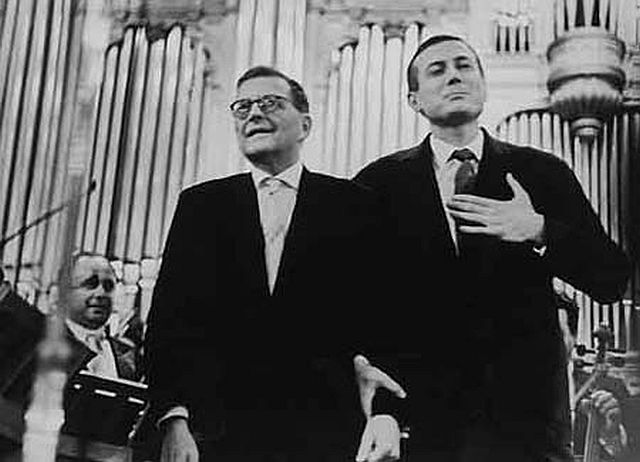
    PHOTO: Shostakovich and Yevtushenko at the premiere of the Symphony No. 13 “Babi Yar”
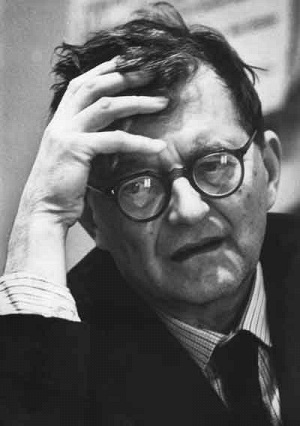
  • Shostakovich Plays Shostakovich

    Shostakovich Plays Shostakovich

    As I mentioned last week, Dmitri Shostakovich was a fabulous pianist, who began serious studies at the age of 9. He continued, formally, at the Petrograd Conservatory, upon his acceptance there, at the age of 13. Once he began to receive international attention for his original compositions, for works such as his Symphony No. 1, written when he was only 19, his principal focus began to shift. He did, however, continue to perform and record his own music.

    This Sunday night on “The Lost Chord,” we’ll revisit a 5-CD set, “Shostakovich Plays Shostakovich,” issued on the Melodiya label, made up of Russian state recordings set down largely between 1946 and 1958, with the composer himself at the piano.

    The documents in this box are riveting, not only for the musicianship they document, but also because of their biographical fascination and their sense of history.

    By way of example, we’ll hear a harrowing account of the Piano Trio No. 2 in E minor. Given its premiere only months after the liberation of Leningrad, the trio predates Shostakovich’s String Quartet No. 8. Both share in common a kind of inexorable, klezmer-inflected danse macabre. Shostakovich always felt a special kinship with the Jewish people. Furthermore, the trio is dedicated to his friend, Ivan Sollertinsky, artistic director of the Leningrad Philharmonic, who was an enthusiast of the music of Gustav Mahler. Sollertinsky died of a heart attack in Siberia, following his evacuation during the Siege of Leningrad.

    In 1947, Shostakovich sat down in front of the microphones to record the work, with violinist David Oistrakh and cellist Miloš Sádlo.

    On a lighter note, “Children’s Notebook” is a collection of trifles (March, Waltz, Sad Tale, Merry Tale, The Bear, The Clockwork Doll, and Birthday). However, they certainly take on added interest when introduced by the composer, as they will be tonight.

    The hour will open with the Concertino for Two Pianos – performed by Shostakovich and his son, Maxim – and conclude with the Piano Concerto No. 2, written for Maxim’s 19th birthday. Maxim introduced the concerto at his graduation from the Moscow Conservatory. Here, Shostakovich himself performs at the conservatory’s Grand Hall, at fever pitch, with the Moscow Radio Symphony conducted by Alexander Gauk.

    In America, artists play with authority. In Soviet Russia, authorities play with you!

    Shostakovich gets all keyed up, on “Black and White and Red Redux,” four more recordings with the composer at the keyboard, this Sunday night at 10:00 EST, on WWFM – The Classical Network and wwfm.org.


    In case you missed it, here’s a link to Part One, “Black and White and Red All Over,” posted as a webcast:

    https://www.wwfm.org/webcasts/2020-01-30/the-lost-chord-february-2-black-and-white-and-red-all-over

  • Shostakovich Plays Shostakovich: A Lost Chord

    Shostakovich Plays Shostakovich: A Lost Chord

    Of the great composers, none enjoyed football more than Dmitri Shostakovich. Russian football, that is. On one occasion he even invited the entire Leningrad Dynamo over to his apartment for dinner.

    This Sunday night on “The Lost Chord,” coinciding with the NFL playoffs, we’ll hear selections from a 5-CD boxed set, on the Melodiya label, of Russian state recordings of Shostakovich performing his own music.

    Admittedly, emphasizing Shostakovich’s rabid enthusiasm for football is something of a bait-and-switch. The show has nothing at all to do with the sport. However, Shostakovich really did love football (i.e. soccer) and all kinds of sports and games of chance.

    Concerning the show itself, Shostakovich was a fabulous pianist, who, early on, eked out a living with his improvisations at a local cinema. He began serious studies at the age of 9, and continued, formally, at the Petrograd Conservatory, upon his acceptance there, at the age of 13. Once he began to receive international attention for his original compositions, for works such as his Symphony No. 1, written when he was only 19, his principal focus began to shift. He did, however, continue to perform and record his own music.

    The documents in this Melodiya set, “Shostakovich Plays Shostakovich,” are riveting, not only for the musicianship they enshrine, but also on account of their biographical fascination and their sense of history.

    Perhaps no Shostakovich recording is imbued with a greater sense of time and place than a 1954 performance of his Symphony No. 10. An arrangement, for piano four-hands, was played by the composer at his apartment with his close friend and neighbor Mieczyslaw Weinberg.

    Weinberg found himself in a very precarious situation only the year before. He was arrested on a charge of “Jewish bourgeois nationalism,” in connection with the so-called Doctor’s Plot, at the command of Stalin himself, on the pretense that Jewish doctors were planning to assassinate Soviet officials. Weinberg’s father-in-law had been implicated, and killed. Shostakovich attempted to intercede on his friend’s behalf, but it was only with the sudden and fortuitous death of Stalin in 1953 that Weinberg was officially rehabilitated, and released.

    In a piece of living history, these two artists sit down to perform on Shostakovich’s home piano. This is music that was claimed, in Solomon Volkov’s “Testimony,” Shostakovich’s alleged memoir, to be about Stalin and the Stalin years.

    The pianos used in some of these recordings may be a little rough around the edges, but they only lend to the neurotic intensity of the music-making. It’s also a kind of window into what it must have been like to have been a musician in Soviet Russia, between 1946 and 1958, commandeering whatever means of expression you could lay your hands on.

    I hope you’ll join me for “Black and White and Red All Over.” Shostakovich tickles the keys, this Sunday night at 10:00 EST, on WWFM – The Classical Network and wwfm.org.


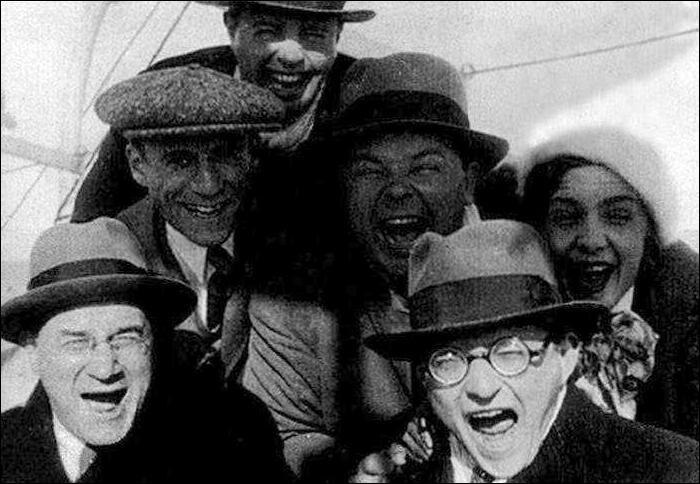
    PHOTO: Shostakovich (lower right), with fellow Soviet football fans

  • Aram Khachaturian’s Birthday Celebrate the Sabre Dance

    Aram Khachaturian’s Birthday Celebrate the Sabre Dance

    Today is the birthday of Aram Khachaturian. You know, the guy who wrote that frenetic music that makes you want to spin plates on sticks.

    Here’s the “Sabre Dance,” with Khachaturian conducting:

    Liberace gives it a whirl:

    Mstislav Rostropovich, the soloist, with again the composer conducting (and highly-decorated), in Khachaturian’s “Concerto-Rhapsody”

    Adagio from the ballet “Spartacus”

    https://www.youtube.com/watch?v=wXsDsLHasWo

    Cristian Macelaru and the West German Radio Symphony Orchestra in a mesmerizing visual fantasy on the Romance from Khachaturian’s “Masquerade Suite”

    Khachaturian at the piano!

    Happy birthday, Aram Khachaturian!


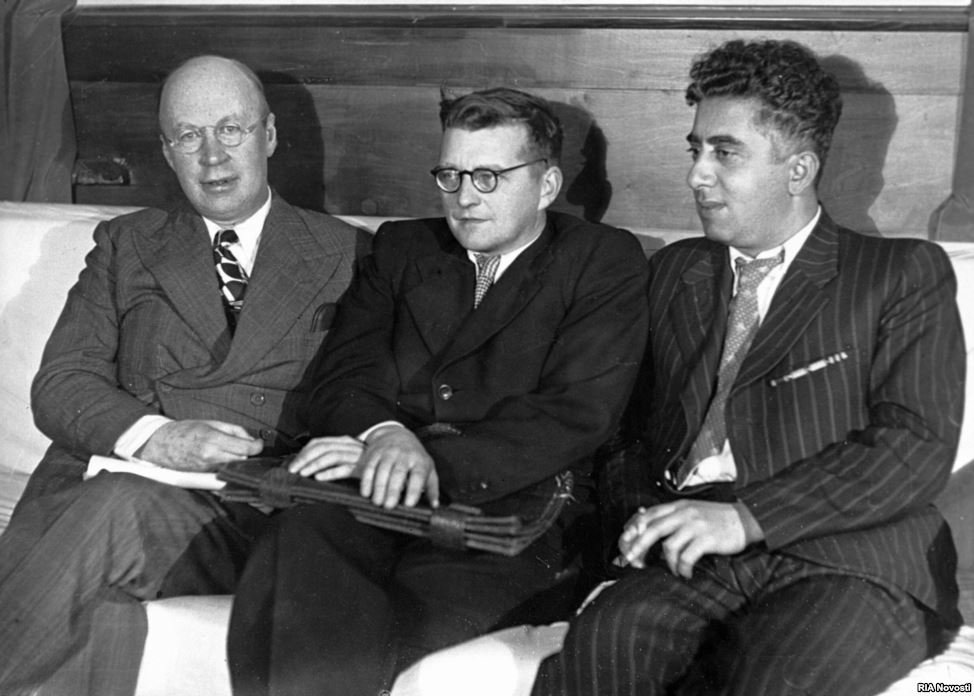
    PHOTO: Troika! (Right to left) Khachaturian with Shostakovich and Prokofiev

  • Alexander Toradze Pianist Dies at 69

    Alexander Toradze Pianist Dies at 69

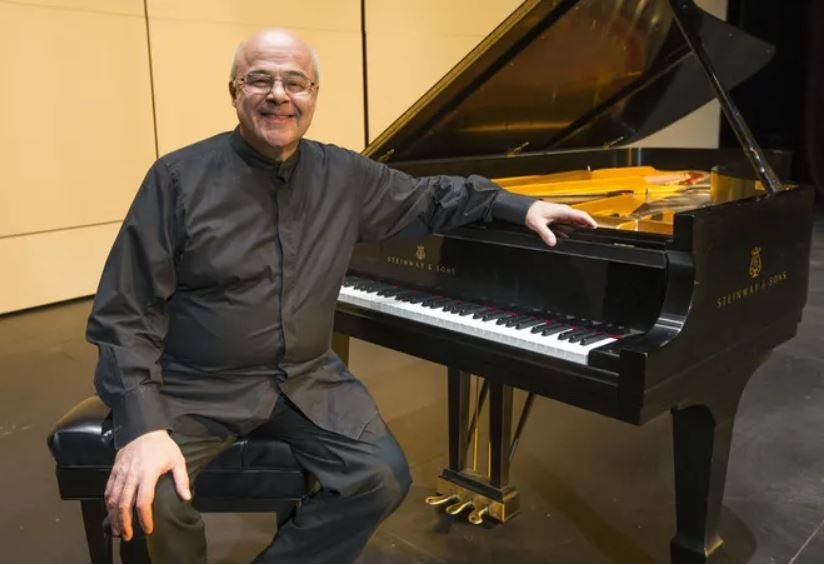
    The Georgian pianist Alexander Toradze has died.

    On April 23, Toradze suffered heart failure in Vancouver, Washington, in the middle of a performance of Shostakovich’s Piano Concerto No. 2. Incredibly, he finished the piece. Then he went to the hospital. It was only then that he learned what had happened.

    Not long after, he posted a message from his bed, in which he was evidently in great spirits – even lauding his doctor, who was still in the room – and full of optimism for a speedy recovery.

    Toradze was professor of piano at University of Indiana University South Bend from 1991 until his retirement from teaching in 2017. He made his home in the United States since 1983.

    As a performer, he was a powerhouse especially in the Russian repertoire. Also on the Vancouver program was Stravinsky’s Concerto for Piano and Wind Instruments. In a comparison of 70 recordings, his performance of Prokofiev’s Piano Concerto No. 3 was selected by International Piano Quarterly as “historically the best on record.”

    Toradze offered the following advice to aspiring pianists in an interview with classical radio host Bruce Duffie: “Don’t forget to pray to God before each performance, and don’t forget to give your soul enough air. Believe in the right purpose of art and believe in being human.”

    http://www.bruceduffie.com/toradze.html

    Toradze died on Tuesday. May 30 would have been his 70th birthday. Dasvidaniya, Lexo.


    In conversation with Joseph Horowitz

    The finale of Prokofiev’s Piano Sonata No. 7

    The lyrical heart of Shostakovich’s Piano Concerto No. 2

Tag Cloud

Aaron Copland (92) Beethoven (95) Composer (114) Film Music (120) Film Score (143) Film Scores (255) Halloween (94) John Williams (185) KWAX (229) Leonard Bernstein (100) Marlboro Music Festival (125) Movie Music (135) Opera (198) Philadelphia Orchestra (88) Picture Perfect (174) Princeton Symphony Orchestra (106) Radio (87) Ralph Vaughan Williams (85) Ross Amico (244) Roy's Tie-Dye Sci-Fi Corner (290) The Classical Network (101) The Lost Chord (268) Vaughan Williams (103) WPRB (396) WWFM (881)

DON’T MISS A BEAT

Receive a weekly digest every Sunday at noon by signing up here


RECENT POSTS