Tag: Sophie Menter

  • Liszt & Friends A Collaborative Genius

    Liszt & Friends A Collaborative Genius

    Sometimes even Romantic geniuses can use a hand.

    This Sunday night on “The Lost Chord,” we’ll hear several works on which Franz Liszt was aided and abetted by his peers.

    While it’s true that, early on, Liszt possessed a degree of insecurity over his abilities as an orchestrator, enlisting the aid of pupils like Joachim Raff and Franz Doppler during his years as Kapellmeister Extraordinaire in Weimar– after all, the bulk of his experience had been as a keyboard composer – he soon mastered the art himself and set about revising every bar, stamping his early orchestral works very much with his own distinctive voice.

    The story behind Liszt’s “Concerto in the Hungarian Style,” however, is quite a different matter.

    German pianist Sophie Menter studied with Liszt in Weimar, beginning in 1869. Her gift was such that Liszt dubbed her “the greatest pianist of her day.” He admired her “singing hand” and called her his “only legitimate daughter as a pianist.” George Bernard Shaw compared her favorably to Paderewski. She was by Liszt’s side in Bayreuth when he died in 1886.

    Menter taught at the St. Petersburg Conservatory between 1883 and 1887. There, she became friendly with Tchaikovsky and convinced him to orchestrate a piano concerto she claimed to have written to showcase her talents as a performer. Tchaikovsky did so and also dedicated the orchestral score of his own “Concert Fantasy” to her.

    What he didn’t realize, and what is now widely believed – thanks to fellow Liszt pupil and Menter confidante Vera Timanoff – is that the piece was actually written, at least in part, by Liszt himself. Had Tchaikovsky known, he may very well have torn up the manuscript. He had come to loathe Liszt, and was particularly disgusted by Liszt’s transcription of the Polonaise from “Eugene Onegin.” But the truth – if truth it be – didn’t emerge, for nearly a hundred years, and Tchaikovsky conducted the first performance of the work in Odessa in 1893.

    Roll over Beethoven, tell Tchaikovsky the news!

    Alongside this colorful concerto by Menter’s mentor, we’ll also hear “The Black Gondola,” orchestrated by John Adams, about a century after Liszt’s death; “Hexameron,” a titanic set of piano variations with contributions from six virtuoso superstars of the 1830s, including Liszt, Carl Czerny, Sigismond Thalberg, and Frederic Chopin; and a selection from the ballet “Apparitions,” engineered in 1936 by Constant Lambert and Gordon Jacob.

    Liszt gets by with a little help from his friends, on “An Assist for Liszt,” this Sunday night at 10:00 EDT, on WWFM – The Classical Network and wwfm.org.
  • Liszt’s Lost Concertos & Musical Secrets

    Liszt’s Lost Concertos & Musical Secrets

    When Franz Liszt died in 1883, his housekeeper allowed his students to go through his belongings and carry off manuscripts to keep as mementos. Just over a hundred years later, in 1989, parts of a previously unknown piano concerto were retrieved from Weimar, Nuremberg, and Leningrad. These were reunited by University of Chicago doctoral candidate Jay Rosenblatt.

    Scholars had simply assumed that the fragments were from an early draft of the much-beloved Piano Concerto No. 1. In reality, it is a “Third Piano Concerto” now believed to predate the accepted two. The work has not entered the standard repertoire, but it remains an interesting curiosity.

    One of the few pianists to take up the piece has been Rosenblatt’s teacher, Jerome Lowenthal, born in Philadelphia on this date in 1932. Here is Lowenthal’s recording of the work:

    Interestingly, it took the better part of a century for the truth about another lesser-known Liszt concerto to emerge.

    Sophie Menter had studied with Liszt in Weimar, beginning in 1869. So gifted a musician was she that Liszt described her as “the greatest pianist of her day.” He praised her “singing hand” and called her his “only legitimate daughter as a pianist.” She was by her teacher’s side when he died in Bayreuth in 1886.

    At the time, she held a professorship at the St. Petersburg Conservatory There, she became friendly with Peter Ilych Tchaikovsky. She asked Tchaikovsky to orchestrate a piano concerto she claimed that she herself had written, to showcase her talents as a performer. Tchaikovsky agreed, and also dedicated his own “Concert Fantasy for Piano and Orchestra” to her.

    What he didn’t realize is that the concerto – according to Menter’s friend, fellow Liszt pupil Vera Timanoff, to whom Menter allegedly confided – was actually composed by Liszt. Had Tchaikovsky known, he might very well have torn up the manuscript. He loathed Liszt, and was especially disgusted by Liszt’s transcription of the Polonaise from “Eugene Onegin.” As it was, Tchaikovsky conducted the work’s first performance in Odessa in 1893.

    Here is the “Concerto in the Hungarian Style” – formerly known as the “Sophie Menter Concerto” – performed by Janina Fialkowska, the same pianist who gave the first public performance of Liszt’s “Third Piano Concerto” in 1990:

    As an addendum, György Cziffra plays the Liszt transcription that Tchaikovsky so despised.

    In classical music, sometimes it’s not so much who you know, as who you don’t know that matters!


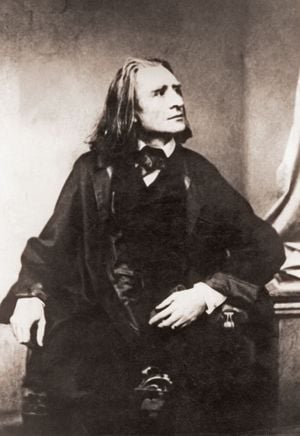
    Clockwise from left: Franz Liszt, Sophie Menter, Janina Fialkowska, and birthday boy Jerome Lowenthal

  • Liszt and Friends Collaborative Classics

    Liszt and Friends Collaborative Classics

    Sometimes even Romantic geniuses can use an extra hand.

    This Sunday night on “The Lost Chord,” on the eve of the anniversary of the birth of Franz Liszt (born October 22, 1811), we’ll have several works in which Liszt was aided and abetted by his peers.

    While it’s true that, early on, Liszt possessed a degree of insecurity over his ability to orchestrate – after all, he had been largely a “keyboard” composer, enlisting the aid of pupils like Joachim Raff and Franz Doppler during his years as a conductor in Weimar – Liszt quickly mastered the art himself and set about revising every bar of his earlier orchestral compositions, stamping them very much with his own distinctive voice.

    The story behind Liszt’s “Concerto in the Hungarian Style,” however, is quite a different matter.

    German pianist Sophie Menter studied with Liszt in Weimar, from 1869. Her gift was such that Liszt dubbed her “the greatest pianist of her day.” He admired her “singing hand” and called her his “only legitimate daughter as a pianist.” George Bernard Shaw compared her favorably to Paderewski. She was by Liszt’s side in Bayreuth when he died in 1886.

    Menter taught at the St. Petersburg Conservatory between 1883 and 1887. There, she became friendly with Tchaikovsky and convinced him to orchestrate a piano concerto she said she had written to showcase her talents as a performer. Tchaikovsky did so and also dedicated the orchestral score of his own “Concert Fantasy” to her.

    What he didn’t realize – and what is now widely believed (according to Menter, who confided it to a friend and fellow Liszt pupil, Vera Timanoff) – is that the piece was actually written, at least in part, by Liszt himself. Had Tchaikovsky known, he may very well have torn up the manuscript. He had come to loathe Liszt, and was particularly disgusted by Liszt’s transcription of the Polonaise from “Eugene Onegin.” But the truth – if truth it be – didn’t emerge, for nearly a hundred years, and Tchaikovsky conducted the first performance of the work in Odessa in 1893.

    Roll over Beethoven, tell Tchaikovsky the news…

    Alongside this colorful concerto by Menter’s mentor, we’ll also hear “The Black Gondola” (orchestrated by John Adams about a century after Liszt’s death); “Hexameron,” a titanic set of piano variations with contributions from six virtuoso superstars of the 1830s, including Liszt, Carl Czerny, Sigismond Thalberg, and Frederic Chopin; and a selection from the ballet “Apparitions,” engineered in 1936 by Constant Lambert and Gordon Jacob.

    Liszt gets by with a little help from his friends, on “An Assist for Liszt,” this Sunday night at 10:00 EDT, on WWFM – The Classical Network and wwfm.org.

Tag Cloud

Aaron Copland (92) Beethoven (94) Composer (114) Film Music (117) Film Score (143) Film Scores (255) Halloween (94) John Williams (185) KWAX (228) Leonard Bernstein (99) Marlboro Music Festival (125) Movie Music (132) Opera (197) Philadelphia Orchestra (86) Picture Perfect (174) Princeton Symphony Orchestra (106) Radio (86) Ralph Vaughan Williams (85) Ross Amico (244) Roy's Tie-Dye Sci-Fi Corner (290) The Classical Network (101) The Lost Chord (268) Vaughan Williams (101) WPRB (396) WWFM (881)

DON’T MISS A BEAT

Receive a weekly digest every Sunday at noon by signing up here


RECENT POSTS