
Tag: St. Nicholas

  • Krampusnacht Creepy Christmas Traditions

    Krampusnacht Creepy Christmas Traditions

    Get ready, kids! It’s December 5. Krampusnacht. Have you been good this year?

    The eve of St. Nicholas Day kicks off a season of creepy Christmas traditions. Long-time followers of this page know I have a weakness for the whacked-out pagan lore that still surges beneath the anodyne veneer of the holidays. Christmas isn’t just about buying things. It’s about scaring the bejeezus out of your kids.

    What exactly is Krampus? He’s St. Nicholas’ dark helper. Horned, hairy and horrendously long-tongued, Krampus emerges from his Alpine domain to dole out corporal punishment to the young and the wicked. For milder offenses, there is the sting of the switch; but for the especially ill-behaved, there are chains, a short ride in a wicker basket, and then drowning in a stream or immolation by hellfire. When a naughty child hears the dull clatter of approaching cow-bells, he knows it’s all over. He only wishes his stocking were full of coal.

    Last year, Krampus became the subject of a major motion picture. It’s ironic that this ultimate expression of anti-commercialism would himself become commercialized. Then again, Krampus cards were once widely circulated, not only on Christmas, but also on Valentine’s Day. I can think of no better way to catch a sweetheart.

    Happy holidays, everyone! Get ready for Black Pete, the Yule Lads, and the Gävle goat. Wait a minute. Better strike that last one. This year’s Gävle goat, apparently, didn’t even last 24 hours. You can read the full, moving account here:

    http://www.npr.org/sections/thetwo-way/2016/11/30/503881528/swedish-revelers-get-their-goat-again-as-holiday-tradition-meets-annual-arson


    “A Krampus Carol” (incorporating a stop motion Krampus!):

    Family-friendly segment on the Krampus Renaissance in Bavaria, produced by The New York Times:

    A real, old-fashioned Krampuslauf:

    Pretty good Krampus carol (full text when you click on “show more”):

    Here comes Krampus:

    Nicholas and Krampus play “good cop/bad cop” with Tobias:

    Small child cowers behind door at 1:25:

    Academy Award-winner Christoph Waltz explains Krampus to Jimmy Fallon:

    The commercialization of Krampus:
  • St. Nicholas: From Saint to Santa in Song

    St. Nicholas: From Saint to Santa in Song

    The character of St. Nicholas underwent a remarkable transformation over the centuries from an austere though generous religious figure, to a gift-giving, jolly old elf. This Sunday night on “The Lost Chord,” we’ll have music reflective of both.

    The historical and legendary Nicholas, fourth century Bishop of Myra, is the patron saint of sailors, merchants, travelers, brewers, prisoners, prostitutes, Russia, and of course children. THAT Nicholas is celebrated for his secret acts of charity, even if he could be rather short-tempered and a bit severe. Nicholas is said to have punched a few heretics, on occasion.

    One famous episode tells of Nicholas saving three daughters of a poor man from a life of prostitution by tossing bags of gold down their chimney, thereby providing them with proper dowries. The episode is reflected in the familiar pawnbrokers’ symbol of three gold spheres suspended from a bar (and also the practice of hanging stockings by the chimney with care).

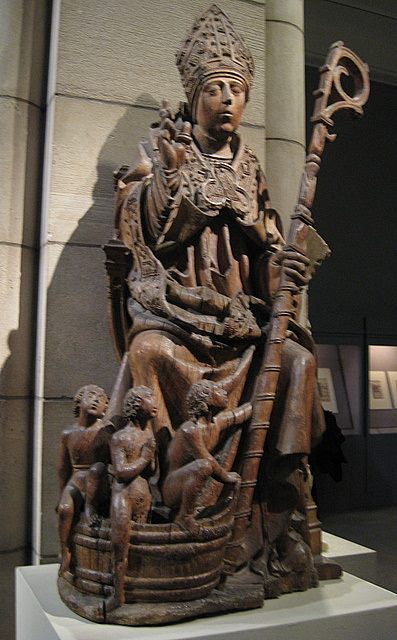
    Composer Joseph-Guy Ropartz, a native of Brittany, and a pupil of Jules Massenet and César Franck, focuses on another famous Nicholas legend, in “Le Miracle de Saint Nicholas,” composed in 1905 on a text by René Avril. Three boys are slain by a butcher, chopped up and pickled in brine, with the goal of passing them off as ham. Nicholas restores the youths, and the butcher repents. The same story would be set some 40 years later by Benjamin Britten, as part of his cantata, “Saint Nicholas.”

    Clement Moore’s poem, “A Visit from Saint Nicholas,” exemplified, and in many ways codified, the modern perception of St. Nicholas as Santa Claus. The work inspired, among other things, a symphony by William Henry Fry.

    Fry was born in Philadelphia in 1813. A pioneering figure in American music, he was the first native-born composer to write on a large scale. He composed orchestral works and the first opera by an American to be performed publicly in his lifetime (that would be “Leonora,” in 1845). He was an outspoken advocate of American music – that is, music composed by Americans – at a time when German imports ruled the roost. It would be decades before American music would gain a toehold in the concert halls, which makes Fry an even more remarkable figure.

    Fry studied music with a former bandleader in Napoleon Bonaparte’s army, who went on to become the head of Philadelphia’s Musical Fund Society. Fry himself would become the society’s secretary.

    He was also a journalist, a writer on music, and the first music critic to write for a major American newspaper. He was a foreign correspondent for the Philadelphia Public Ledger and acted as music critic for the New York Herald Tribune.

    Fry composed seven symphonies, all of them of a descriptive nature. His “Santa Claus Symphony,” of 1853, is more of a precursor to the Straussian tone poem, a detailed blow-by-blow of incidents enshrined in Moore’s verse.

    Both recordings were issued on the Naxos label (with the Ropartz originally appearing on Marco Polo). Interestingly, I’m noticing for the first time that the liner notes to the Fry disc are by my good friend Kile Smith!

    I hope you’ll join me for two faces of St. Nick, “Dr. Nicholas and Mr. Claus,” tonight at 10 ET, with a repeat Wednesday evening at 6; or that you’ll listen to it later as a webcast, at wwfm.org.


    PHOTO: After resurrecting dismembered boys from the dead, Saint Nicholas kicks back with a Coke and a smile

Tag Cloud

Aaron Copland (92) Beethoven (95) Composer (114) Film Music (120) Film Score (143) Film Scores (255) Halloween (94) John Williams (185) KWAX (229) Leonard Bernstein (100) Marlboro Music Festival (125) Movie Music (135) Opera (198) Philadelphia Orchestra (88) Picture Perfect (174) Princeton Symphony Orchestra (106) Radio (87) Ralph Vaughan Williams (85) Ross Amico (244) Roy's Tie-Dye Sci-Fi Corner (290) The Classical Network (101) The Lost Chord (268) Vaughan Williams (103) WPRB (396) WWFM (881)

DON’T MISS A BEAT

Receive a weekly digest every Sunday at noon by signing up here


RECENT POSTS