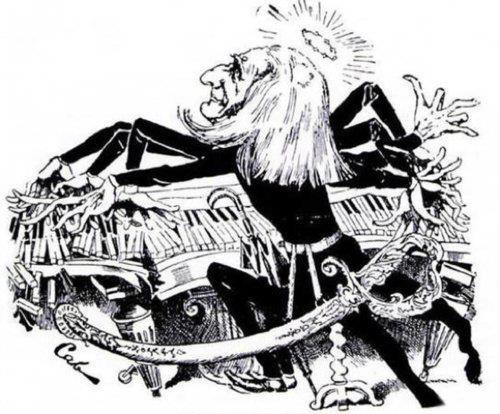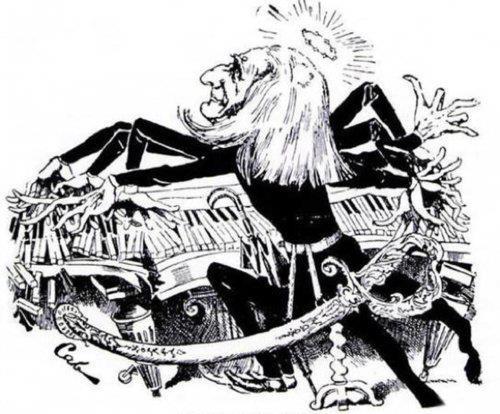
While the adjective “diabolical” could be applied to Franz Liszt, both in terms of his prowess as a pianist and as a ladies’ man, its application is justified, really, by only two aspects of his outsized personality.
Liszt was an especially complex individual, marked by much nobility of character. He was a generous human being, a humanitarian, and an all-around nice guy. He was also quite devout. It was his intention to marry his long-time companion, the Princess Carolyne zu Sayn-Wittgenstein, on his 50th birthday, but his hopes were dashed, after the Church refused to grant her an annulment (she had been estranged from her husband long before she met the handsome touring virtuoso). He reacted by taking minor orders and living in a monastic cell in Rome, where he became known as the Abbé Liszt. (He had also recently lost two of his three children born to him by Marie d’Agoult.)
Liszt’s religiosity was not something he wore lightly. From an early age, he felt certain he would be a musician or a priest. In the end, he became both.
This Sunday night on “The Lost Chord,” we’ll sample from two of at least seven of Liszt’s works inspired by his fascination with the saints – “The Legend of St. Elisabeth” and “St. Stanislaus.” St. Elisabeth was the Hungarian princess much concerned with the welfare of the poor, and St. Stanislaus the patron saint of Poland. These are the subjects of Liszt’s first and last oratorios.
I hope you’ll join me, on All Saints’ Day, for “Liszt of Saints,” this Sunday night at 10:00 EST, on WWFM – The Classical Network and wwfm.org.
THANK YOU to everyone who contributed to WWFM’s fall membership campaign. It’s because of listeners like you that The Classical Network is able to bring you homegrown specialty shows like “The Lost Chord.” If you haven’t had a chance to contribute and have been meaning to do so, you can still make your donation online at wwfm.org. You don’t have to be a saint to make a difference. Thanks again for your support of classical music on WWFM!