Even at Christmas, it seems, some people just want to get your goat.
How else to explain the continued desire to see one city’s oversized symbol of Christmas cheer go up in flames?
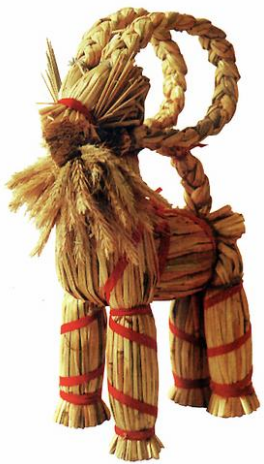
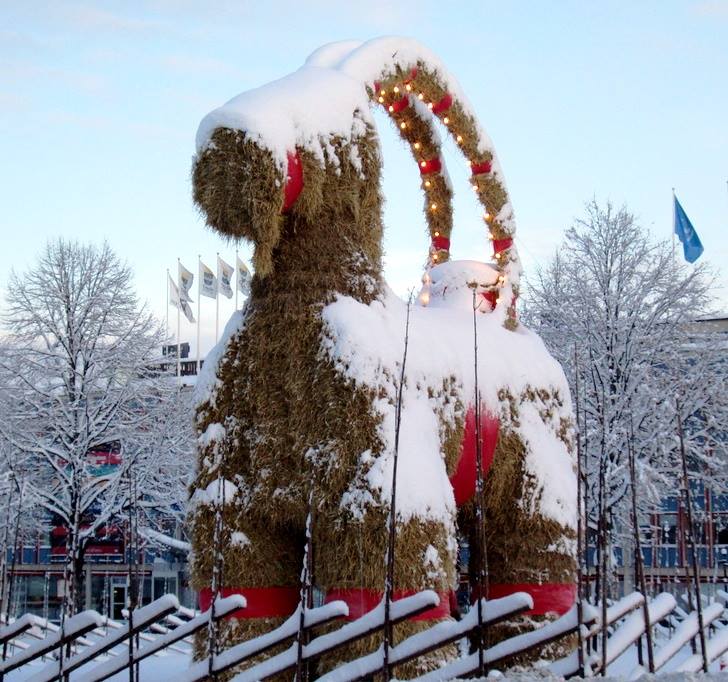
The Gävle Goat, basically a 40-foot version of those miniature tree ornaments you sometimes see, made of straw and bound by red ribbon, is erected annually in Castle Square, Gävle, Sweden. The Goat is constructed over a period of two days, just in time for Advent.
Then begins an unsanctioned game of cat-and-mouse, with the authorities attempting to guard the Goat, while everyone else attempts to light it off. If the Goat is burned to the ground before December 13 (today, St. Lucia’s Day), it is rebuilt.
This is all highly illegal, by the way. Neither the police nor the local businesses that rely on the Goat to draw tourists are terribly happy when there’s an immolation.
Nevertheless, over the years, the Goat has been damaged by fireworks, rammed by a Volvo, stomped to pieces, fired upon with flaming arrows (launched by vandals dressed as Santa and gingerbread men), and torched by a hapless American, who was egged-on by Swedes who convinced him that doing so was an accepted holiday tradition. (It’s not; he was fined $14,700 and spent a month in jail.) In 2010, there was even a failed attempt to abduct the Goat by helicopter.
In 2016, the Big Goat was set ablaze within hours of its construction. The catastrophe was timed to coincide with a security guard’s bathroom break. Then for four years, the Big Goat stood unmolested, the longest it has survived. A rival Natural Science Club Goat (only a kid by comparison), also located in Castle Square, did get singed a couple of times, but was not destroyed.
Last year, the streak ended, with both goats going up in flames. A 40-year-old man was implicated in the burning of the larger goat. He was sentenced to six months in prison and fined 109,000 Swedish kronor (10,691.93 U.S. dollars). That’s a lot of goat feed.
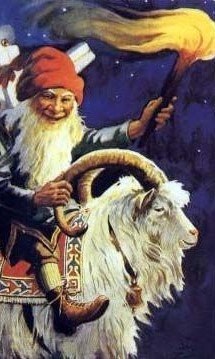
The Gävle Goat has been a Christmas staple since 1966, but its origins reach back into the shadowy past of Northern Europe, when wacky pagan traditions enlivened midwinter celebrations. The Yule Goat may have derived from the worship of Thor. The God of Thunder’s chariot was drawn by two goats. The Christmas version of the goat was led about by Saint Nicholas, possibly as a symbol of the subjugation of evil.
Whatever the goat’s function, it’s been around for hundreds of years. A time there was when rowdy young men in costumes would travel door to door to enact plays and demand gifts. One of these assumed the role of the ornery Yule Goat. For this reason, Scandinavians sometimes refer to the practice of wassailing as “going Yule Goat.”
In the 19th century, the Goat’s role was transformed into a giver of gifts. Though the Goat has since been replaced by a humanoid Father Christmas, in Finland he is still referred to by the name Joulupukki (literally Yule Goat).
The second, smaller goat appeared in Gävle in 1986. Well, it’s not always smaller. There were a couple of dust-ups early on as it attempted to usurp the Guinness title for “Largest Yule Goat.” But usually it’s smaller, at around 7-feet. The larger Goat is sponsored by the Southern Merchants. The little goat was added by the Natural Science Club of the School of Vasa. For the most part, the goats peacefully coexist.
In Sweden, Norway, and parts of Finland, St. Lucia’s Day is celebrated as a festival of lights, falling as it does so close to the winter solstice. Girls dress in white, wear a red sash around their waists (to signify Lucy’s martyrdom), carry a palm, and, most strikingly, wear a crown or wreath of candles on their heads.
St. Lucy makes an appearance today on the Goat’s Twitter feed. “I’ll make sure to watch from a safe distance,” writes the Goat. “I’m not really a fan of all the lit candles.”
You’ll find more information and a complete history of the Gävle Goat’s destruction here:
http://en.wikipedia.org/wiki/G%C3%A4vle_goat
Excellent time-lapse burning of the Goat:
Follow the Goat’s Twitter feed:
View the live webcam (note the security booth, just to the right of the Goat):
https://www.visitgavle.se/en/gavlebocken
And to keep it musical, a Christmas song by Swedish composer Hugo Alfvén: