Tag: Symphony No. 6

  • Richard Arnell Centenary on WPRB

    Richard Arnell Centenary on WPRB

    It’s all-Richard Arnell this Thursday morning on WPRB, on this, the eve of the centenary of his birth.

    My special guest will be Warren Cohen, music director of the MusicaNova Orchestra, who has conducted a good many of Arnell’s works, including all of the symphonies. In fact, MusicaNova will perform Arnell’s Symphony No. 6 on October 29th, in Phoenix, AZ, on the same program as Sir Malcolm Arnold’s Symphony No. 5 and Ralph Vaughan Williams’ Concerto Grosso for String Orchestra. You can learn more at http://musicanovaaz.com/orchest…/2017-18-orchestra-concerts/.

    Cohen will join me at 8:00 EDT. We’ll anticipate his visit by listening to his recording of Arnell’s Symphony No. 4, beginning around 7:35. It’s all the Arnell you can eat, until 11:00 EDT, on WPRB 103.3 FM and wprb.com.

  • Howard Hanson’s Bold Island Inspiration

    Howard Hanson’s Bold Island Inspiration

    For many people, having to work through vacation can be a real drag; but for the creative artist, vacation can be a time to really get things done.

    For 40 years, Howard Hanson was the director of the Eastman School of Music. In that capacity he nurtured and championed innumerable American composers, giving literally thousands of premieres at the helm of the Eastman-Rochester Orchestra, an ensemble he founded. The lucky ones found their way onto records, issued on the Mercury label.

    Hanson, of course, was himself a composer. He was awarded the Pulitzer Prize for Music in 1944, for his Symphony No. 4 “Requiem,” written in memory of his father. But his best known music, undoubtedly, is his Symphony No. 2 “Romantic,” composed in 1930.

    The famous “Hanson sound” is one of heart-on-the-sleeve romanticism, characterized by glowingly nostalgic melodies, though he also had his severe side. After all, he was born in Wahoo, Nebraska, to Swedish immigrants, and a certain Nordic austerity can be detected, especially in his later works.

    This Sunday night on “The Lost Chord,” we’ll be listening to three pieces inspired by Hanson’s summer home on Bold Island, which is located in the North Atlantic, off the coast of Maine. The major work will be the Symphony No. 6, written in 1967 for the New York Philharmonic and dedicated to Leonard Bernstein.

    The piece is more tightly argued than Hanson’s earlier, more famous symphonies, structured in six brief movements, built on a recurring motif. At times, it can sound a bit like Sibelius, though Hanson very much remains his own man. Hanson being Hanson, he doesn’t really skimp on the lyricism, but he doesn’t exactly indulge it to the same extent he does in the earlier works. Still, predictably, the symphony was derided as old-fashioned by the genuinely austere musical establishment of the day.

    The Bold Island connection is through Hanson’s “Summer Seascape No. 2,” written a few years earlier, and clearly the blueprint for the symphony. In fact, the opening of the symphony is identical.

    The first “Summer Seascape” was the centerpiece of the “Bold Island Suite,” a separate work composed in 1961. The suite also contains movements with the descriptive titles “Birds of the Sea” and “God in Nature.”

    For Howard Hanson, summer in the North Atlantic was clearly a time to give his Nordic sensibility free rein. I hope you’ll join me for “August Hanson,” tonight at 10 EDT on WWFM – The Classical Network; or that you’ll listen to it later as a webcast at wwfm.org.


    PHOTO: Not-very-austere Puffins off the coast of Maine

  • Atterberg’s Dollar Symphony Escapism

    Atterberg’s Dollar Symphony Escapism

    As the tax panic takes hold today, here’s a little musical escapism – the “Dollar Symphony” by the Swedish composer Kurt Atterberg.

    In 1928, Atterberg entered his Symphony No. 6 into a contest held by the Columbia Record Company in honor of the 100th anniversary of the death of Franz Schubert. He was awarded the first prize of $10,000. The work became known as the “Dollar Symphony.” It remains the composer’s most frequently-recorded piece, beginning with a commercial recording by Sir Thomas Beecham and a recorded broadcast by Arturo Toscanini.

    Atterberg was the winner of the international competition. In case you’re curious, divisional winners (by “zone”) included the now-forgotten English composer John St. Anthony Johnson, for his work, “Pax Vobiscum,” and the equally-forgotten American Charles Haubiel, for a piece called “Karma.”

    Franz Schmidt was recognized in Austria, for his Symphony No. 3. Havergal Brian won second prize in England, for the first three movements of his “Gothic Symphony.”

    You can find all the details here:

    http://en.wikipedia.org/wiki/1928_International_Columbia_Graphophone_Competition

    I don’t know, maybe you’re getting money back. If that’s the case, either you’ve got a good accountant, or you’re not a freelancer.

  • Hovhaness Celestial Gate Symphony Birthday Salute

    Hovhaness Celestial Gate Symphony Birthday Salute

    Busy day today. Here’s an eleventh hour salute to Alan Hovhaness (1911-2000) on his birthday – the Symphony No. 6, “Celestial Gate”:

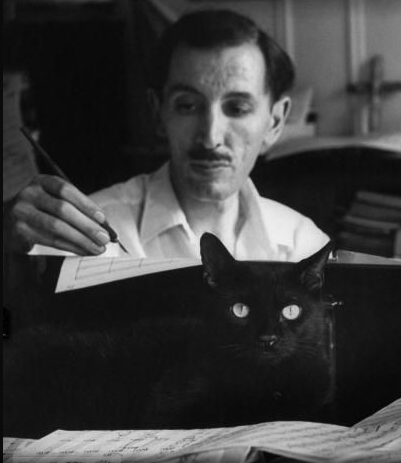
    PHOTO: Hovhaness with his cat, Rajah Mahatma Hoyden

  • Howard Hanson Bold Island Inspiration

    Howard Hanson Bold Island Inspiration

    For many people, having to work through vacation can be a real drag; but for the creative artist, vacation can be a time to really get things done.

    For 40 years, Howard Hanson was the director of the Eastman School of Music. In that capacity he nurtured and championed innumerable American composers, giving literally thousands of premieres at the helm of the Eastman-Rochester Orchestra, an ensemble he founded. The lucky ones found their way onto records, issued on the Mercury label.

    Hanson, of course, was himself a composer. He was awarded the Pulitzer Prize for Music in 1944, for his Symphony No. 4 “Requiem,” written in memory of his father. But his best known music, undoubtedly, is his Symphony No. 2 “Romantic,” composed in 1930.

    The famous “Hanson sound” is one of heart-on-the-sleeve romanticism, characterized by glowingly nostalgic melodies, though he also had his severe side. After all, he was born in Wahoo, Nebraska, to Swedish immigrants, and a certain Nordic austerity can be detected, especially in his later works.

    This Sunday night on “The Lost Chord,” we’ll be listening to three pieces inspired by Hanson’s summer home on Bold Island, which is located in the North Atlantic, off the coast of Maine. The major work will be the Symphony No. 6, written in 1967 for the New York Philharmonic and dedicated to Leonard Bernstein.

    The piece is more tightly argued than Hanson’s earlier, more famous symphonies, structured in six brief movements, built on a recurring motif. At times, it can sound a bit like Sibelius, though Hanson very much remains his own man. Hanson being Hanson, he doesn’t really skimp on the lyricism, but he doesn’t exactly indulge it to the same extent he does in the earlier works. Still, predictably, the symphony was derided as old-fashioned by the genuinely austere musical establishment of the day.

    The Bold Island connection is through Hanson’s “Summer Seascape No. 2,” written a few years earlier, and clearly the blueprint for the symphony. In fact, the opening of the symphony is identical.

    The first “Summer Seascape” was the centerpiece of the “Bold Island Suite,” a separate work composed in 1961. The suite also contains movements with the descriptive titles “Birds of the Sea” and “God in Nature.”

    For Howard Hanson, summer in the North Atlantic was clearly a time to give his Nordic sensibility free rein. Join me for “August Hanson,” tonight at 10 ET, with a repeat Friday morning at 3. You can also listen to the show later as a webcast at http://www.wwfm.org.

    PHOTO: Not-very-austere Puffins off the coast of Maine

Tag Cloud

Aaron Copland (92) Beethoven (95) Composer (114) Film Music (120) Film Score (143) Film Scores (255) Halloween (94) John Williams (185) KWAX (229) Leonard Bernstein (100) Marlboro Music Festival (125) Movie Music (135) Opera (198) Philadelphia Orchestra (88) Picture Perfect (174) Princeton Symphony Orchestra (106) Radio (87) Ralph Vaughan Williams (85) Ross Amico (244) Roy's Tie-Dye Sci-Fi Corner (290) The Classical Network (101) The Lost Chord (268) Vaughan Williams (103) WPRB (396) WWFM (881)

DON’T MISS A BEAT

Receive a weekly digest every Sunday at noon by signing up here


RECENT POSTS