Tag: Symphony No. 6

  • Rochberg: D-Day, Music, and Unlikely Heroism

    Rochberg: D-Day, Music, and Unlikely Heroism

    On the 80th anniversary of D-Day, my thoughts turn to American composer George Rochberg, who could write symphonies with the best of them, but was also a man of principle, who had real guts.

    Rochberg, born in Paterson, NJ, in 1918, was for decades a fixture at the University of Pennsylvania, where he chaired the music department until 1968. He continued to teach there until 1983.

    But his big claim to fame – or, in some circles, notoriety – is that he was one of the first composers of his kind to emerge from the strictures of serialism, predominant in academic circles from mid-century, to embrace a new tonality. The shift was brought on, it is said, by the untimely loss of his son, Paul, to a brain tumor in 1964.

    Rochberg felt the musical vocabulary he had been employing inadequate to express his grief and rage. Beginning with his String Quartet No. 3 in 1971, he began to incorporate tonal passages back into his music, much to the dismay of his academic peers. His String Quartet No. 6 of 1978 includes a set of variations on Pachelbel’s “Canon.” Horrors!

    Little did anyone realize at the time that this was the most avant-garde thing Rochberg could have done. He was the unwitting prophet of a new pluralism that went on to become the norm.

    What is perhaps not so well known is that Rochberg’s mettle had been tested well before the petty skirmishes of Ivory Tower politics, when he was thrown into the deep-end of one of the pivotal operations of World War II.

    Rochberg was drafted into the U.S. Army infantry in 1942. A lot of musicians fulfilled their military service by composing marches or playing in military bands. Many were never even shipped overseas. While Rochberg did have his share of musical assignments, he saw real action as part of George S. Patton’s Third Army during its perilous breakout from Normandy following D-Day in 1944.

    Amy Lynn Wlodarski writes about it in her book, “George Rochberg, American Composer: Personal Trauma and Artistic Creativity” (University of Rochester Press, 2019):

    “Nearly fifty years later, he could still vividly recall the ‘look of fear’ on the faces of the soldiers who had been wounded in the initial onslaught: ‘Walking away from the plane that had just landed on an airstrip on Omaha Beach… and seeing the wounded, walking and on stretchers, going to the same plane that had just taken us from England. The look in their eyes, a look I’d never seen before that day. Almost an animal look; glistening fear, anxiety, uncertainty radiating from their eyes.’ Upon arrival, his division was immediately dispatched to help with the second stage of the invasion, which involved breaking through the hedgerows in northern France, a deafening assault that required explosive charges to dislodge the thick, thorny bushes of the French countryside. The fatigue from constant marching and physical work was overwhelming despite nearly a full year of basic training: ‘I remember being dog-tired [at] night. Apparently I [once] slept through some minor bombing by German reconnaissance planes.’”

    Mangled feet were par for the course, but Rochberg himself wound up taking a bullet, the first of several substantial injuries he would receive in combat. His doctors remarked that if it had been the First World War, it would have cost him a leg.

    The accepted narrative is that the composer’s later grief over the death of his son motivated his drift toward a more communicative means of expression in his music. But Rochberg was always at heart a humanist, and already during the war, twenty years earlier, his worldview and aesthetic outlook were beginning to coalesce, as when he came to regard the destruction he witnessed at the town of Saint-Lô, where the Allies faced off against the Second SS Panzer Division of the German Army, as “a metaphor for the precarious state of Western culture.”

    Rochberg, of course, was not the only artist to think this way. The war left its indelible mark on all the arts. In music, especially, its devastation and sorrow were reflected in the creations of composers on all sides, as demonstrated in Jeremy Eichler’s recent, excellent book, “Time’s Echo: The Second World War, the Holocaust, and the Music of Remembrance” (Knopf, 2023).

    The varied experiences of Richard Strauss, Arnold Schoenberg, Dmitri Shostakovich, and Benjamin Britten are examined at some length. None of them actually “saw action,” although Shostakovich was present during the siege of Leningrad and Britten performed on site for survivors of Bergen-Belsen. Rochberg is not part of the narrative.

    Rochberg drafted a number of musical sketches during the European campaign. These later became the basis for his Symphony No. 6, completed in 1986. The work is tonal, yet harmonically extremely loose. I don’t believe it has even been recorded for commercial release. The linked performance is conducted by Raymond Leppard, which is interesting, since Leppard was regarded for so long as a Baroque specialist. But of course his repertoire was much broader than that, and he conducted a number of first performances of works by contemporary composers.

    There’s another recording on YouTube, taken from a concert with Leppard conducting the Saint Louis Symphony, but the sound isn’t as good. So we’ll stick with this one, with Leppard’s own orchestra, the Indianapolis Symphony, the orchestra he directed from 1987 to 2001.

    What’s with the video’s moon imagery is anyone’s guess.

    Rochberg died in Bryn Mawr, outside Philadelphia, in 2005. He left more than 100 works, including six symphonies, seven string quartets, and an opera, “The Confidence Man,” after Melville. At the time of his death, he was 86-years-old.

    His service is remembered, as is that of everyone who made the push through on D-Day possible, so that the free world could achieve victory over fascism.


    Symphony No. 2 (1955-1956), serial but, contrary to the composer’s later concerns, still emotionally expressive

    Pachelbel Variations from the String Quartet No. 6 (1978)

    Opening of the “Transcendental Variations” (1971-1972, the third movement of Rochberg’s String Quartet No. 3, transcribed for string orchestra in 1975)


    PHOTO: Wlodarski and the cover of her book, with Rochberg in uniform

  • Mahler Rattle and Reclaiming My 20s

    Mahler Rattle and Reclaiming My 20s

    Every time I listen to Mahler, I feel like I’m in my 20s again. The whiplash emotional states, the seething, the intensity, and romance. Actually, it’s all right there still, just beneath the surface, but I try to keep a lid on it these days. Now that I’m in my 50s, I’m too old to be storming heaven all the time and hurling myself into volcanoes.

    Even so, it’s nice to remember once in a while by revisiting the symphonies in concert, and last night Sir Simon Rattle brought one of the angstier ones to Philadelphia’s Kimmel Center for the Performing Arts, when he led the touring Bavarian Radio Symphony Orchestra in Mahler’s Symphony No. 6. Sometimes identified by the nickname the “Tragic,” this one has all the vertiginous highs and de profundis lows one expects from this composer – Mahler making good on his pronouncement (to Sibelius, no less) that a symphony must be like the world: it must embrace everything!

    So we get plenty of foreboding and ardent love music and weird macabre passages, crashing cymbals, and eerie harps, and most notoriously, that magnificent hammer delivering the blows of fate. Of course, I’m not convinced it always has quite the effect Mahler intended, as he was savagely lampooned for it in his lifetime, and even last night it elicited big grins and conspiratorial nods from the audience. When you want to suggest something very serious, it’s probably a good idea not to have your percussionist solemnly ascend stairs to a riser to swing a five-foot Bugs Bunny style circus mallet. That said, I wouldn’t have it any other way.

    I’ve seen Rattle conduct Mahler before, of course, in the days when Philadelphia was trying way too hard to land him as its next music director. Back then, he was certainly an effective interpreter, if sometimes prone to mannerisms (which I understand he may not yet have fully shaken, though they were not on display in yesterday’s performance), in particular his obsession with bringing the music’s pianissimos down to a ridiculously hushed level.

    None of that was in evidence last night, and it was satisfying to watch and hear the Bavarians rise to the occasion and ride a few killer waves, especially in the last movement. But for me, the ardent second movement was the most magically sustained, a passionate andante moderato played for all the sublimity it was worth. Rattle opted, as many do, for the composer’s original ordering of the movements, with the scherzo placed third. (Mahler had second thoughts after conducting the symphony’s first performance and decided to flip the scherzo and the andante.) In this movement, I swear, you can sense the love music for virtually every big budget fantasy movie of the 1980s – not quoted outright, necessarily, but completely in spirit. Back in the days when the movies were still wondrous and did wonderful things to your insides, much the way Mahler’s symphonies do.

    Hearing Mahler in concert also reminds me just how important it is to experience these things live. The composer was a master orchestrator, and the 6th is full of unusual touches (the strange duets between Masque-of-the-Red-Death harps and leviathan brass, the bird of prey multi-cymbal effect at the end, and of course, that carnival hammer (ring the bell and you win a cigar!) that just won’t have the same impact when listening on record. Also, in these days of attention deficit classical radio, when’s the last time you heard a complete Mahler symphony, if it doesn’t turn up on a broadcast concert?

    Bravo to Sir Simon, recalled again and again – at least five times – and his German musicians, who each embraced their neighbors as the applause finally began to subside in a kind of life-affirming group hug.

    I would be dead by now if I continued to live my life as tightly-wound as, and at the fever pitch conjured in, Mahler’s symphonies. But it’s nice to remember once in a while what it was like to seethe and combust.


    Beneath the authoritative gaze of Sir Simon: with fellow Mahlerite Robert Moran at the Kimmel – but who is that forehead-slapper photobombing us?

  • Sibelius Symphony No 6 A Century of Enigmatic Beauty

    Sibelius Symphony No 6 A Century of Enigmatic Beauty

    Jean Sibelius’ Symphony No. 6 was performed for the first time, in Helsinki under the composer’s baton, on this date 100 years ago. Kile Smith shares his thoughts on this gorgeous, enigmatic work (as might describe much of Sibelius’ greatest music), on this month’s “Fleisher Discoveries.”

    Sibelius noted that the symphony always reminded him of the first scent of snow. He also penned the descriptive phrase “When shadows lengthen.” It’s funny, I don’t find the work at all gloomy, but then I’ve always disliked the sun.

    The Symphony No. 6 is rarely encountered in U.S. concert halls. I think in my 40 years of attending orchestral concerts, I have heard it only once, on the same program with the equally underperformed Symphony No. 3 (with Osmo Vänskä, unsurprisingly, guest conducting in Philadelphia).

    Sibelius remarked, “Whereas most other modern composers are engaged in manufacturing cocktails of every hue and description, I offer the public cold spring water.” This from a man who knew a thing or two about libations! Listen to Sibelius’ Symphony No. 6, with Kile’s commentary, at the link.

    Fleisher Discoveries: Sibelius the Revolutionary


    PHOTO: Sibelius monument “Passio Musicae” (1967), located in Helsinki, by Elia Hiltunen

  • Rainy Day Music Vaughan Williams Symphonies

    Rainy Day Music Vaughan Williams Symphonies

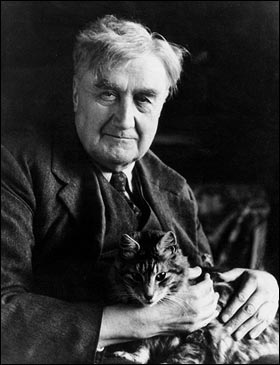
    A good rainy day. The perfect time to hunker down with Ralph Vaughan Williams.

    Here are links to two of his symphonies – the first, his most desolate, the Symphony No. 6, and the second, his most unambiguously hopeful, the Symphony No. 5. In common with the greatest classics, both exist outside of time – they are timeless – yet both speak perfectly to the present. Life in the time of Coronavirus

    Vaughan Williams’ Sixth Symphony (1944-47) is full of tension, turbulent, bleak, with a few wistful passages that seem to reflect on a lost world. Though the composer denied any extramusical program, the last movement has been interpreted by many as an aural portrait of the world laid waste. Some have attributed the barren atmosphere as a response to the atomic bomb.

    https://www.youtube.com/watch?v=I1suBbnp5Go

    The Symphony No. 5 (1938-43), by contrast, is a balm for the soul. Though completed at the height of World War II, the symphony is a musical celebration of the endurance of humanity and tradition against an implacable enemy. The work shares much in common with Vaughan Williams’ passion project, the opera “The Pilgrim’s Progress,” which he had already been writing for 30 years. Not only does it quote some of the opera’s themes, it also reflects its spirit. The piece is brimming with solace, hope, and indescribable beauty.

    Vaughan Williams dedicated the work to Jean Sibelius, “without permission and with the sincerest flattery.” When Sibelius heard the piece, he confided to the conductor Sir Adrian Boult, “This Symphony is a marvelous work… the dedication made me feel proud and grateful… I wonder if Dr. Williams has any idea of the pleasure he has given me?”

    Keep calm and carry on. Pour youself a cuppa. Listen to Ralph Vaughan Williams, and find your strength.

    https://www.youtube.com/watch?v=q9YoEETzYsE

  • Christopher Rouse Pulitzer Winner Dies at 70

    Christopher Rouse Pulitzer Winner Dies at 70

    The American composer Christopher Rouse has died. Rouse was the recipient of the Pulitzer Prize for Music in 1993 for his Trombone Concerto. His final work, his Symphony No. 6, will be given its world premiere by the Cincinnati Symphony Orchestra on October 18-19. A life-long Baltimore resident, Rouse was 70 years-old.

    https://www.broadwayworld.com/bwwclassical/article/Composer-Christopher-Rouse-Dies-At-Age-70-20190921

    Jasmine Choi plays Rouse’s Flute Concerto:

Tag Cloud

Aaron Copland (92) Beethoven (95) Composer (114) Film Music (120) Film Score (143) Film Scores (255) Halloween (94) John Williams (185) KWAX (229) Leonard Bernstein (100) Marlboro Music Festival (125) Movie Music (135) Opera (198) Philadelphia Orchestra (88) Picture Perfect (174) Princeton Symphony Orchestra (106) Radio (87) Ralph Vaughan Williams (85) Ross Amico (244) Roy's Tie-Dye Sci-Fi Corner (290) The Classical Network (101) The Lost Chord (268) Vaughan Williams (103) WPRB (396) WWFM (881)

DON’T MISS A BEAT

Receive a weekly digest every Sunday at noon by signing up here


RECENT POSTS