Tag: Symphony No. 8

  • Vaughan Williams Late Bloom Colorful Genius

    Vaughan Williams Late Bloom Colorful Genius

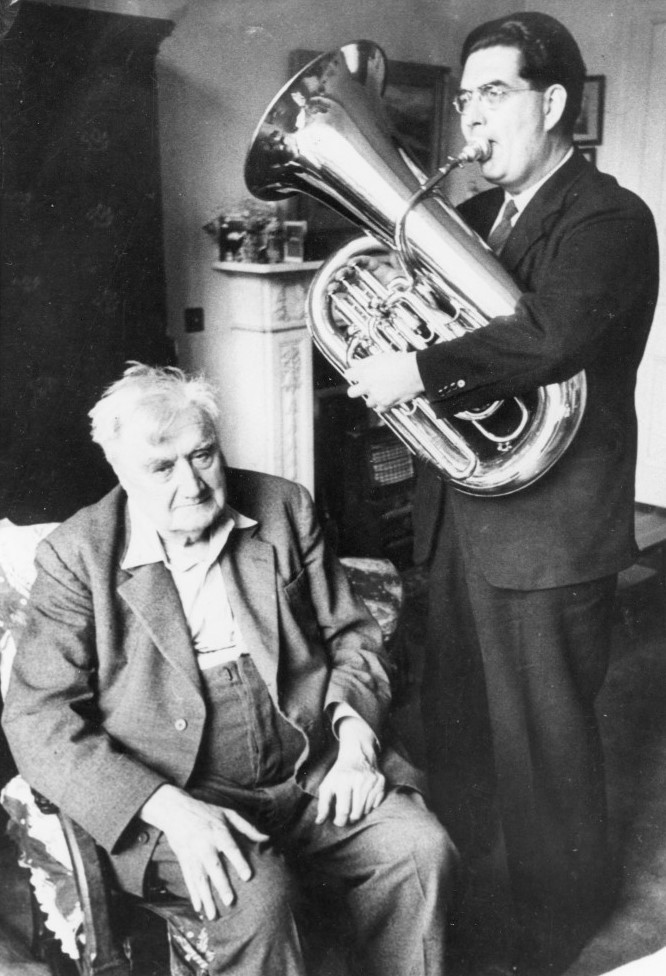
    Here’s Ralph Vaughan Williams, looking as miserable as you would imagine, being serenaded by the tuba. The composer wrote the first ever concerto for the instrument in 1954. A late and unusual work, the piece was dedicated to Philip Catelinet, principal tubist of the London Symphony Orchestra. “Glorious John” Barbirolli conducted the premiere. These are the forces heard on the work’s first recording. Listen here, for a tubby start to your Friday.

    BONUS! Vaughan Williams’ “Romance for Harmonica,” composed in 1952.

    Vaughan Williams seemed often to be in search of unusual timbres in his later years. Rather ironic, since by then he was severely deaf, the result of prolonged exposure to heavy artillery during World War I. But he was a true composer, a master of his craft, who didn’t have to hear what he wrote in order to know the sound. Moreover, as a pupil of Maurice Ravel, he never lost his sense of color.

    Take for example the exotic percussion in the outer movements of his Symphony No. 8, composed in 1953-54. (The second movement is scored for brass and the third for strings alone.) It’s heard here in a superb performance from perhaps an unlikely source, given the pervasive claims that the music of this quintessentially English composer does not “travel.” Nobody told Charles Munch and the Boston Symphony Orchestra.

    Or the insinuating saxophones and mysterious harps in the valedictory Symphony No. 9, written in 1956-57. Vaughan Williams died on the eve of the first recording session, with Sir Adrian Boult and the London Philharmonic Orchestra. Boult’s brief eulogy appears at the beginning of this world premiere recording.

    It’s extraordinary that a composer in his 80s would remain so vital and so full of invention. (RVW was 80 back when 80 was REALLY 80!) His symphonies, in particular, are among the greatest of the 20th century. And he never repeated himself. All nine have such a distinctive character, and there’s not a weak link in the bunch. Would that more of our music directors would get to know them.
  • Sibelius’s Lost Symphony No 8 & Nordic Influence

    Sibelius’s Lost Symphony No 8 & Nordic Influence

    Okay, this will probably be my last Sibelius post for the present. But I wrote most of it yesterday, and I don’t want it to go to waste!

    Even now, 64 years after his death, no composer has held as profound an influence over the cultures of the North. Given that Sibelius composed no major works for the last 30 years of his life, we’re talking about close to a century. That’s quite a long shadow.

    Here’s an interesting work by Norwegian composer Ragnar Søderlind (born 1945). His Symphony No. 8, “Jean Sibelius in memoriam,” was written in 2004-05. The symphony alludes to some of Sibelius’ own music, including the organ work “Surusoitto.” “Surusoitto” is thought to contain material from Sibelius’ own unreleased Eighth Symphony.

    Sibelius never completed his Symphony No. 8, or so he’d have us believe. Perhaps he just didn’t complete it to his satisfaction. After the Symphony No. 7 and the tone poem “Tapiola,” written in the mid-1920s, he’s said to have completed no further major works. But it certainly wasn’t for want of trying.

    At the very least, he grappled with the Eighth, the manuscript of which he is supposed to have destroyed. I heard as much from the mouth of his own grandson, who claimed to have been present at its burning. Did Sibelius finish it?

    Only within the past ten years, a few tantalizing sketches have surfaced, seemingly out of nowhere. Is it possible more could have survived? Perhaps somewhere, among the composer’s papers, a draft might even exist. I’m not in favor of “reconstruction” from mere fragments, but if there is a somewhat complete version of the symphony, even in embryonic form, it would be a thrill to be able to hear it.

    It makes my heart ache to listen to these sketches and contemplate that there actually could have been another Sibelius symphony. Had the composer only been able to defy his demons and hold it together one more time!

    Could it have topped his crowning achievement, the Seventh Symphony? Sibelius didn’t think so, which is why, likely, he consigned it to flames of woe.


    “Surusoitto” (“Funeral Music”) – does it contain material intended for the Symphony No. 8?

    https://www.youtube.com/watch?v=MFX8giq21S4

    The Symphony No. 7

  • Dvořák’s Symphony No. 8: A Celebration of Life

    Dvořák’s Symphony No. 8: A Celebration of Life

    This is one of those works that just makes you feel like it’s great to be alive.

    Antonin Dvořák composed his Symphony No. 8 over two months, from the end of August to the beginning of November, in happy seclusion at his country home of Vysoká, in 1889. The symphony is his most bucolic, cheery, and lyrical, steeped in the Bohemian folk song he adored.

    Dvořák himself conducted its first performance, at the National Theater in Prague, in 1890. He then took it to Frankfurt and Cambridge, where he was awarded an honorary doctorate. The symphony became a great favorite in England. In fact, it was published there, by the London firm of Novello, after the usual disagreements with Simrock, Dvořák’s regular publisher. Simrock preferred shorter, snappier works and insisted on marketing them in German. Dvořák, a proud Bohemian, found this increasingly annoying. Not incidentally, Simrock had also low-balled him on the price (offering one thousand marks, as opposed to the three thousand marks he had paid for the Symphony No. 7).

    In 1893, Dvořák was in America, as director of the National Conservatory of Music in New York, when he brought his new symphony to the World’s Columbian Exposition. At the time, the symphony was promoted as his Fourth. It was only in the 1950s, with the publication of Dvořák’s earlier works in the form, that the symphonies were renumbered, which is why there are now nine Dvořák symphonies, as opposed to five. At the world’s fair, Dvořák conducted his Eighth with an expanded Chicago Symphony Orchestra. According to the Chicago Tribune, the performance was met with enthusiasm, marked by “tremendous outbursts of applause.”

    The composer claimed that in its writing the melodies simply poured out of him. Here’s my favorite recording of the piece, made with the Columbia Symphony Orchestra, assembled specifically for the great Bruno Walter.

    Všechno nejlepší k narozeninám! Happy birthday, Dvořák!


    PHOTO: Composer and family, relaxing at Vysoká

  • Beethoven Liszt Symphony 8 Piano

    Beethoven Liszt Symphony 8 Piano

    BEETHOVEN BIRTHDAY BASH

    Curve ball!

    As an exercise in deferred gratification and an addendum to that period instrument performance of the Symphony No. 8, by Frans Brüggen and the Orchestra of the 18th Century, we’ll hear Franz Liszt’s transcription of the 8th for solo keyboard.

    NOW PLAYING: Beethoven/Liszt – Symphony No. 8 in F major (Cyprian Katsaris, piano)

    From authenticity to audacity!

    Stick around, our concluding Beethoven symphony, the Symphony No. 9 – the beloved “Choral” Symphony – is on its way, in a powerhouse performance that’s bound to make an impression.

    We want to impress upon you that you’re the one who helps make it happen, when you call us with your contribution at 1-888-232-1212 or donate online at wwfm.org.

    Beethoven’s on our Liszt, on WWFM – The Classical Network and wwfm.org.


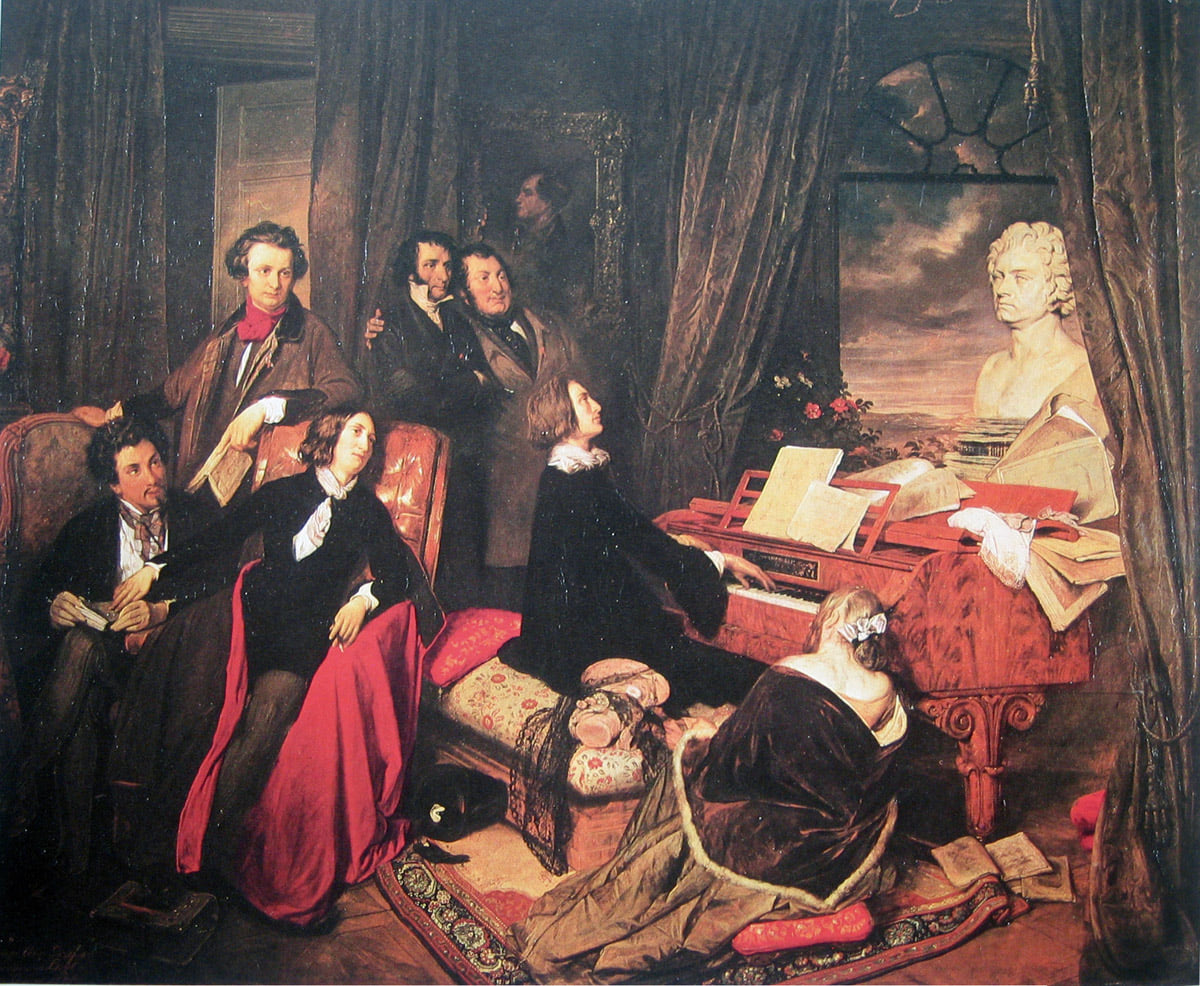
    “Franz Liszt Fantasizing at the Piano” (1840), Josef Danhauser

    Standing: Hector Berlioz, Niccolò Paganini, Gioachino Rossini

    Seated: Alexandre Dumas, George Sand, Liszt, Marie d’Agoult

    Bust: Beethoven

  • Beethoven’s 8th Symphony Subversive Masterpiece

    Beethoven’s 8th Symphony Subversive Masterpiece

    BEETHOVEN BIRTHDAY BASH

    WWFM – The Classical Network’s symphony marathon continues!

    NOW PLAYING: Symphony No. 8 in F major (Orchestra of the 18th Century/Frans Brüggen)

    Like the 4th Symphony, Beethoven’s 8th tends to be swallowed up in the long shadows cast by its neighbors. But this work, frequently dismissed as Haydnesque, is actually quite subversive. The composer deconstructs many of the practices of standard classical symphonic form, with most of the weight thrown onto the shoulders of the last movement, as opposed to the first, no real slow movement, and the return of the minuet, which Beethoven handily dispensed with in earlier symphonies through the inclusion of more volatile scherzos.

    Was Beethoven secretly the Stravinsky of his day?

    Show this sphinx some love. Consider supporting it by calling us at 1-888-232-1212, or by donating online at wwfm.org.

    Thank you for your generous contribution!


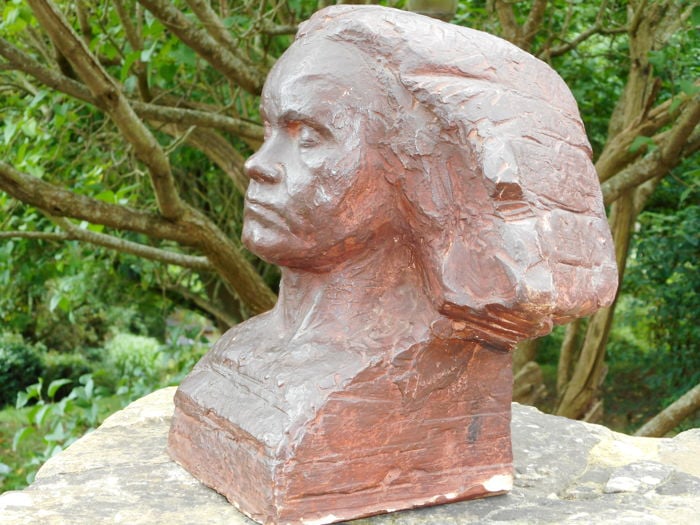
    “Beethoven in Sphinx,” Jules Jourdain (1873-1957)

Tag Cloud

Aaron Copland (92) Beethoven (94) Composer (114) Film Music (117) Film Score (143) Film Scores (255) Halloween (94) John Williams (185) KWAX (228) Leonard Bernstein (99) Marlboro Music Festival (125) Movie Music (132) Opera (197) Philadelphia Orchestra (86) Picture Perfect (174) Princeton Symphony Orchestra (106) Radio (86) Ralph Vaughan Williams (85) Ross Amico (244) Roy's Tie-Dye Sci-Fi Corner (290) The Classical Network (101) The Lost Chord (268) Vaughan Williams (101) WPRB (396) WWFM (881)

DON’T MISS A BEAT

Receive a weekly digest every Sunday at noon by signing up here


RECENT POSTS