Tag: Tapiola

  • Sibelius’ Silence Lost Symphony & Cigars

    Sibelius’ Silence Lost Symphony & Cigars

    EIGHT DAYS OF SIBELIUS – DAY 6

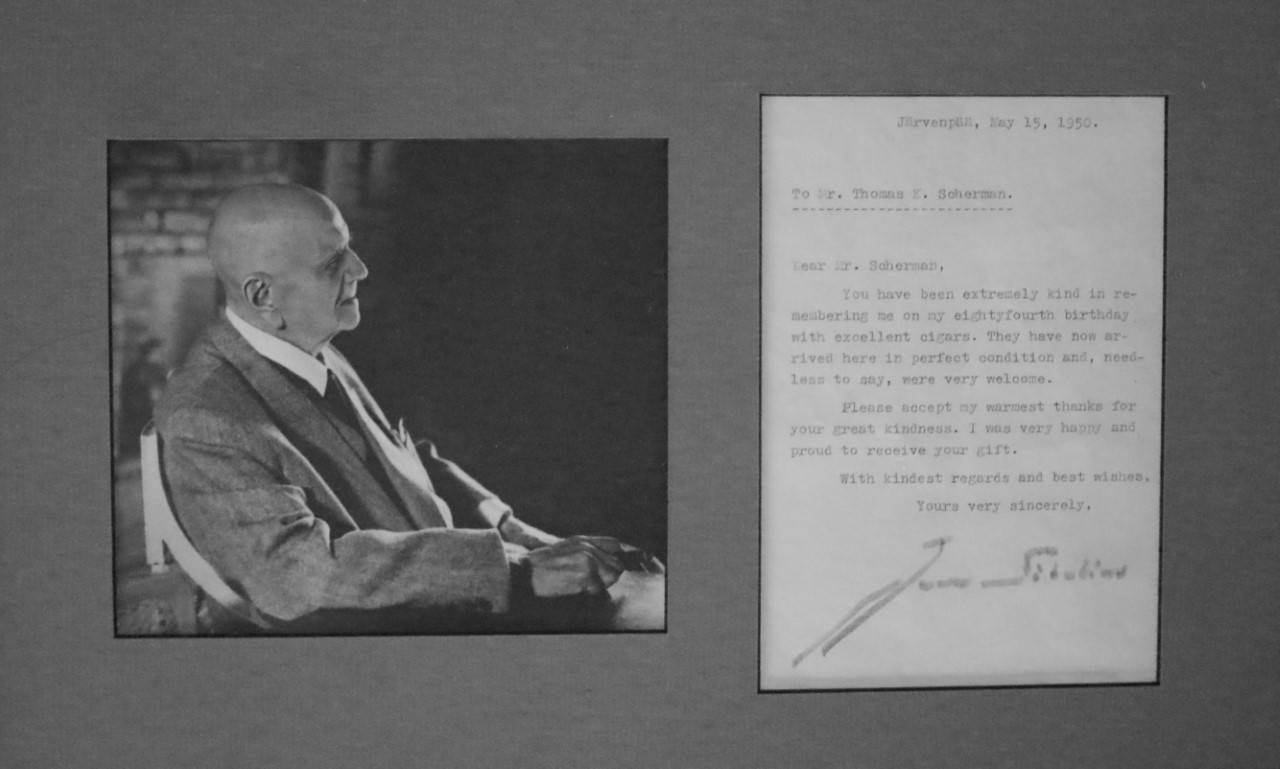
    I’ve got two Sibelius autographs in my possession. One is a signed copy of the famous Yousuf Karsh portrait from 1949 that I am currently using as my profile pic. I have been unable to locate it since my last move, but I assure you it’s around here somewhere!

    The other, as you can see, when you click on the image to enlarge, is a note of thanks for a gift of cigars on the occasion of the composer’s 84th birthday. The accompanying photo (note the cigar in his hand) was copied for me by Anssi Blomstedt, the composer’s grandson. I had the two matted and framed together.

    Evidently, Sibelius never lost his fondness for cigars – and vodka – though he abstained for a time, beginning in 1908, a harrowing period for the composer, during which he underwent a series of operations to have a cancerous tumor removed from his throat. Understandably, this brush with mortality dominated his thoughts until the clouds began to lift in 1913. Then, just as his prospects seemed to be improving, war enveloped Europe. It was during his health crisis that Sibelius composed his Symphony No. 4, a work he himself described as “a psychological symphony.” It is certainly the strangest of his oeuvre, unsettling, bleak, even desolate, but also quite beautiful.

    Sibelius suffered periods of depression and self-doubt throughout his life, and they only worsened the more famous and acclaimed he became. Following his Symphony No. 7 of 1922-24, the purest distillation of his revolutionary approach to symphonic form (the entire work, a breathtaking, organic expanse of 20-25 minutes in length), and his sublime tone poem “Tapiola” of 1926 (Tapio being the forest god of the “Kalevala”), he acknowledged no further major works. Both pieces were met with some of the greatest acclaim of his career, but combined they help to induce such overwhelming pressure that he was essentially hobbled.

    The Symphony No. 7:

    “Tapiola”:

    Sibelius had just turned 61 at the time “Tapiola” was premiered. Though for a time he would labor heroically at an Eighth Symphony, the effort made him miserable. Several leading conductors, including Serge Koussevitzky and Eugene Ormandy, were jockeying for the work’s first performance, and the composer experienced increased anxiety to meet expectations and push beyond what he had already expressed. A kind of paralysis ensued, though a number of people, pupils, colleagues, and family, insist that the symphony had been completed.

    It is thought that Sibelius destroyed the work – actually I have it on good authority from Anssi, who says that he was present at its burning – but at least some of the sketches have survived. It was only in 2011 that a few fragments came to light. They are maddeningly gnomic and make the Sibelius lover yearn for more. What would it be like to hear a new Sibelius symphony?

    But if the composer didn’t think it was up to his standards, perhaps it is best that it is lost. Here are two-and-a-half minutes that have survived:

    Sibelius’ retirement was a long one. He would finish nothing of consequence for his last 30 years. This period has been enshrined in legend as the “Silence of Järvenpää.” During this time, though the composer was not overly fond of company, he continued to receive some notable guests at his home, Ainola, located 23 miles north of Helsinki. A number of these were still hoping to wrest from him the elusive Eighth Symphony.

    Once, Ormandy showed up with the entire Philadelphia Orchestra. Though in frail health and cripplingly shy, the composer was convinced by Ormandy to walk out onto the porch and acknowledge the musicians. It was a raw day, and everyone had been waiting in the rain, but when the door opened finally, and the composer emerged, he was met with a resounding cheer.

    Sibelius died two years later, in 1957, at the age of 91.
  • Sibelius Early Recordings & Stories

    Sibelius Early Recordings & Stories

    Jean Sibelius – Finnish master and a unique voice in 20th century music – was born on December 8, 1865. In our latest contribution to #12DaysOfSibelius, we will honor him tonight on “The Lost Chord” with an hour of early recordings of his music.

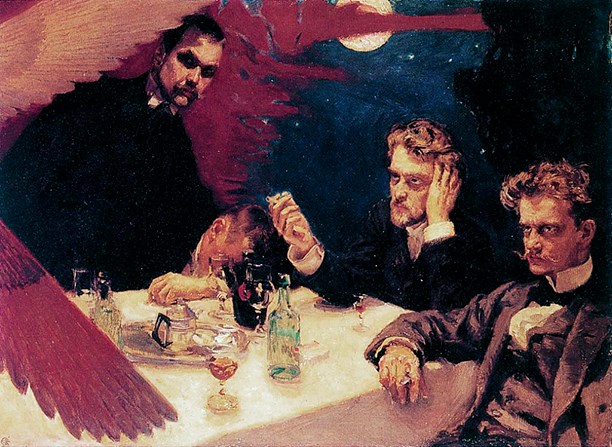
    Robert Kajanus was a good friend of Sibelius, a sometimes rival and a frequent drinking buddy. The two of them were immortalized during one of their infamous binges in a painting by the artist Akseli Gallén-Kallela (see below). Kajanus set down first recordings of a number of Sibelius’ major works, including the underappreciated Symphony No. 3, which will be heard in a 1932 performance, with the London Symphony Orchestra.

    If you’ll allow me a personal anecdote, it was actually this recording that served as an introduction for me to the composers’ grandson. I owned a second-hand book business in Philadelphia for a number of years. I suppose it’s hardly surprising that if anyone ventured into the shop there would be probably an 8-in-10 chance that I would be playing Sibelius.

    Well, on this particular occasion, Anssi wandered in during the Kajanus 3rd, which impressed him sufficiently that he struck up a conversation with me. It turns out he is a documentary filmmaker who was actually living in Philadelphia at the time. By further coincidence, Simon Rattle was coming to town to conduct Sibelius’ 5th Symphony. I was able to get Anssi an introduction to Rattle, who invited us to attend a rehearsal. Somewhere in Vanity Fair’s archives there is a photo of Rattle planting a big kiss on Sibelius’ grandson’s forehead.

    Anssi later returned the favor by introducing me to Einojuhani Rautavaara, who came to Philadelphia for the premiere of his 8th Symphony. I’ve got a snapshot somewhere of me with Rautavaara, and I’m grinning like a Tyrannosaurus rex. If and when I find it, I will be sure to post it.

    Back to tonight’s show: In response to a request from a listener who called during my WPRB tribute this past Thursday, I’ll also include a highly regarded performance of Sibelius’ last major work, the tone poem “Tapiola,” from 1926. The piece takes its name from Tapio, the forest god mentioned throughout the Kalevala, who inhabits the stark pine forests of the wild North. Again, Kajanus gave the piece its first recording, in 1932, but we’ll hear an equally atmospheric, and a times awe-inspiring reading, given seven years later, with the Boston Symphony Orchestra, conducted by Serge Koussevitzky.

    Sibelius would live another 30 years after the completion of “Tapiola.” Though he spent a portion of that time laboring at a highly-anticipated 8th Symphony, with the premiere promised to Koussevitzky, he eventually destroyed the manuscript.

    Koussevitzky’s recording of Sibelius’ 7th Symphony is a knockout. Unfortunately, I didn’t have time to include it on my WPRB playlist. It won’t be heard tonight. However, some might be happy to learn, in response to comments made to me by way of this page, email, and personal interactions in the real world, I’ve decided to devote another five hours to great Sibelius recordings this Thursday, from 6 to 11 ET.

    Speaking of the Kalevala, I’ll give the last word to one of the heroes of that work, the swashbuckling Lemminkainen. Eugene Ormandy was a superb interpreter of Sibelius’ “Four Legends from the Kalevala.” A stereo recording he made with the Philadelphia Orchestra in 1978 must be one of his finest. However, his 1940 recording of the last of the legends, “Lemminkainen’s Return,” is on a whole other level. It surpasses even Sir Thomas Beecham’s legendary account, in terms of sheer virtuosity and visceral excitement. If there’s a more hell-for-leather performance of the piece, I have yet to hear it.

    I hope you’ll join me for “Vintage Sibelius,” tonight at 10 ET, with a repeat Wednesday evening at 6; or that you’ll listen to it later as a webcast at wwfm.org.

    Then join me on Thursday morning, from 6 to 11, at WPRB 103.3 FM, as we continue with #12DaysOfSibelius.

    With thanks to Kenneth Hutchins, for coining the hashtag #12DaysOfSibelius (after #12DaysOfSinatra, of course).


    PHOTO: “Kajustaflan,” painted by Akseli Gallén-Kallela. Pictured (from left to right), the artist, composer Oskar Merikanto, Robert Kajanus and Jean Sibelius.

    More about “The Symposium,” with the original version of Gallén’s painting, here:

    http://www.sibelius.fi/english/elamankaari/sib_symbosion.htm

Tag Cloud

Aaron Copland (92) Beethoven (94) Composer (114) Film Music (117) Film Score (143) Film Scores (255) Halloween (94) John Williams (185) KWAX (228) Leonard Bernstein (99) Marlboro Music Festival (125) Movie Music (132) Opera (197) Philadelphia Orchestra (86) Picture Perfect (174) Princeton Symphony Orchestra (106) Radio (86) Ralph Vaughan Williams (85) Ross Amico (244) Roy's Tie-Dye Sci-Fi Corner (290) The Classical Network (101) The Lost Chord (268) Vaughan Williams (101) WPRB (396) WWFM (881)

DON’T MISS A BEAT

Receive a weekly digest every Sunday at noon by signing up here


RECENT POSTS