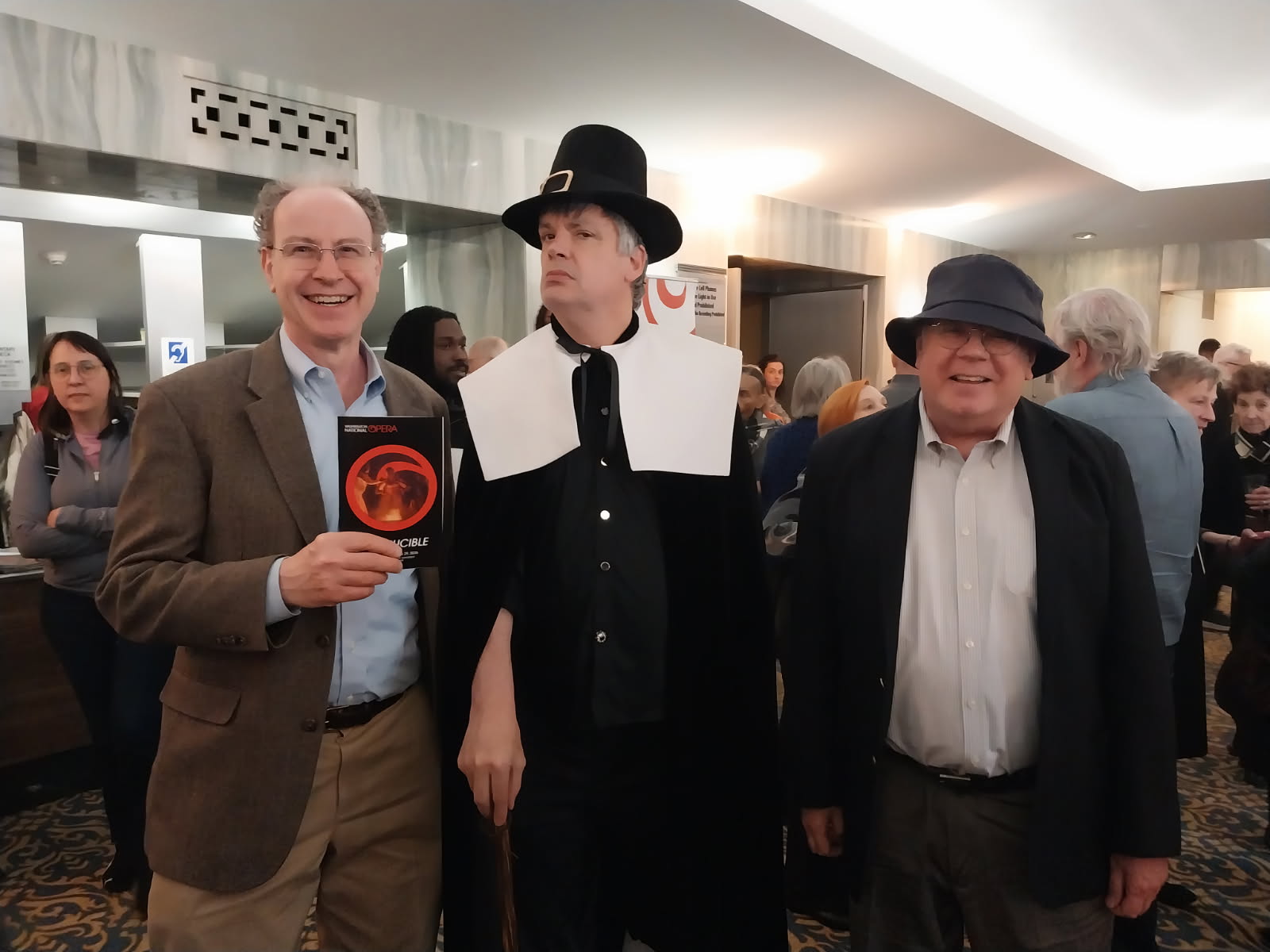
This lighthearted photo isn’t actually what I had planned to post today, but I think it suits the mood for April Fools’. Here I am on the left, in the lobby of George Washington University’s Lisner Auditorium this past Sunday, with Mather Pfeiffenberger on the right, during intermission at the final performance of Robert Ward’s 1963 Pulitzer Prize winning opera “The Crucible,” presented by Washington National Opera.
Between us is a gentleman who identified himself in his contact info (presented so that I could send him a copy of the photo) only as “Crucible Puritan Guy.” It turns out he’s Gary O’Connor, a DC resident who also frequently attends performances at the Met. An opera cosplayer of sorts, Gary has also worn theme costumes to performances of “Die Frau ohne Schatten” (complete with faux falcon), “Lohengrin,” “Der Rosenkavalier” (in silver face paint), “Tosca,” and “Tristan und Isolde” (with the “Tristan chord” on the sail of a headdress resembling a dragon boat).
Of course, there’s nothing foolish about “The Crucible” itself. Adapted from the Arthur Miller play, it’s perennially, chillingly relevant (people are people, after all, no matter what era they live in), but especially so now. Ward’s opera is inexorable, riveting, and powerful, with a dramatic sweep that makes it seem almost like American verismo.
It was certainly well-cast, with J’Nai Bridges and Ryan McKinny as the ill-fated Proctors, who manage to wrest grace and redemption from the Salem Witch Trials. There were good voices throughout, with the men (including McKinny as John Proctor, Chauncey Packer as Judge Danforth, and Nicholas Huff as Giles Corey) carrying especially well. I had my concerns at the start, as some of the voices were muddied as the singers moved upstage, but everyone soon rose to the occasion. I am sorry to have to leave out some of their names, but I didn’t really intend this as a review.
I will add, however, they were also good actors, with Lauren Carroll exuding menace and unpredictability as Abigail Adams. Bridges has some great moments, especially touching in the final scene, which concludes “He have his goodness now. God forbid I take it from him.”
Robert Spano conducted in the cramped pit, and the musicians played well. Had I not been made aware of it in another write-up, I would never have known that the brass and percussion had to be piped in from another room.
Bravo to Washington National Opera, now free of the Kennedy Center. Hopefully they’ll be back, if there’s anything left of the performing arts complex, a memorial to fallen president John F. Kennedy, under a different administration.
It’s shameful that the Washington Post, now under the ownership of Jeff Bezos, did not review “The Crucible.” Then, all the qualified music people have been driven out.
“West Side Story” will conclude the WNO season, at Lyric Baltimore and the Music Center at Strathmore, May 8-15. If I remember correctly the organization’s 2026-27 season will be announced on May 5. For more information, visit https://washnatopera.org/.
Robert Ward’s “The Crucible” is no laughing matter, but Gary the Crucible Puritan Guy brought some welcome levity to a gorgeous DC afternoon. If only it didn’t take me 4 ½ hours to drive home!
Tag: The Crucible
-
“The Crucible,” Unfortunately, Never Goes Out of Style
-

With Washington National Opera Out, I’m In
When I heard that Washington National Opera would be performing Robert Ward’s “The Crucible” this season, my ears pricked up. Ward’s opera was awarded the Pulitzer Prize for Music in 1962.
At the time of the work’s premiere at New York City Opera in 1961, Ward’s musical language, unabashedly accessible and melodic, must have seemed awfully old fashioned to the academic Rapunzels walled up in their towers girded by thorns. But the powerful subject matter cries out for directness of expression.
Bernard Stambler’s libretto is based on Arthur Miller’s play, a dramatic response to the climate of fear, abuse, and hysteria shaped by Senator Joseph McCarthy in the early 1950s, in his zeal to stamp out what he characterized as an internal communist threat. The metaphorical witch hunts, during which civil liberties were suspended, lives destroyed, and basic human decency corroded, are now a not-so-distant mirror. In 1953, Miller’s play practically wrote itself. I mean, where are you going to look, when you’re in the middle of a witch hunt, but Salem in 1692?
Alas, everything old is new again. With demagoguery, extraordinary popular delusions, and “justified” atrocities back in style, the time is ripe to put “The Crucible” back in opera houses.
Maybe so, but I wasn’t exactly eager to walk into the Kennedy Center. My interest in the opera is musical, not political, but somewhere along the way somebody got the bright idea to politicize everything. Well before the “renaming” controversy, my inclination had already been to stay the hell away. For as much as I would have loved to have seen it, Washington’s “The Crucible” was out.
Then all out once, so was Washington National Opera.
With the intensifying flow of talent away from what clearly had become a toxic waste dump, the WNO, in the most gracious, diplomatically worded statement imaginable, announced it would be departing the Kennedy Center. The Opera had been affiliated with the center SINCE ITS OPENING IN 1971. The statement was conciliatory (the move characterized as an “amicable transition”), the writer bending over backwards to extend well-wishes to the center’s administrators.Not long after, Kennedy’s executive director issued his own statement, acting as if it was not the Opera’s decision, but rather that of the Kennedy regime. That’s right: the WNO hadn’t quit; they were fired. Pure class, but would anyone expect anything less? Then he put on a happy face and tried to persuade everyone that it was a GOOD thing WNO was leaving. Patrons “clearly wanted a refresh,” he wrote, and now the center can bring in visiting companies. Yeah, good luck with that. The post was subsequently deleted.
At any rate, now that WNO has extricated itself from a bad situation, I am happy to support them. So I’ll be joining my friend, Mather Pfeiffenberger, to see “The Crucible” at George Washington University’s Lisner Auditorium in March. Mezzo-soprano J’Nai Bridges and bass-baritone Ryan McKinny will head the cast.
I would also consider seeing Scott Joplin’s “Treemonisha” (March 7, 8 & 15) had I not scheduling conflicts. Yet to come: a revival of Leonard Bernstein’s “West Side Story” with Marin Alsop conducting (dates and venue TBA).
In a more recent statement, Francesca Zambello, WNO’s artistic director of 14 years, had this to say about the season’s offerings:
“We will present three American works that explore themes at the heart of what makes our country great. ‘Treemonisha’ celebrates the triumph of education over ignorance, while ‘The Crucible’ is a cautionary tale about a righteous mob that murders innocent women and tears families apart. We close with ‘West Side Story’, a modern spin on the Shakespeare play that Leonard Bernstein called ‘an out and out plea for racial tolerance.’”
The arts are so woke! /s
Viva Washington National Opera!——–
Washington National Opera website
More about “The Crucible”
Tag Cloud
Aaron Copland (92) Beethoven (94) Composer (114) Film Music (116) Film Score (143) Film Scores (255) Halloween (94) John Williams (185) KWAX (228) Leonard Bernstein (99) Marlboro Music Festival (125) Movie Music (131) Opera (197) Philadelphia Orchestra (86) Picture Perfect (174) Princeton Symphony Orchestra (106) Radio (86) Ralph Vaughan Williams (85) Ross Amico (244) Roy's Tie-Dye Sci-Fi Corner (290) The Classical Network (101) The Lost Chord (268) Vaughan Williams (99) WPRB (396) WWFM (881)