March 21st is the birthday of Johann Sebastian Bach. I’ve already got my order in for a cake, and it had to be a big one, in order to accommodate 336 candles.
The Princeton Symphony Orchestra has just posted the last of its four-part series on Bach’s “The Musical Offering.” PSO musicians perform Bach’s contrapuntal, often chromatic – and for at least one canon, crabby – masterwork, with Assistant Conductor Nell Flanders offering absorbing insights into its history and structure. The series is free. Watch all four installments at princetonsymphony.org.
On Sunday, The Dryden Ensemble will stream a lecture by Bach scholar Michael Marissen on the musical aims of the “St. John Passion.” Then the following Sunday, March 21st – Bach’s birthday – experience a performance of the oratorio from last year, an especially notable concert, in that it was documented just as the world was shutting down for the pandemic. Both of the Bach events will be made available, on their respective Sundays, at 3 p.m. The lecture is free. More information and tickets for the performance are available at drydenensemble.org.
Finally, WWFM The Classical Network is in the midst of its annual “Bach 500” challenge. 500 listener donations in any amount will be matched by funds from the station’s “Bach Pot” (fortified by some very generous leprechauns). If the goal is reached, fundraising will be cancelled for Bach’s birthday. The reward will be a euphoric playlist of uninterrupted Bach, free from pecuniary concerns – lutes in place of lucre, concertos supplanting chatter, pipe organs in preference to pitching.
Won’t you be one of the Bach 500? Make a contribution now, and watch the mercury rise on the Bach thermometer at wwfm.org. Thank you for your support of classical music on WWFM – The Classical Network. It’s because of listeners just like you that we are able to continue to Bach-around-the-clock!
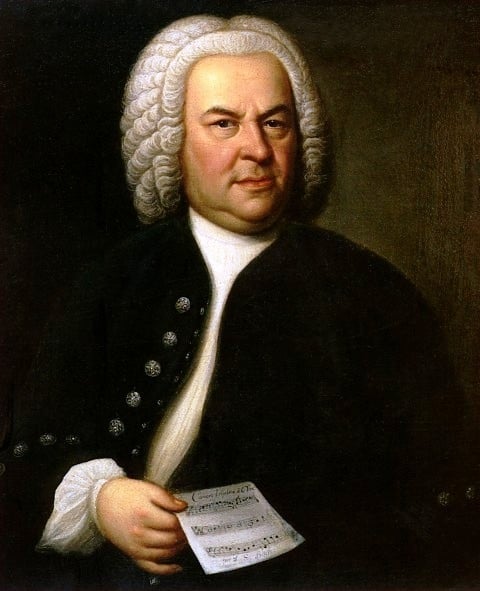
IMAGE: Bach makes a musical offering in the form of a riddle canon, in the famous Elias Gottlob Haussmann portrait. The painting, which was housed in Princeton for over 60 years, in the private collection of William H. Scheide, was bequeathed by Scheide to the Bach Archive in Leipzig – the city in which Bach spent most of his creative life – where it now resides.