I’m probably the last person on the internet to congratulate John Williams for his latest Grammy nominations. It was announced on Friday that Williams received three nominations for the excellence of his work over the past year – in the categories of Best Score Soundtrack for “The Fabelmans” and Best Score Soundtrack and Best Instrumental Composition (“Helena’s Theme”) for “Indiana Jones and the Dial of Destiny.” Too bad the idiots at Disney only pressed something like three copies of the “Indiana Jones” CD (and that the movie was terrible).
This brings Williams’ career total to 76 nominations. He’s won 25 times. Williams’ first Grammy nomination was for “Checkmate,” 61 years ago. He is the fifth most-nominated Grammy artist. But who would be interested in owning a new John Williams’ “Indiana Jones” soundtrack, right? Nice going, Disney.
The Grammys ceremony will be held on February 4. Congratulations, John Williams!
“Helena’s Theme”
“The Fabelmans”
“Checkmate”
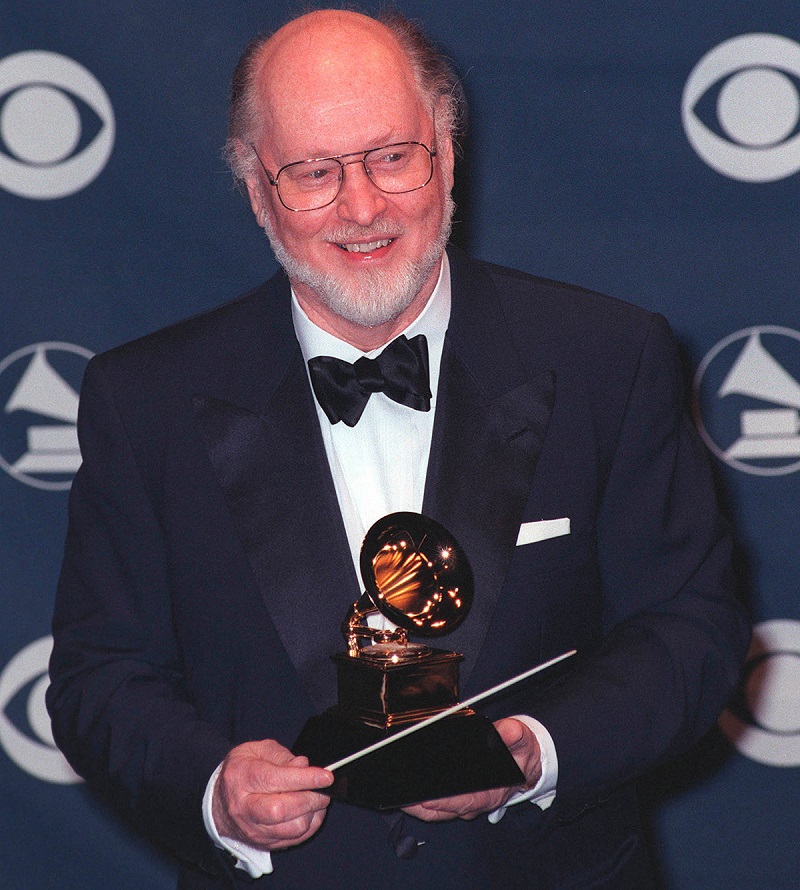
PHOTO: Williams at the 60th Grammy Awards, at which he was honored for “Escapades” for alto saxophone and orchestra (a concertino of sorts arranged from his score to “Catch Me If You Can) and a Trustees Award, for “individuals who, during their careers in music, have made significant contributions, other than performance, to the field of recording”
More than anyone else in history, John Williams has had the pleasure of scoring the highest-grossing motion picture of the year. Those films remain among the most-successful of all time.
Now, with his 53rd Oscar nomination, announced today, Williams sets another record, as the oldest person ever to be nominated for an Academy Award. The oldest person ever to win an Oscar is James Ivory who, at 89, was recognized in 2018 for his screenplay to “Call Me by Your Name.”
Williams is already the second most-nominated person ever – a record he breaks every time he’s nominated – behind only Walt Disney (with 59). He has earned five statuettes, for his work on “Fiddler on the Roof,” “Jaws,” “Star Wars,” “E.T. The Extra-Terrestrial,” and “Schindler’s List.” However, it has been 30 years since his last win.
What are the odds of this year bringing Williams more Oscar gold? Rather slim, I’m afraid. His work on “The Fabelmans,” while certainly effective and wholly appropriate for one of Steven Spielberg’s most intimate projects, is fairly understated and supplemented by a lot of classical music, including works by Kuhlau, Clementi, Bach, and Haydn. (Spielberg’s mom was a pianist.) The soundtrack album in only 31 minutes long, and at least one of the themes flirts with Satie’s “Gymnopédie No. 3.”
That said, somebody should campaign for an honorary Oscar for this guy already. For 60 years, the movies would have been so much poorer without him. Not that he’ll be crying himself to sleep for lack of recognition. What a charmed career he’s had!
At least since “Star Wars: The Rise of Skywalker” in 2019, Williams has teased his retirement from film scoring several times. Most recently, he stated that “Indiana Jones and the Dial of Destiny,” due this summer, would be his last score. Now, however, he intimates that that might not be entirely true.
“I’ll stick around for a while,” Williams told Entertainment Weekly. “I can’t retire from music.” Which should be fairly obvious, when seemingly not a week goes by that he’s not conducting one of the world’s great orchestras, in between work on his long-anticipated Piano Concerto and fulfilling smaller commissions for occasional works and television themes.
John Williams will be 91 on February 8.
This year’s nominees for Best Original Score: “Everything Everywhere All at Once” (Son Lux), “Babylon” (Justin Hurwitz), “Banshees of Inisherin” (Carter Burwell), “All Quiet on the Western Front” (Volker Bertelmann), and “The Fabelmans” (John Williams).
More details about William’s latest world record here:
Some interesting comparisons can be drawn between Steven Spielberg’s semi-autobiographical “The Fabelmans,” now in theaters, and Patrick Read Johnson’s coming-of-age-in-the-era-of-“Star Wars” comedy, “5-25-77” (2002). Both filmmakers clearly poured their hearts and souls into these creative reminiscences of their early discoveries and explorations of the magic of film, largely through experiments with their families’ home movie equipment. In their cases, the cinema bug bit early and it wound up shaping their lives.
On the next “Roy’s Tie-Dye Sci-Fi Corner,” Roy and I will talk a little bit about Johnson’s “new” film (actually 18 years in the making), but mostly we’ll be using it as a springboard for our own personal recollections of writing and producing Super-8 movies all throughout our teens
My cousin and Roy’s lifelong friend, Joe Metz, will join us, along with special guests, a few of those who appeared in the films and helped out behind the scenes. We’ll talk about our undiscovered treasures, projects that occupied our formative summers (mostly), including “The Last Plot,” “Omelet,” “Inner Vorzyd,” “AERO/VOID,” “An Hour to Live,” “Journey to Where,” “Leviathan,” “The Pterodactyls,” “Man and Thin Man,” “The Road to Insanity,” and “A Gorgeous Guy in a City of Women.”
Sadly, the films themselves will not be shown, but we’ll have plenty of stories, a few stills, some first-hand accounts, and boxes of paraphernalia.
Self-indulgent? You bet. But Spielberg and Johnson’s passions were not unique. They just happened to be blessed with that magic combination of calling, talent, drive, and good luck to get where they are today. I’m sure there will be others among our viewers who’ve had parallel experiences.
We’ll be ready for our close-ups on the next Roy’s Tie-Dye Sci-Fi Corner. Join the paparazzi in the comments section when we livestream on Facebook, YouTube, etc. The geekery and nostalgia will be strong with this one, this Friday evening at 7:30 EST!
John Williams will be 90 in February. He hasn’t composed a new film score since “Star Wars: Episode IX: The Rise of Skywalker” in 2019. In fact, he kind of intimated at the time that he would be retiring, leaving the window open to future Spielberg projects, perhaps, and the odd opportunity that would be too good to refuse. Essentially, that’s the position he’s been in now for years anyway. When you’re John Williams, you can pretty much do what you want.
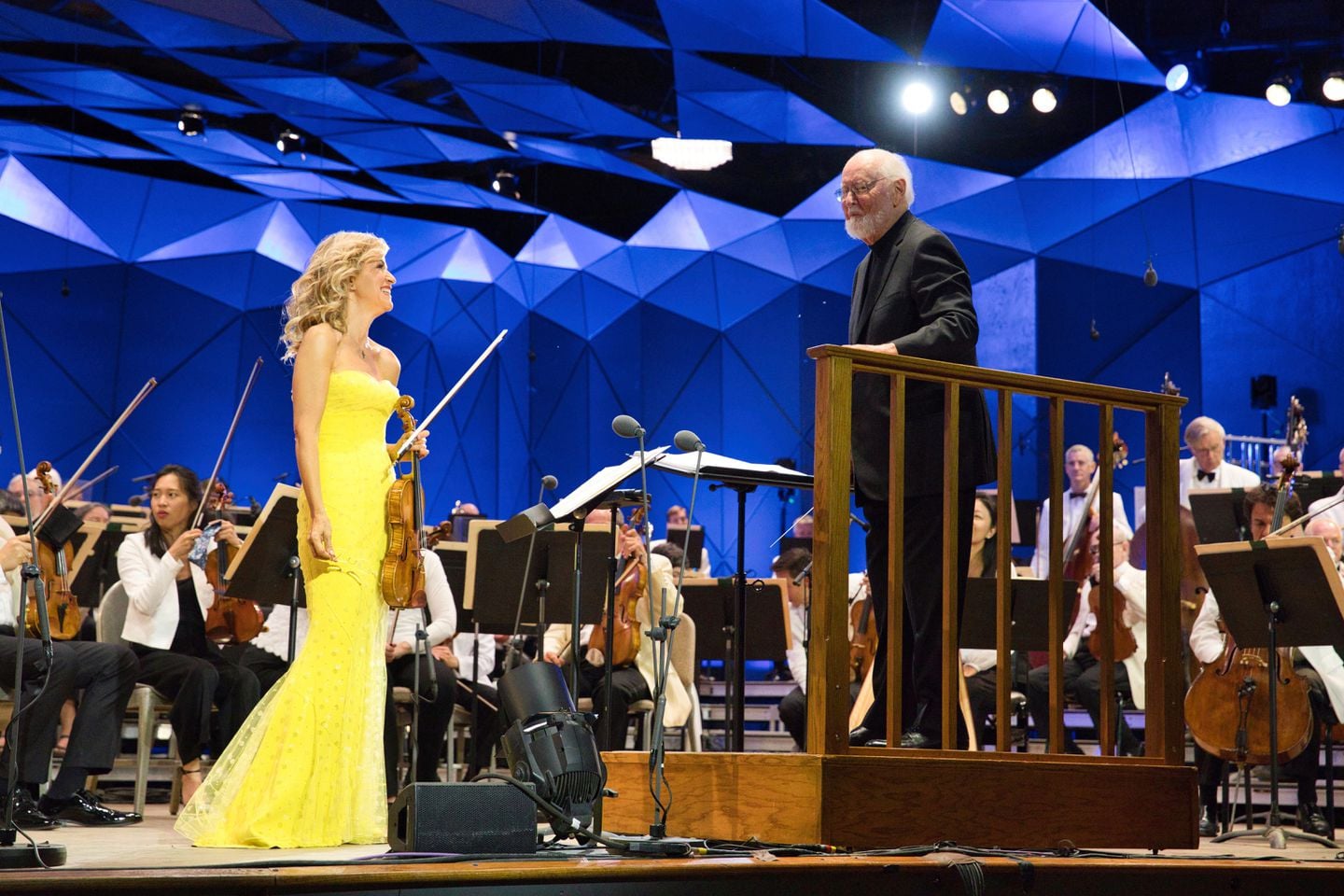
The lack of film projects certainly doesn’t mean he hasn’t kept busy. In fact, Williams seems to be as active as ever, with a full schedule of conducting engagements and recordings. In particular, he’s being seen everywhere with Anne-Sophie Mutter, touring his new Violin Concerto (No. 2) and assorted film themes arranged for violin and orchestra. The audio for the concerto, in its Tanglewood debut (which took place on July 24), was available briefly on YouTube – long enough for me to share the link and listen to it a couple of times – but, alas, it has since been taken down. Thankfully, it’s been recorded for commercial release on compact disc, which still has not been the case for too many of Williams’ other concert works.
If you’re interested and you haven’t heard it yet, PBS will be broadcasting the concert on “Great Performances” THIS FRIDAY EVENING AT 9:00 EST. Williams’ concerto will form the centerpiece of a program that will include Aaron Copland’s “Quiet City,” Igor Stravinsky’s “The Firebird Suite,” and Jesse Montgomery’s “Starburst,” with the Boston Symphony Orchestra conducted by Andris Nelsons. Williams will conduct the concerto with Mutter as soloist. Check your local listings. You’ll find an interview and promos here:
In other recording news, Williams has been in the studio with Yo-Yo Ma and guitarist Pablo Sáinz Villegas (for whom he composed his concert piece “Rounds”). I’m hoping it will result in an album of more concert music. I know new arrangements of the film themes are popular, but I always find those types of records to be a little kitschy. (Sorry, Morricone.) Why do I need movie themes arranged for cello or violin, when I can already enjoy them as written? Regardless of my preferences, the orchestra on the new recording, whatever it contains, will be the New York Philharmonic.
Williams was supposed to have begun scoring the latest Indiana Jones film – still being referred to simply as “Indy 5” – in the coming weeks, but now Disney has pushed the release date back a year, to 2023, to accommodate the crush of superhero movies that have been piling up, presumably, since the start of the pandemic. This means Williams may actually be scoring the film at the age of 90 or 91? Harrison Ford will be 81 at the time of the film’s new projected release date of June 30, 2023.
On the bright side, that will take some of the pressure off Williams’ commitment to score Spielberg’s semi-autobiographical coming-of-age drama, “The Fabelmans,” which will be released next year.
So, as he nears the end of his eighth decade, Williams is not just resting on his throne of gold, tabulating his mountains of royalties. It must be very rewarding indeed to be able to show up to packed houses all over the world and perform one’s own music to engaged listeners, paying top dollar to hear one conduct it. Well, he earned it. Have a great “retirement,” John Williams.