
Tag: The Lost Chord

  • Leon Fleisher A Legend’s Journey

    Leon Fleisher A Legend’s Journey

    At 86, Leon Fleisher is a living legend. A former child prodigy, his is a direct line to Beethoven. He studied with Artur Schnabel, who studied with Theodor Leschetizky, who studied with Carl Czerny, who studied with the master himself.

    When he performed with the New York Philharmonic under Pierre Monteux at the age of 16, Monteux called him “the pianistic find of the century.” Fleisher landed a recording contract with Columbia Records and began laying down benchmark recordings of Beethoven, Brahms, Schumann, Grieg and Rachmaninoff with George Szell and the Cleveland Orchestra.

    Then everything changed.

    Fleisher was diagnosed with focal dystonia in 1964. He gradually lost control of his right hand, throwing his career as a concert pianist into jeopardy. His struggle with the affliction led to a period of soul-searching, and it forced him to diversify. He realized, as Schnabel had espoused, that music came first, the piano second.

    Fleisher began channeling his energy into teaching and conducting. He has been a venerable presence at the Peabody Conservatory of Music in Baltimore, the Royal Conservatory of Music in Toronto, and the Curtis Institute of Music in Philadelphia.

    Fortunately, the left-hand piano repertoire is extensive, and Fleisher himself has added considerably to it, through commissioned works from contemporary composers or gifts from friends. His new album, “All the Things You Are,” issued by Bridge Records, documents some of these, alongside his performance of Brahms’ towering arrangement of the Bach Chaconne.

    The record has become a surprise hit. This week, according to Nielsen Soundscan data, the album ranked second, in terms of overall sales of classical records, in the United States. Billboard ranked it at number 11. The New Yorker’s Alex Ross lauded it as “one of [Fleisher’s] finest hours on record.”

    This Sunday night on “The Lost Chord,” I am honored to have Leon Fleisher as my guest. He will join me to talk a little bit about the album and share some of his reflections on music.

    Fleisher is an extraordinary individual. Not only has he fought hard to regain control of his right hand – and done so, thanks to experimental treatments with, of all things, Botox – he is quite possibly the most gracious and generous interview subject I’ve ever encountered. It pains me to have had to edit the conversation. But perhaps there will be a follow-up show, in which I’ll air his thoughts on Paul Wittgenstein, Franz Schmidt, Paul Hindemith, Federico Mompou and Erich Wolfgang Korngold.

    In the meantime, I hope you’ll join me for “In Good Hands,” this Sunday night at 10 ET, with a repeat Friday morning at 3. Remember, you can enjoy episodes of “The Lost Chord” later as a webcast, at http://www.wwfm.org.
  • Leopold Stokowski Cartoon Cameo Mystery

    Leopold Stokowski Cartoon Cameo Mystery

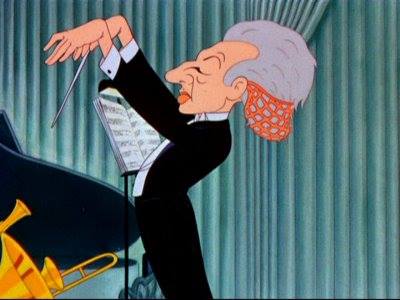
    Classic movie fans will have to stay sharp (and likely hit the pause button a few times) to catch all the cameos and references in this Warner Brothers Merry Melodies short.

    Of particular interest is an appearance by Leopold Stokowski in a hairnet (although he conducts with a baton).

    http://www.ebaumsworld.com/video/watch/82363595/

    Stokowski will conduct Aram Khachaturian’s Symphony No. 2, tonight on “The Lost Chord.” The show airs at 10 PM, with a repeat Friday morning at 3. Or you can catch it later as a webcast at http://www.wwfm.org.

  • Khachaturian’s Lost “Bell” Symphony on “The Lost Chord”

    Khachaturian’s Lost “Bell” Symphony on “The Lost Chord”

    I don’t know what got into me – maybe I feel beleaguered? – but this Sunday night on “The Lost Chord,” I’ll be presenting Leopold Stokowski’s rarely-heard recording of Aram Khachaturian’s Symphony No. 2, sometimes called “The Bell.”

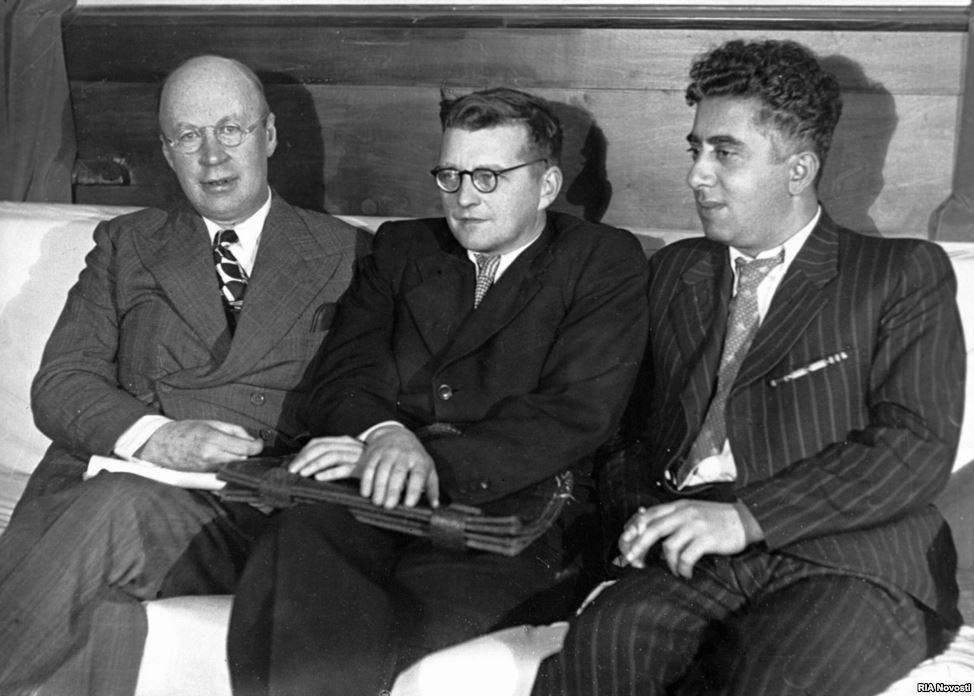
    Khachaturian wrote the work in 1943, the height of World War II, while he was holed up at a Composers Union retreat with Shostakovich, Prokofiev, Miaskovsky and Gliere. He said of the piece, “The Second Symphony is a requiem of wrath, a requiem of protest against war and violence.”

    The symphony’s nickname alludes to a kind of alarm that opens and closes the work. Overall, the tone is one of resolution in the face of tragedy.

    Stokowski’s recording, long unavailable, was originally issued on United Artists Records in the late 1950s. It reappeared briefly on compact disc, on the EMI label, in 1994, and again in 2009, as part of a 10-disc box set of entrancing Stokowski performances.

    The master tapes have not weathered the years well, alas, so there are moments of distortion, but the power of the piece transcends any technical limitations. There is certainly nothing wanting in the performance.

    To round out the hour, we’ll hear the Russian-born pianist, Nadia Reisenberg, in a selection from her 1947 Carnegie Hall recital, Khachaturian’s most famous piano work, the “Toccata.” Reisenberg studied at Philadelphia’s Curtis Institute of Music under Josef Hoffman.

    Join me for these rare Khachaturian performances, “Khach As Khach Can,” tomorrow night at 10 ET, with a repeat Friday morning at 3. Or listen to the webcast later, at your convenience, at http://www.wwfm.org.

    In the meantime, here’s an even rarer Khachaturian document of the composer singing about the glories of Armenian wine!

    https://www.youtube.com/watch?v=vtKHrg7w3_o

    PHOTO: Troika! (Right to left) Khachaturian with Shostakovich and Prokofiev

  • Labor Day Road Trip American Music

    Labor Day Road Trip American Music

    Labor Day weekend. Summer’s last hurrah.

    This Sunday night on “The Lost Chord,” it’s an hour of quintessentially American music about travel by car.

    Frederick Shepherd Converse’s “Flivver Ten Million” celebrates the Ford Motor Company’s affordable assembly line automobile, from its creation in a Detroit factory to the manifest destiny of America’s roadways.

    John Adams’ “Road Movies” has nothing to do with Bob Hope and Bing Crosby, alas; what it is, however, is a violin sonata written firmly within the American tradition, with a special affinity at its core with Copland’s Violin Sonata.

    Virgil Thomson’s “Filling Station,” written for Leon Kirstein’s Ballet Caravan, may have the distinction of being the only ballet set at a gas station. The work’s success gave Copland the confidence to follow through on a Caravan commission which resulted in “Billy the Kid.”

    Finally, we’ll hear one of Michael Daughtery’s most performed works, the exuberant “Route 66,” inspired by the storied “Main Street of America.”

    Join me for “The Last Roads of Summer.” American composers hit the road for Labor Day this week, on “The Lost Chord.” This Sunday night at 10 ET, with a repeat Friday morning at 3. Or catch it later as a webcast, at http://www.wwfm.org.

  • Bulgarian Music on The Lost Chord

    Bulgarian Music on The Lost Chord

    This Sunday night on “The Lost Chord,” we’re off to Bulgaria.

    Pancho Vladigerov – despite his Mexican-sounding first name and Swiss birth – was a seminal figure in Bulgarian music. He was the country’s first major composer to harness the idioms of Bulgarian folk traditions to classical forms.

    Fairly well known in Central Europe during the 1920s, when he was an associate of the theatrical impresario Max Reinhardt, Vladigerov had many of his works published by Universal Edition and recorded by Deutsche Grammophon. He was a composer of opera, ballet, symphonic music, five piano concertos, two violin concertos, chamber music, songs, choral works and piano pieces.

    We’ll be listening to a generous selection from Vladigerov’s “Bulgarian Dances” of 1931.

    Also on the program will be American composer Derek Bermel’s musical recollections of his studies in the region, his “Thracian Echoes” of 2002. Bermel served as artist-in-residence at Princeton’s Institute for Advanced Study from 2009 to 2013. His “Thracian Echoes” was performed locally,by the Princeton Symphony Orchestra, in 2011.

    Join me tonight for “The Lost Chord,” as we seek the cream of Bulgarian music – “Bulgar Wheat.” The show airs at 10 ET, with a repeat Friday morning at 3. Or you can listen to it later as a webcast, at http://www.wwfm.org.
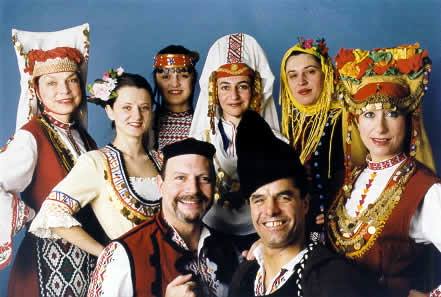
    Be sure to don colorful national costume!

Tag Cloud

Aaron Copland (92) Beethoven (94) Composer (114) Film Music (116) Film Score (143) Film Scores (255) Halloween (94) John Williams (185) KWAX (228) Leonard Bernstein (99) Marlboro Music Festival (125) Movie Music (131) Opera (197) Philadelphia Orchestra (86) Picture Perfect (174) Princeton Symphony Orchestra (106) Radio (86) Ralph Vaughan Williams (85) Ross Amico (244) Roy's Tie-Dye Sci-Fi Corner (290) The Classical Network (101) The Lost Chord (268) Vaughan Williams (99) WPRB (396) WWFM (881)

DON’T MISS A BEAT

Receive a weekly digest every Sunday at noon by signing up here


RECENT POSTS