Tag: The Orchestra Now

  • Martinů at Bard: Weekend 1 Impressions

    Martinů at Bard: Weekend 1 Impressions

    Okay, here we go: my impressions of this year’s Bard Music Festival, “Martinů and His World,” Weekend 1. If you’re looking for festival background, see yesterday’s post.

    One of the things I’ve always found refreshing about the Bard approach to its honored subject (this year, the chameleonic composer Bohuslav Martinů) is its mix-and-match philosophy of programming. With the exception of Saturday night concerts, for which larger forces are amassed for the duration – an orchestra, with perhaps the addition of soloists and/or a chorus – it’s not uncommon to experience instrumental, vocal, chamber, and orchestral music on the same program.

    Concerts frequently push, and sometimes exceed 150 minutes. At Bard, there is no such thing as too much of a good thing. There is an intermission, of course. Sometimes. This past Sunday morning’s concert ran two hours without break. It was projected to run 90 minutes.

    The Friday night opener took place at Bard College’s 900-seat Sosnoff Theater, inside the Frank Gehry-designed kaiju armadillo that is the Richard B. Fisher Center for the Performing Arts. Festival inaugural concerts always serve as introductory affairs, so we were treated to Martinů across various genres and periods.

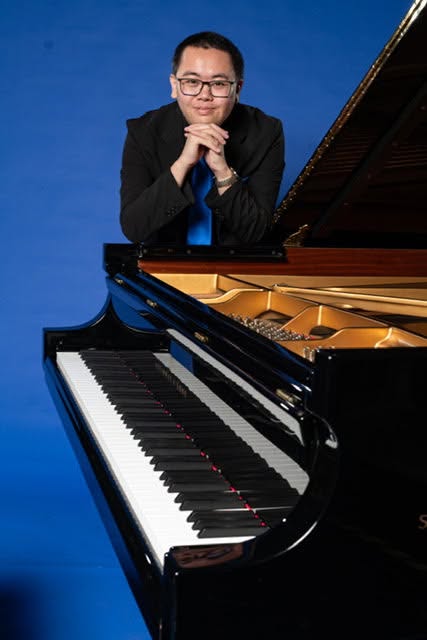
    The program commenced with Orion Weiss, a pianist whom I’ve heard at Bard pretty much every year since I first encountered him there in 2008, during “Prokofiev and His World.” That would have been my first visit to the festival, which was established in 1990. Throughout the weekend, Weiss exhibited a remarkable grasp of the Martinů idiom. For starters, he played two selections (both in F major) from the composer’s “Etudes and Polkas.” I would have liked to have heard more of these, so delectable they were. I’ve enjoyed them very much on record. But on Friday, they were mere appetizers.

    As was the folk-inflected “Primrose,” a collection of five brief, though characterful songs for two voices, violin (an inspired choice on the part of the composer), and piano. This is music with roots in the soil of Moravia and shoots in the New World. The vocal duets were sung by soprano Jana McIntrye and mezzo-soprano Taylor Raven, with foundations and embellishments provided by violinist Luosha Fang and pianist Erika Switzer.

    In browsing the promotional material during the weeks and months leading up to the festival, it did not register that the third work on the program, titled “Fantasia,” was indeed Martinů’s Fantasia for Theremin, Oboe, String Quartet, and Piano. If you don’t know the theremin, it’s that electronic instrument often used in old science fiction movies to denote UFOs and mad science. Tones are conjured and bent without physical contact by manipulating electromagnetic fields with hands held in varying proximities to the machine’s dual antennae. You have to give Martinů credit for employing this most unusual device for its musical capabilities, as opposed to gimmicky ends.

    Believe it or not, this is not the first time I’ve encountered the piece. I heard it performed in 2013 by the Concordia Chamber Players with the New Jersey Symphony’s Darryl Kubian on the theremin. Granted, that was in a more intimate venue (Trinity Church in Solebury, PA), but the instrument, and by extension the work itself, made more of an impression on that occasion. That said, I must confess, despite some intriguing interplay between the theremin and the oboe, for me the piece kind of outstays its welcome. But not by much. Maybe I’m just one of those vulgarians who actually craves more mad science. On Friday, Dorit Chrysler was the thereminist. She shared the stage with oboist Alexandra Knoll, the Balourdet Quartet, and again, pianist Orion Weiss.

    The first half of the concert concluded with Weiss and members of the Balourdet in a profoundly absorbing performance of Martinů’s Piano Quartet No. 1. This is a work of urgency and uncertainty that yet manages to attain real beauty with its flashes of irrepressible humanity. In my notebook, I jotted down the impression that Shostakovich might have recognized the emotional soundscape of the work’s second movement. A ray of hope appears in the third, and it occurred to me, perhaps quirkily, that Martinů’s piano passages, when he is in hopeful mode, put me in the mind, somewhat, of Vince Guaraldi’s “Cast Your Fate to the Wind,” if only in spirit. I mean that generally, not just in this piece. But Martinů is never the same for long. As it was, hope was not to continue untroubled, and peace was not guaranteed. Optimism pierced the gloom, shining sporadically, like shafts of light through clouds.

    For me, this was the high-point of the program thus far, and perhaps it would have carried the evening, had it not been for the Double Concerto for Two String Orchestras, Piano, and Timpani. Positioned as it was after interval, on top of everything else, the Double Concerto had the advantage of contrast with the smaller-scale works on the concert’s first half, which enhanced its impact enormously. As I observed in yesterday’s post, it was like the effect of having viewed a 35 mm film and then having the screen suddenly open up to the dimensions of Cinemascope.

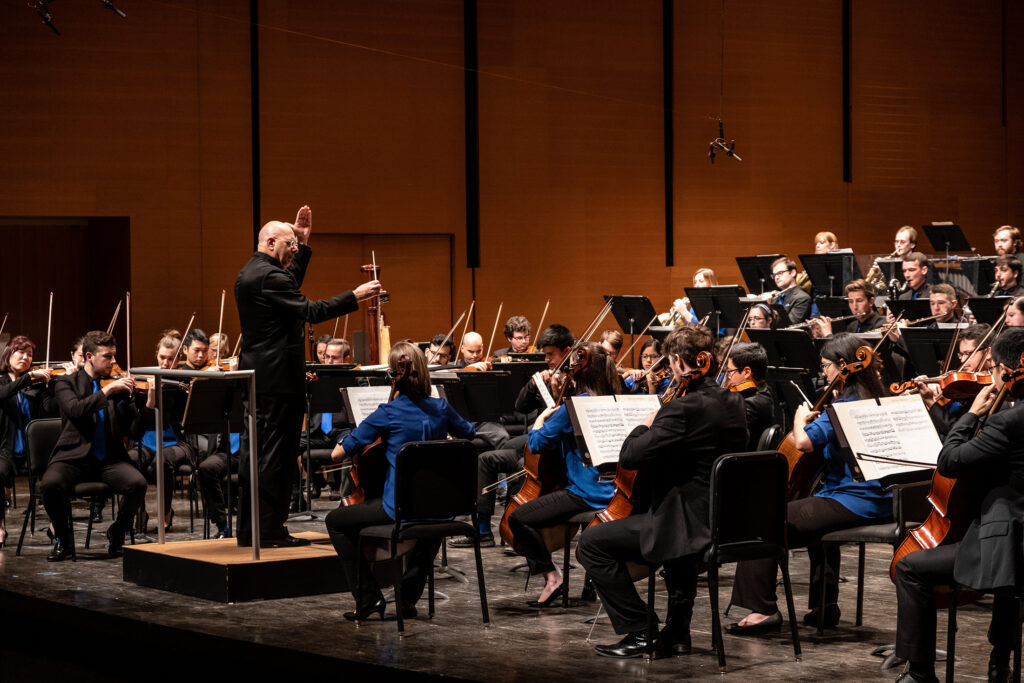
    The visual of pianist Michael Stephen Brown seated in an antiheroic position, behind the instrument, the piano perpendicular in relation to the seats in the auditorium, so that hands and keys were invisible to the audience, emphasized his neoclassical function as a musician in, as opposed to apart from, the orchestra, as in a Baroque concerto grosso. But there was nothing remotely 18th century about the content of the music, with its white hot divisi strings ratcheting up the intensity. I own several recordings of the Double Concerto, but it wasn’t until I heard it live in concert, here for the first time, that I realized what an outstanding work it truly is. Again, as I remarked yesterday, this is searing, full-bodied music that can stand toe-to-toe with the finest works of Béla Bartók. Music director Leon Botstein (also Bard’s co-artistic director) and the young musicians of The Orchestra Now, Bard’s graduate training ensemble, gave it as fine a performance as I ever expect to hear.

    In the wake of this emotionally-taxing work and the staggering success of its execution, I was all set to decompress with the Symphony No. 2, one of the composer’s more carefree inspirations. It’s a piece that bears the influence of Martinů’s Czech antecedents (especially Dvorak), but also conjures the kind of wide-open positivity we associate with a lot of American music of the era. By then, 1943, Martinů was safely across the Atlantic and composing in the United States. The work was written for the Czech community of Cleveland and first performed by the Cleveland Orchestra conducted by Erich Leinsdorf.

    To be fair, Botstein and his musicians had set the bar awfully high. So when the symphony commenced, my heart sank a little, as I began to suffer flashbacks to a performance of Charles Ives’ Symphony 2 these same forces had given last season at Carnegie Hall that just refused to spring to life. One of my favorite American symphonies wound up sounding like John Knowles Paine on a bad day. I feared a recurrence on Friday, with the first movement of the Martinů symphony played, to my ears, with more diffidence than such a characterful, optimistic piece should have been. It lacked forward momentum, which is not something you generally experience with this composer.

    Or at least, that was my impression. Who knows. Maybe it was just me. (I HAD eaten some undercooked salmon for dinner.)

    HOWEVER, I am very happy to report, things improved markedly in the second movement, which of course could handle a more relaxed tempo. The third movement, lively in its mechanized energy, was better still. It made me wonder if my reaction to the first was but “an undigested bit of beef, a blot of mustard, a crumb of cheese, a fragment of underdone potato.” The last movement was exuberant, exciting, and ebullient. The performance had rebounded – possibly; again I concede that it could have been fine all along – and the work was brought to a satisfying close. Not quite on the level of the Double Concerto, mind you, but still, a job well-done.

    At various points throughout the concert, Botstein offered some remarks while the stage was being reset. The man is a master of extemporization. If you’re ever looking to fill five, ten, or even thirty minutes with engaging perambulation, then Botstein is your man. A lifetime of public speaking and a devotion of one’s thoughts to interesting things will do that. Before the concert, he was presented with a framed certificate by New York Assemblymember Didi Barrett in honor of his 50 years as president of Bard College.

    Apologies. This is getting long again. I’ll have to wrap it up tomorrow, likely in a more concise fashion. Otherwise, I’ll never get it all in before Weekend 2!

    The Bard Music Festival, “Martinů and His World,” will continue this weekend at Bard College in Annandale-on-Hudson, NY. For more information, visit

    Bard Music Festival

    Fisher Center at Bard

  • Bard Music Festival: Exploring Martinů and His World

    Bard Music Festival: Exploring Martinů and His World

    Tackling a topic as vast as the Bard Music Festival can be intimidating. Also, life tends to get in the way, often keeping me from being my best self, particularly in the narrow windows during which my brain is actually firing at peak capacity. All disclaimers aside, let’s see what I can do.

    The Bard Music Festival, now in its 35th year, is the crown jewel of Bard SummerScape, an eight-week celebration of the arts, held on the campus of Bard College beginning in late June. The Bard Festival itself, which spans two weekends in August, focuses on certain composers and their worlds – encompassing works by their associates, contemporaries, influences, and those who were influenced by them. The subject’s life and artistry are explored by way of marathon concerts, but also through pre-concert talks, Saturday morning panels with visiting and resident scholars, a book of related essays, and a 70-page festival program booklet which is so much more than a utilitarian compilation of concert listings, lavishly-illustrated and brimming with valuable information about every aspect of the subject.

    This year’s focus is the neglected Czech master, Bohuslav Martinů, whose life took him from the comparative isolation of a childhood spent in a provincial bell tower, to a period of lackluster studies in the city of Prague, to an artistic flowering in Paris, to a flight from war and authoritarianism in Europe to safety and recognition in the U.S., to final years spent in Switzerland on the estate of conductor and music patron Paul Sacher. That’s quite a journey, and Martinů was an expert assimilator, sensitive to stimuli from a broad array of influences, all siphoned through a lively, fecund, and voracious sensibility. All converge in his highly unique, multifaceted creations, which are full of human touches, while often seeming to churn with the vitality of a mechanized age.

    Alas, Martinů has shared the fate of so many composers who clove to tonality in the 20th century. A multiplicity of factors that contributed to the “Great War” sent strains of decadence and malaise out into the arts. There was a little bit of a reprieve during World War II, when a certain amount of populism was tolerated, in the interest of keeping up the morale of the unwashed. But after two devastating conflicts, the Holocaust, and the atomic bomb, arbiters and academics tended to marginalize composers who did not cast off tradition, which they perceived as upholding destructive tendencies, to embrace the brave new world of the avant-garde. Ironically, the sterility of the Ivory Tower was viewed as the only way forward.

    Thankfully, we are, for the most part, beyond all that, and composers of Martinů’s generation, who continued to seek new ways within a continuity of tradition and form, are gradually being reassessed. However, the process has been a slow one. Many still get lost in the cracks between the classics and the “new” – younger, trendier composers – while concert programmers wrangle with the challenges of fulfilling their obligations to the living and programming enough Beethoven and Mahler to guarantee a full house.

    Bard is in the unique position that it doesn’t have to worry about all that. With Leon Botstein at the helm, fashion and factionalism are shown the door in favor of unbiased inquiry and clear-eyed appreciation. Not only is he insatiably curious, he is also Bard’s president, as he has been for the past 50 years. (He assumed the position at the age of 28!) Botstein serves as co-artistic director of the festival with Christopher H. Gibbs. He is also its music director.

    Many of the concerts feature the young players of Bard’s graduate training ensemble, The Orchestra Now, a post-conservatory group of highly-skilled performers. Others feature the American Symphony Orchestra, a professional group founded by none other than Leopold Stokowski, which Botstein has directed since 1992. Soloists and chamber instrumentalists are equally questing, vibrant, and first-rate. Many are long-time Bard associates or faculty. Pianists Piers Lane and Danny Driver have long recorded unusual and neglected repertoire for Hyperion Records, among others. Occasionally, there are genuine “celebrity” guests. I’ve seen Michael York and David Strathairn there. This past weekend, Mahan Esfahani, whose recordings on Hyperion and Deutsche Grammophon have helped develop a world following, was the soloist in Martinů’s Harpsichord Concerto.

    Daytime panels and chamber concerts are held in the 300-seat Olin Hall, in Bard’s Franklin W. Olin Humanities Building. Evening concerts are held at the 900-seat Sosnoff Theater in the campus’ Frank Gehry-designed Richard B. Fisher Center for the Performing Arts, which I have often described as a gigantic, reflective armadillo. Under certain conditions, it’s hard to get a good photo, because of the venue’s sleek, reflective surfaces.

    My plan today had been to give an account of the festival’s first weekend, but already this is getting a little long. So watch this space! More tomorrow. The Bard Music Festival, “Martinů and His World,” will continue this weekend, with choral, chamber, instrumental, and orchestral works – and even one of Martinů’s 14 operas, “Julietta.”

    For more information, visit

    Bard Music Festival

    Fisher Center at Bard

  • Finally Hearing Ives’ Symphony No. 2 Live

    Finally Hearing Ives’ Symphony No. 2 Live

    In the comments under my post of October 20 – Charles Ives’ 150th birthday anniversary – I was made to realize that in my 40 years of concertgoing I have never heard an Ives symphony live. How can this possibly be? It’s not like I wasn’t living in a good place, with the Philadelphia Orchestra and the New York Philharmonic at my disposal. But I missed the Ormandy days in Philly (his associate, William Smith, conducted Ives’ 2nd in 1983, the year before I moved there) and the cost and time investment to get to New York, with a pain-in-the-ass train transfer in Trenton, meant that trips in to “the City” were rare. (Bernstein programmed and recorded Ives’ 2nd at Avery Fisher Hall in 1988.)

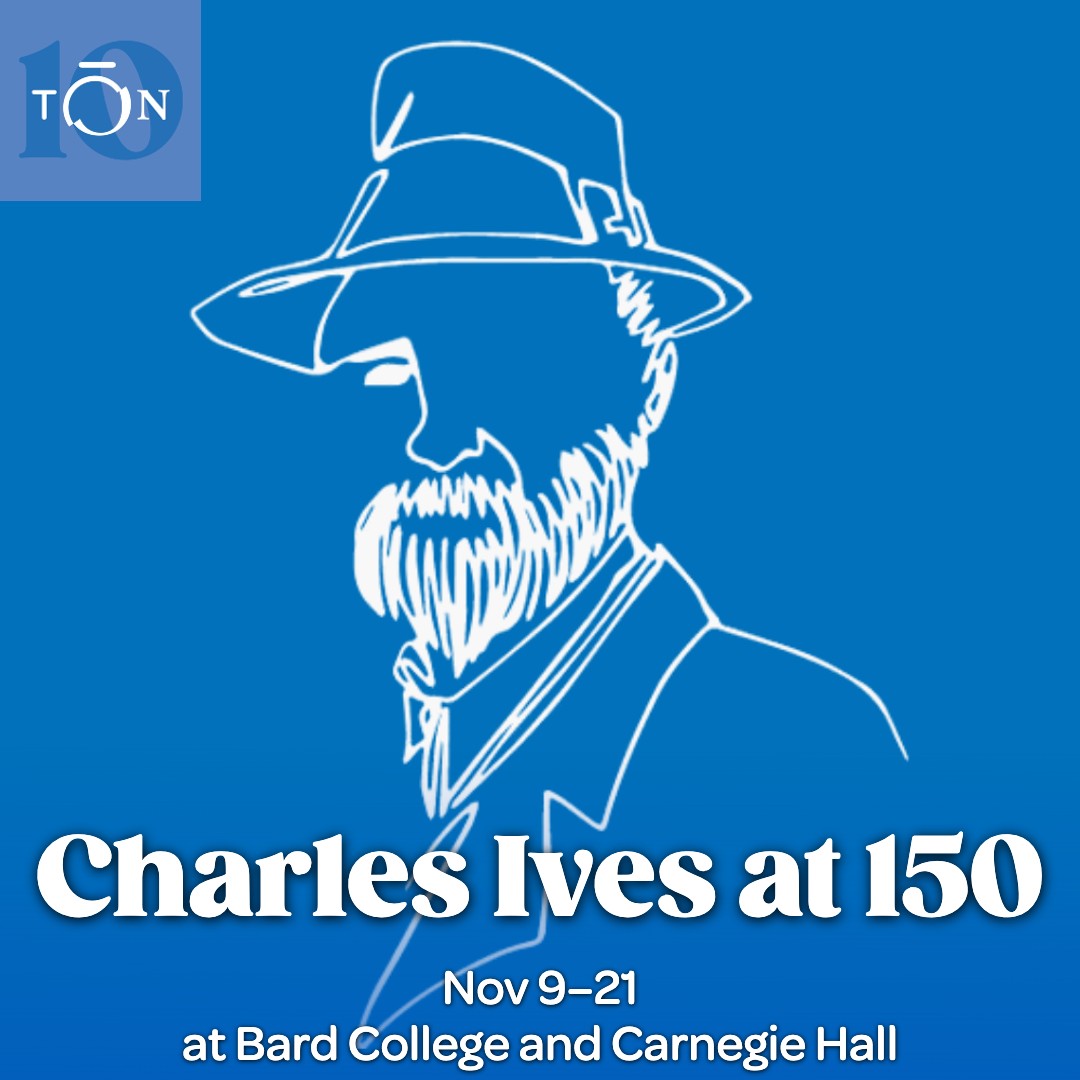
    So imagine my excitement when my friend, H. Paul Moon – the filmmaker with whom I’ve been working on a documentary about the cellist Leonard Rose – contacted me to let me know that Leon Botstein and The Orchestra Now (TŌN) would be bringing Ives’ 2nd as part of an all-Ives concert to be performed at Carnegie Hall tonight. His email began, “Small thing here, nothing special, and there’s always another time, but…”

    My response was through-the-roof excitement.

    It so happens, I did notice that TŌN was scheduled to perform the same program at Bard College last weekend – the college is also the base of the Bard Music Festival I so adore (next summer the focus will be on the Czech composer Bohuslav Martinu and his world) – but getting there on a good day is a three-hour drive, and I would have gone on a Sunday afternoon, which would have meant automatic end-of-weekend traffic on my return. So I was on the fence about it – they do so many good concerts up there (of course, many of them are livestreamed, but it’s not the same as being in the hall, at the Fisher Center at Bard) – but when I learned they would be bringing the show to Carnegie, I didn’t even have to think about it. I didn’t even look at my schedule. If I had anything else planned, I would change it. I’m in!

    And what a program! “The Fourth of July.” “Central Park in the Dark.” The Orchestral Set No. 2. And THE SYMPHONY NO. 2!!! Pardon me for shouting, but this is quite simply not only one of my favorite American symphonies; it’s one of my favorite symphonies by anyone, anywhere, for all time.

    Everyone knows Ives the iconoclast, the experimentalist, the cranky Yankee who smashed harmonies and rhythms together like a recalcitrant toddler with its toys in a playpen. But the Symphony No. 2 is different. It distills all of Ives’ musical experiences into one beguiling work that’s like a snapshot of a faded America, with its hymn tunes, parlor songs, and patriotic marches, recollected through a nostalgic, but no less vital for it, glow.

    It also serves as a portrait of the artist as a young man, assimilating works by Bach, Beethoven, Brahms, Wagner, Dvořák, Bruckner, and others. So if you were ever curious to hear Beethoven’s 5th Symphony and Wagner’s “Tristan und Isolde” rub shoulders with “America the Beautiful,” “Camptown Races,” “Turkey in the Stray” and “Columbia, the Gem of the Ocean,” then this is the symphony for you. Truly, the more you know about music, the more you’ll be able to get out of it.

    All that aside, the music is simply gorgeous, transporting, and exciting – of its time, and perhaps even now (though a lot of the allusions will likely be lost on many), quintessentially American. For me, this is a perfect Thanksgiving concert.

    Before each piece, baritone William Sharp will sing some of the songs Ives references. There will be a pre-concert talk at 6:00, with the performance beginning at 7:00.

    Of course, any time I’ve got a ticket to Carnegie Hall, it rains. I’d say there’s a good 90 percent chance of that happening, always. Well over a month, probably six or seven weeks, without rain in New Jersey, and now there’s rain in the forecast for today and tomorrow. Next time there’s a drought, just buy me a ticket to Carnegie Hall.

    I’ll try to add a picture of the poster tonight.

    For more information about the concert, look here:

    https://www.carnegiehall.org/Calendar/2024/11/21/The-Orchestra-Now-0700PM

    Leonard Bernstein introduces Ives’ Symphony No. 2

  • Berlioz’s Crazy Genius at Bard Festival

    Berlioz’s Crazy Genius at Bard Festival

    Hector Berlioz was not the kind of guy to always go about things the way you might expect. For instance, if you wanted to impress a prospective lover, would you think it would be in your best interest to write a programmatic symphony, in which your obsession with her drives you to overdose on opium? Then, under its influence, to dream about murdering her, so that you’re condemned to execution by the guillotine? Then to vividly illustrate being tormented in the Hereafter by her spirit, now transformed into a jeering, cackling witch?

    Well, Berlioz, arch-Romantic that he was, was a guy who followed his gut. And what do you know, it worked! The Shakespearean actress Harriet Smithson, who inspired the piece (even though Berlioz didn’t speak English and she couldn’t speak French), said “I do.” Some chicks dig the crazy.

    Not that they lived happily ever after. I know, who could have predicted it?

    Anyway, this is the backdrop to Berlioz’s “Symphonie fantastique,” his most famous work, and it kicked off the Bard Music Festival, “Berlioz and His World,” at Bard College’s Fisher Center for the Performing Arts on Friday night. Leon Botstein, founder and co-artistic director of the festival (and president of Bard College), conducted The Orchestra NOW (TON for short), Bard’s graduate-level training orchestra.

    As is so often the case, if you own a recording of the piece, for as transporting as it might be, it just isn’t the same as hearing it live. Reencountering Berlioz’s forward-looking symphony (which must have caused heads to explode in 1830) blew my hair back, or what’s left of it, again and again. It’s hard to believe I once had a coif every bit as impudent as the composer’s. Why, it seems like only yesterday…

    But I digress.

    With its faltering chromatic harmony, beefed-up orchestra (for the period), Beethovenian length, and outlandish instrumental effects, it pushed the envelope decades into the future. Wagner (among others) glommed onto Berlioz, but the composer’s legacy truly flourished with the generation of Gustav Mahler, nearly 70 years later. That’s an entire lifetime. His concept of the “idée fixe,” a recurring motif that intrudes on the flow of every movement, signifying unbidden remembrances of the composer’s beloved, was also influential.

    On to the performance at hand: I may have heard wilder ones, but none quite so visceral. With the strings at stage level, the rowdier instruments were positioned on risers, and the bass drums in particular were like volcanoes that exploded into the audience. The chimes that herald the “Dies Irae,” a presentiment of the doom if ever there was one, were immediate and chilling. It was great fun to watch the strings put through their diabolical repertoire of col legno, con sordino, pizzicato, tremolo, and double stopping, and the ensemble was able to bring the energy to put the piece over the top and bring a sense of abandon at its peak moments.

    Also notable was the inclusion of the obbligato cornet in the second movement, the one in which composer’s pangs of longing contrast with the spirited whirl of festivity at a ball, a touch seldom employed. Apparently Berlioz added the cornet (perhaps for the virtuoso Jean-Baptiste Arban), but it never made it into the published score in the composer’s lifetime. I love you, Berlioz, but in this instance I think your original conception was best. For me, the cornet brings unfortunate associations with the gazebo or the boardwalk, and also obscures the elegance of this waltz through the composer’s haunted mansion – but it was ear-opening to hear the alternative version for once at Bard. Part of the festival’s mission, after all, is to be a platform for scholarly inquiry and display. If the movement were going to be done this way, this was definitely the context in which to do it. (I believe the cornet soloist was Jid-anan Netthai, but this I will have to confirm.)

    I confess, I had my reservations about starting the festival with such a substantial and well-known piece. When the program was first announced, I was puzzled as to why Bard, known for its exploration of unusual and the neglected repertoire, would open its festival with Berlioz’s greatest hit. But in the event, it certainly paid off and got blood pumping. I also realized after a moment’s reflection, its inclusion provided the necessary context for the full appreciation of the seldom-encountered “Lelio,” which was heard on the second half of the concert.

    A sequel of sorts to the “Symphonie fantastique,” “Lelio, or the Return to Life” comes across as a much more self-indulgent affair, if only because of the extensive dramatic commentary allotted to the narrator. Again, this is a heavily autobiographical piece. Unfortunately, if you take away all the lofty references to art and Shakespeare, it’s basically the whiny “reflections” of a lovelorn 20-something.

    The Bard presentation made it even more so. I have nothing against Babe Howard (the son of Debra Winger), who was presumably a late substitute for the scheduled narrator, Wyatt Mason, and I wish him all the best with his career. But here he came across as sorely miscast and underprepared, to the extent of not perhaps fully understanding the character of the figure he was meant to portray. I can think of no lower compliment than to say that I could have done it just as well myself. (I too spent much of my twenties as lofty, whiny, and lovelorn.) For me, it was just too much of a stretch to accept him as the convincing alter ego of a seething, half-mad artist, emerging from an opium-induced nightmare to grasp his breaking heart. About the only thing he played convincingly was young. Also, he didn’t impress me much as an actor accustomed to appearing on the stage. That’s not to say the technique will not come, but I imagine he would be much more at home in something more contemporary.

    That aside, the music was fascinating, and very well performed. Having previously known “Lelio” only from recordings – especially Jean Martinon’s, in which the narrator delivers his part in French – it was as if the scales had fallen from my eyes. THIS is what Bard is all about! I’ve aired the concluding “Fantasy on Shakespeare’s ‘The Tempest’” on my radio shows many times, but I had no idea the entire score was so varied and beautiful, with the quality of the music quite high. That said, it’s impossible that it will ever secure a place in the public’s affection equal to that enjoyed by the “Symphonie fantastique,” especially as presented here, as the composer originally intended, emulating the salon format, so popular in that era, but also in the guise of a melodrama, a largely-defunct genre in which narration and music are combined to form a cohesive dramatic statement.

    As always, the Bard Festival Chorus and vocal soloists were first-rate, with bass-baritone Alfred Walker delivering a lusty “Brigands’ Song” and tenor Joshua Blue (who returned on Saturday night to solo in Berlioz’s “Te Deum”) lending further allure to “The Fisherman Ballad” and the “Song of Happiness.” The cumulative effect was one of magnification of the impressive range of Berlioz’s genius, which ranges well beyond the heaven-storming orchestral works that are so well known, especially as a composer for voice.

    I pause to wonder: whatever happened to the brigand, anyway? It’s a career that seems to have gone the way of the melodrama.

    All in all, a rewarding, often captivating, and at times even thrilling evening, and presented in a manner that Bard has perfected over the past 33 seasons. Bravo, and more, please!

    The Bard Music Festival continues through August 18. For more information, follow the link.

    https://fishercenter.bard.edu/whats-on/programs/bard-music-festival/

    Fisher Center at Bard

  • Leon Botstein on Vaughan Williams at Bard

    Leon Botstein on Vaughan Williams at Bard

    Profoundest thanks to Leon Botstein, music director of the American Symphony Orchestra, founder and music director of The Orchestra Now (TŌN), and president of Bard College, very generous with his time this morning in discussing the music of Ralph Vaughan Williams, along with a great many other things, in connection with an article I am preparing on this year’s Bard Music Festival.

    Botstein is co-artistic director of the festival, which completed its 33rd season on Sunday. He possesses an enviable combination of traits and talents, not least of which include intellectual curiosity, clearness of purpose, and an uncanny ability to trace baroque lines of thought through a network of arabesques while somehow never losing sight of his conclusions. The whole process is rather breathtaking, I must say. He plants his landings like an Olympic gymnast.

    He also seems genuinely interested in getting to know his interviewer. It’s not the first time we spoke, but I walk away feeling as if the conversation was nearly as much about me as it was him. Of course, I won’t be appearing in the article.

    Thanks again, President Botstein. Looking forward to “Berlioz and His World” at Bard in 2024!

    Fisher Center at Bard

Tag Cloud

Aaron Copland (92) Beethoven (95) Composer (114) Film Music (120) Film Score (143) Film Scores (255) Halloween (94) John Williams (185) KWAX (229) Leonard Bernstein (100) Marlboro Music Festival (125) Movie Music (135) Opera (198) Philadelphia Orchestra (88) Picture Perfect (174) Princeton Symphony Orchestra (106) Radio (87) Ralph Vaughan Williams (85) Ross Amico (244) Roy's Tie-Dye Sci-Fi Corner (290) The Classical Network (101) The Lost Chord (268) Vaughan Williams (103) WPRB (396) WWFM (881)

DON’T MISS A BEAT

Receive a weekly digest every Sunday at noon by signing up here


RECENT POSTS