I try to watch “The Quiet Man” every year on St. Patrick’s Day, whether I need it or not. If, already a quarter of the way into the 21st century, this confirms that I am hopelessly out of touch, so be it. Someday, someone will pry this twee, politically-incorrect Irish fable from my cold dead hand.
I’m working my way through the recent John Williams biography by Tim Greiving, and although I am having some major issues with it (the book, published by Oxford University Press, reads like a first draft, to put it kindly), it is obviously written with love and chock full of valuable information. I know Williams always speaks fondly of Victor Young, but it was interesting to learn that Young’s music for “The Quiet Man,” which Williams saw in the theater in 1953, was one of the first film scores that really made him sit up and take notice and made him consider the possibility of writing for the movies.
I guess this makes sense, especially with having everything laid out chronologically in a biography. Progressions become clearer, and from the start Williams was always a gifted arranger. I mean, his first Academy Award was for his arrangements for Norman Jewison’s film of “Fiddler on the Roof,” and it was far from his first musical. Even apart from the movies, Williams was arranging for and accompanying Frank Sinatra, Vic Damone, Frankie Laine, and so many others. So he would have had a connoisseur’s appreciation of what Young achieved in his score for “The Quiet Man,” which positively overflows with inspiring arrangements of folk and popular song and sentimental ballads.
On a related note, for a long time, after having run across some clips, probably on YouTube, I’ve wanted to see a film called “Broth of a Boy.” It stars Barry Fitzgerald (who plays the “Quiet Man’s” insatiably thirsty Michaeleen Oge Flynn) as the oldest man in the world. With that premise, how could it miss? Unfortunately, the film is seemingly unavailable in the United States – only intensifying my desire to see it – and the reviews I’ve read ranged from mildly charmed to middling. So I certainly knew not to expect a classic.
Every year, around St. Patrick’s Day, I search for it, and what do you know, last night I found it on YouTube! The transfer is barely adequate, but you know how old movies are from the United Kingdom. Even the Alastair Sim version of “A Christmas Carol” (released in the U.K. as “Scrooge” in 1951 – a year before “The Quiet Man!”) looks like it was made in the 1930s. I don’t blame the technology; I blame post-war austerity.
Anyway, “Broth of a Boy” looks older than its years, as for that matter, does Barry Fitzgerald. His character is supposedly 110. Fitzgerald died in 1961 at the age of 72. But here, in 1959, he looks tired. Or maybe he was just hammered the whole time.
Be that as it may, if you’re a “Quiet Man” fan, I think you will find much to enjoy. The humor and characterizations are of the same cloth, and both films employ actors from Dublin’s Abbey Players – the National Theatre of Ireland – although, as far as I can tell, Fitzgerald is the only common denominator between the two.
Alas, the screenplay isn’t as consistent or sharp, and the scenes are not always the most imaginatively captured. I sure do miss John Ford’s direction and Technicolor. The score, by Stanley Black, will never be mistaken for Victor Young. The film feels longer than its 77 minutes, but if you are a “Quiet Man” die-hard, you might want to give it a shot. Or have a few yourself, if you know what’s good for you.
Tag: The Quiet Man
-
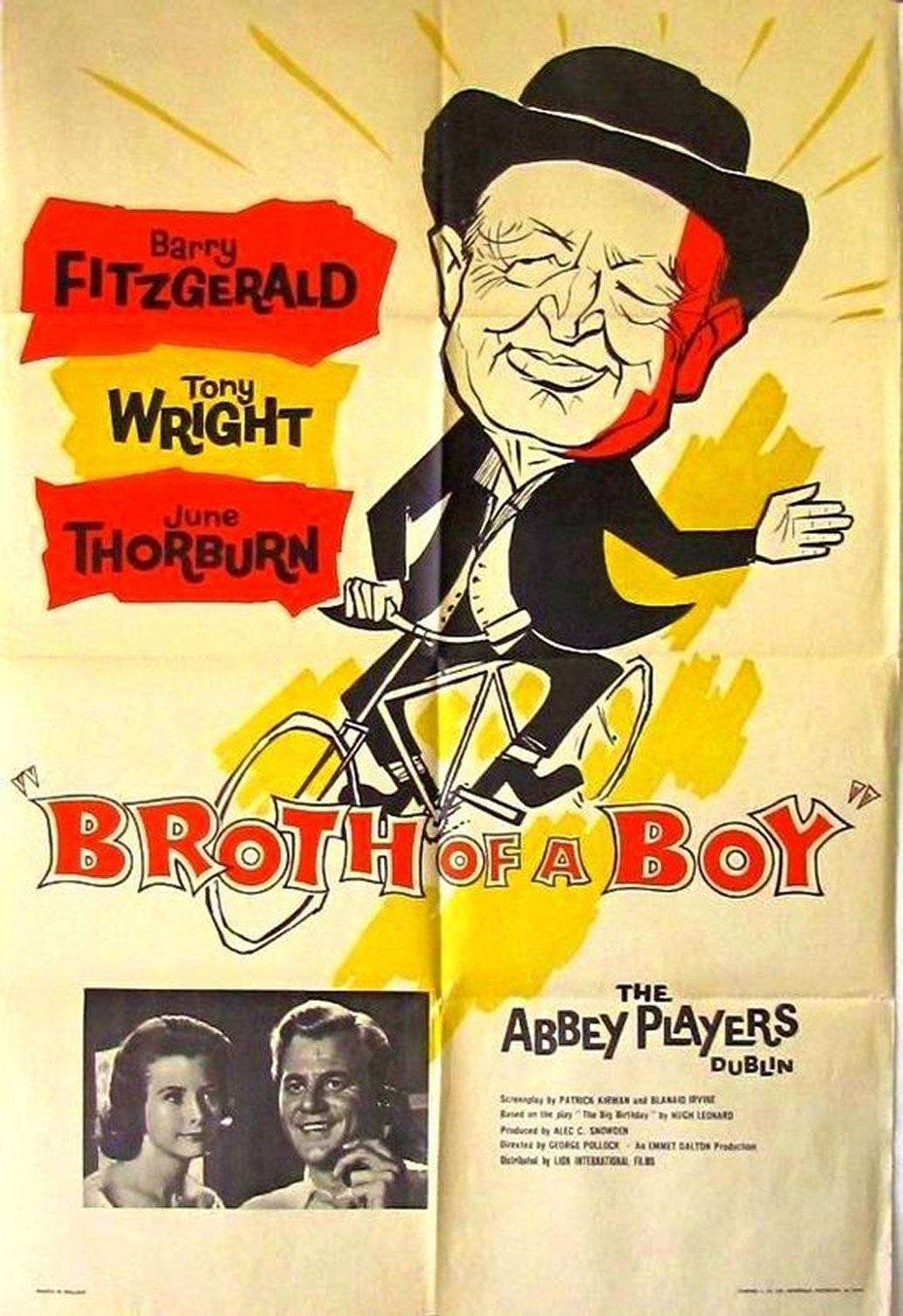
Raising a Pint to Barry Fitzgerald for St. Patrick’s Day
-

Irish Movie Music The Quiet Man and More
Bad luck for Victor McLaglen. Still three days away, but John Wayne will pound his face so hard that he’ll still be spitting teeth on St. Patrick’s Day.
McLaglen gets his lathering in the epic climax of John Ford’s “The Quiet Man.” Victor Young’s score will be one of the highlights this week, on “Picture Perfect,” which will be devoted to films with Irish settings and Irish themes.
“The Luck of the Irish” (1948) stars Tyrone Power as an American journalist who travels to Ireland, where he gets in touch with his roots – and a full-size leprechaun, played by Cecil Kellaway.
No “Darby O’Gill”-style special effects here. Kellaway is just some guy in a leprechaun hat. When Power comments, “Say, aren’t you rather large for a leprechaun?,” Kellaway responds, “That’s a page of me family history I’d rather we not go into.” It was hoped that Barry Fitzgerald would have taken the role – and how perfect would that have been? – but he couldn’t be secured. In the event, Kellaway was nominated for an Academy Award for Best Supporting Actor.
The music is by the English-born Cyril J. Mockridge, who was Alfred Newman’s assistant at 20th Century Fox. Mockridge is probably best known for his score to “Miracle on 34th Street.” “The Luck of the Irish” is full of Celtic-style folk melodies and some shimmering leprechaun music, but why it quotes “Greensleeves” is anybody’s guess. Probably at the request of a producer. (Green = Irish, right?)
John Williams wrote a gorgeous, melancholy score for “Angela’s Ashes” (1999), adapted from Frank McCourt’s bestselling memoir. It’s refreshing to hear Williams give free rein to his lyrical side, beyond the context of lightsabers, magic wands and rampaging dinosaurs. The recording we’ll hear is from the difficult-to-acquire international release. The version issued stateside was marred by dialogue from the film. (Why do they do that?)
You can’t have an hour of Irish film music without including something with The Chieftains. “Circle of Friends” (1995) is based on the novel by Maeve Binchy, about three childhood friends, who reunite in college, and their adventures with the young men they find there. The film stars Minnie Driver, Chris O’Donnell, Alan Cumming and Colin Firth. Michael Kamen wrote the score, but it’s The Chieftains, obviously, that lend it an air of authenticity.
Finally, Victor Young’s palette is all green in “The Quiet Man” (1952). John Wayne, Maureen O’Hara, Barry Fitzgerald, Victor McLaglen, Mildred Natwick, Ward Bond, and a Mulligan stew of American and Irish character actors flesh out what must be John Ford’s most delightful film. It earned him his fourth Academy Award for Best Director, and the film itself was nominated for Best Picture.
The alternately romantic and boisterous, folk-inflected score perfectly complements Ford’s tone of sustained whimsy, for what is essentially a love story unfolding in the face of cultural differences. Also the face of Victor McLaglen.
Shamrocks will shake amidst the blarney rubble, on “Picture Perfect,” music for the movies, now in syndication on KWAX, the radio station of the University of Oregon!
Clip and save the start times for all three of my recorded shows:
PICTURE PERFECT, the movie music show – Friday at 8:00 PM EDT/5:00 PM PDT
SWEETNESS AND LIGHT, the light music program – Saturday at 11:00 AM EDT/8:00 AM PDT
THE LOST CHORD, unusual and neglected rep – Saturday at 7:00 PM EDT/4:00 PM PDT
Stream them, wherever you are, at the link!
-

Quiet Man to Castle Gillian The Irish Literary Journey
Last year on St. Patrick’s Day, I posted some thoughts on John Ford’s perennial classic, “The Quiet Man” (1952), and Maurice Walsh’s book, “Green Rushes” (1935), the collection of stories – really a novel, as all the stories are interconnected – that inspired it. I finally got around to reading it in a reissue, as “The Quiet Man and Other Stories,” after having had it in my library for 30 years.
Toward the end of the post, I mentioned a forthcoming musical, based on another Walsh novel, “Castle Gillian” (1948). (An earlier musical based on “The Quiet Man,” “Donnybrook,” tanked in 1960.) Well, it appears “Castle Gillian” is upon us, and it looks like one freaky, virtual reality uncanny valley. To borrow from the title of yet another one of Walsh’s books, trouble in the glen, indeed!
More about it here
https://fivars.net/spotlight/fivars-2023-spotlight-on-castle-gillian-an-irish-tale/
More still
https://www.kazanandpurcell.com/castle-gillian/
My reflections on Maurice Walsh and “The Quiet Man”
An interview with Maurice Walsh
https://www.rte.ie/archives/2022/1030/1330613-writer-maurice-walsh/
-

The Quiet Man Book vs Movie A Surprising Tale
This is another one of those books I’ve had in my library for 30 years. I finally took it down to read it as part of my St. Patrick’s Day celebrations. Last year, I had it out, thinking I’d read just the title story, but then time got away from me (again), and I figured I’d save it for 2023, hoping to read the entire collection. And I’m glad I did. Because if you read just “The Quiet Man,” you’re not getting the full story.
First of all, the 1952 John Ford classic, starring John Wayne and Maureen O’Hara, is one of my favorite movies. If you’re put off by Wayne, thinking this going to be like one of his westerns (many of which I’ve also grown to love), give it a shot. I think you’ll really enjoy it. It’s full of whimsy, with a colorful supporting cast of memorable character actors. I’m sure there are some Irish who are worn out on the stereotypes, and maybe millennials, if they ever watch anything made before 1980, who would be appalled at the treatment of O’Hara’s Mary Kate; but if you meet it on its own terms, I find it very hard to believe it won’t charm your emerald socks off. I try to watch it every St. Patrick’s Day over several pints of Guinness. (One of these days I’ll have to write about “The Quiet Man” Drinking Game, if I haven’t done so already.)
But this is not a review of the movie, and if you’ve read this far, you are probably of an age that it would already be familiar to you in any case, so I’ll get to the matter at hand.
Maurice Walsh’s “The Quiet Man and Other Stories” – retitled, because of the success of the film, from “Green Rushes” – has very little in common with Ford’s adaptation. In fact, any reader who picks it up expecting the porter-fueled hilarity of that leprechaun incarnate Barry Fitzgerald is in for a shock. Because Walsh’s original tales, set during and after the Black-and-Tan War, all deal with the IRA, men and women (and the oblique manner in which they sometimes communicate), and the pleasures of fishing. It’s small wonder that Hemingway was an admirer. These stories are nothing at all like the film version, but I’d be lying if I said they weren’t fascinating. And very well written, in the manner of the day. (Walsh was one of Ireland’s bestselling authors of the 1930s.) The prose is evocative without entirely tipping its hand, so that there’s plenty to be gleaned from reading between the lines.
Basically, the screenwriters took the premise of the title short story and a couple of lines of dialogue (surely no more than two or three), and then just went with their own thing. It is amusing and disorienting to discover that many of the characters look and behave quite differently than they do in the film. Michaleen Oge Flynn is Mickeen Oge Flynn in the stories and, beyond his fondness for a pipe and his involvement with the IRA (quite subtle in the film), by no stretch of the imagination is he anything like Barry Fitzgerald.
There is no Sean Thornton. In the book, he’s Paddy Bawn Enright – named after one of Walsh’s real-life field hands – and his dark, squat-but-powerful, heavy-browed character does not in any way resemble John Wayne. Closer is Art O’Connor, an Irish-American who comes to Ireland, he says, for the fishing. Mary Kate Danaher, the Maureen O’Hara character, is Ellen Roe Danaher in the book. She’s given a lot more to do in the movie. In fact, the only character I can think of that is pretty much the same on the page as he is on the screen is Red Will Danaher, the hard-headed, closed-fisted slab of beef played by Victor McLaglen.
The primary reason I am thankful for not having simply read the title story, apart from the rest, is that the tales all interlock. The book is more like a novel, in which we learn more about the characters and events with each successive story. Moreover, the stories in themselves are like novellas, subdivided into chapters. There is nothing twee about them. The tone more realistic than fey (although there is a ghost); the stories are serious, but not without flashes of wit. Come to think of it, they all turn out to be love stories, in their understated way. And the rhythms are unmistakably Irish.
The prologue sends ripples across the rest of the book. By the end, I was compelled to go back and reread the beginning, as it wound up having more of a bearing on the conclusion than I previously anticipated. Also, the significance of the original title, “Green Rushes,” is only apparent from the final pages.
In 1954, flush with the success of “The Quiet Man,” Republic Pictures optioned another Walsh story to be made into a film, “Trouble in the Glen.” It reassembled the producers, screenwriters, composer (Victor Young), and some of the crew involved with the previous picture, which was nominated for seven Academy Awards and won two (including a Best Director Oscar for Ford), hoping to recapture some of that Celtic whimsy, though this time transplanted to Scotland. Victor McLaglen returns, but Forrest Tucker steps in for John Wayne, and Orson Welles, who previously adapted and starred in “Macbeth,” plays a Scottish laird.
Alas, Ford was notably absent, and the film was not a success. In fact, Walsh was so depressed by the result that he vowed never to have any more of his books made into films.
I recall, many years ago, my friendly neighborhood video shop had a copy of “Trouble in the Glen” on VHS, but I never got around to renting it. The box had a picture of Tucker beating the tar out of McLaglen, in true “Quiet Man” fashion. For some reason, the film doesn’t appear to be available for streaming anywhere online, but you can watch a couple of clips at the link below. In particular, the opening credits hew closely to those for “The Quiet Man,” right down to Victor Young’s score.
https://www.silversirens.co.uk/productions/trouble-in-the-glen-1954/
Interestingly, I learn even as I write this that a stage musical, “Castle Gillian,” is supposedly in development, based on another one of Walsh’s books. A musical of “The Quiet Man,” called “Donnybrook,” was produced in 1960, but flopped.
At any rate, if it sounds appealing, and you can find a copy, you might consider giving Walsh’s “The Quiet Man and Other Stories” (or “Green Rushes”) a whirl. I picked mine up off a remainder table at Borders bookstore back in the early ‘90s. My library is full of books purchased over the past 40 years that I have not read and I am very glad not to have traded them off or sold them outright! But what’s the purpose of a library, if not to stock it with future dreams and hidden treasures?
-

Kenneth Alwyn Film Music Conductor Dies at 95
Oh my goodness! The conductor Kenneth Alwyn has died.
Alwyn recorded many popular classics and much film music. I remember the thrill of discovering his first, extensive digital recordings of music from “The Bride of Frankenstein” and “The Quiet Man” – two of my desert island film scores – in the bins at Tower Records.
He also conducted Decca’s first stereophonic recording of the “1812 Overture” and several albums devoted to the works of Richard Addinsell, including, of course, the ubiquitous “Warsaw Concerto.”
He was an experienced ballet and musical theater conductor. He held posts at the Sadler’s Wells Theatre Ballet and the Royal Ballet, Covent Garden. He served as musical director at the English premieres of many British and Broadway musicals. He recorded ballet music by Lord Berners. He made at least two very fine recordings of works by Samuel Coleridge-Taylor, including the complete oratorio, “The Song of Hiawatha.”
Some of Alwyn’s other memorable records include albums devoted to Max Steiner, a selection of music from Ealing Studios comedies, and orchestral highlights from classic British film scores by Vaughan Williams, Sir Arthur Bliss, and others. For Silva records, he led collections devoted to Alfred Newman, Miklós Rózsa, and Ennio Morricone, as well as any number of thematically-organized anthologies.
In 1992, he toured with the BBC Concert Orchestra, with his friend, Dudley Moore, at the piano.
Alwyn died yesterday at the age of 95. By coincidence, I happened to include his recording of Sir Arnold Bax’s “Oliver Twist” on last night’s broadcast of “Picture Perfect,” and on Friday, shipped his recording of Paul Ben-Haim’s Symphony No. 2, as part of a Christmas mailing to a friend.
R.I.P. Kenneth Alwyn.
Tag Cloud
Aaron Copland (93) Beethoven (95) Composer (114) Film Music (144) Film Score (143) Film Scores (255) Halloween (94) John Williams (195) KWAX (229) Leonard Bernstein (104) Marlboro Music Festival (125) Movie Music (159) Mozart (90) Opera (212) Philadelphia Orchestra (89) Picture Perfect (174) Princeton Symphony Orchestra (109) Radio (88) Ross Amico (244) Roy's Tie-Dye Sci-Fi Corner (290) The Classical Network (101) The Lost Chord (269) Vaughan Williams (105) WPRB (397) WWFM (881)