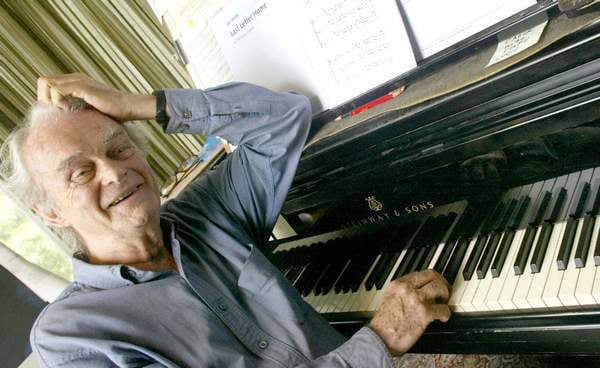
Today marks the 100th anniversary of the birth of American composer Lee Hoiby. Hoiby, a disciple of Gian Carlo Menotti, wrote a lot of vocal music and received particular acclaim for his operas. However, I first discovered him through an old recording of his Piano Concerto on the CRI label.
Hoiby, born in Madison in 1926, studied at the University of Wisconsin with Gunnar Johansen and Egon Petri. (His early ambition had been to become a concert pianist.) Then he struck out for California, where he studied at Mills College with Darius Milhaud. In San Francisco, he worked with a number of musicians whose thinking was decidedly outside-the-box, including Rudolf Kolisch, brother-in-law of Arnold Schoenberg, and Harry Partch.
It’s interesting, therefore, that his own music would wind up being so traditional. Chalk it up to further studies with Menotti at the Curtis Institute of Music in Philadelphia. It was Menotti who introduced Hoiby to opera, instilling in him a life-long love of the human voice. Hoiby was employed as an assistant on the Broadway debut productions of Menotti’s “The Consul” and “The Saint of Bleecker Street” (the latter of which earned his teacher a Pulitzer Prize). Menotti would produce Hoiby’s first opera, “The Scarf” (1958). Eight more would follow. The most highly-regarded of these is perhaps his Tennessee Williams adaptation, “Summer and Smoke” (1971).
Hoiby also had a powerful champion in Leontyne Price, who introduced many of his best-known arias and songs. He claimed Franz Schubert as an important influence. “What I learned from Schubert came from a long, deep and loving exposure to his songs. A lot happens on a subconscious level, so it’s hard to verbalize, but what I think his songs taught me have to do primarily with the line, the phrasing, the tessitura, the accentuations of speech, the careful consideration of vowels, the breathing required, and an extremely economical use of accompaniment material, often the same figure going through the whole song.”
I first encountered Hoiby’s opera – or perhaps monodrama – “Bon Appetit!” about five years ago, when it was streamed by Opera Philadelphia, with Jamie Barton as Julia Child. The work, Straussian (late Straussian) in its intimacy and word-painting, is through-sung, with a libretto essentially compiled from two transcripts of Child’s popular public television program, “The French Chef.” Most of it is lifted from an episode devoted to the creation of L’Éminence Brune, a classic French chocolate cake.
First performed at the Kennedy Center by Jean Stapleton with Hoiby at the keyboard in 1989, this is a work that seems to have really gained traction since the pandemic, since it requires a lone singer (no need for social distancing), often supported by a pianist (inexpensive). I was delighted to have been able to catch it live when it was performed at the Trenton State Museum in 2024, with mezzo-soprano Christine Meadows and the Philadelphia Virtuosi Chamber Orchestra, in a version for ten players, which I didn’t even know existed, enjoyment of the piece unquestionably enhanced by the additional musical colors.
Wholly by coincidence, not long after watching the Barton stream, I revisited a DVD I own of a production of “The Taming of the Shrew” that was staged by the American Conservatory Theater of San Francisco in 1976. Lo and behold, the incidental music is by Lee Hoiby!
The production is robust, Rabelaisian (influenced by commedia dell’arte, actually), and it moves like lightning. Come to think of it, it would be an appropriately festive viewing choice for Carnival. I guarantee it will charm your pantaloons off. And it is introduced by the late Hal Holbrook (with cigarette, no less).
Furthermore, it features Marc Singer as Petruchio, in a performance of astounding physicality. Indeed, it’s a wonder that any of the actors have enough breath to speak their lines. Singer went on to notoriety in the 1980s, when he seemingly singlehandedly sustained cable television through incessant repeats of his breakout feature, “The Beastmaster.”
Watch “The Taming of the Shrew” here, and see if you don’t owe me a debt of thanks. And note Hoiby’s contribution.
https://www.youtube.com/watch?v=ZMdXHoZD6Ag
Leontyne Price sings “Winter Song” (1950)
https://www.youtube.com/watch?v=McTpedYH15U
Schubert Variations (1981)
https://www.youtube.com/watch?v=X6K7IKG7oqs
Hoiby’s Piano Concerto (1957)
https://www.youtube.com/watch?v=jI_eCWlZ6_o&list=OLAK5uy_kddqucIKS2L3_HC4-JHoduWLauok6SEjM&index=5
Christine Meadows performs “Bon Appetit!”
https://www.youtube.com/watch?v=cTMg-mlzhRE
The primary episode of “The French Chef” adapted by Hoiby
https://www.facebook.com/watch/?v=1316700049262748
Audio of Jean Stapleton performance at the Kennedy Center
https://soundcloud.com/astrodreamer/bonappetit-jean-stapleton-composer-lee-hoiby
All roads lead to Lee Hoiby! Happy centenary!
Tag: The Taming of the Shrew
-
100 Years of Lee Hoiby
-

Lee Hoiby at 95 Opera Broadway Shrew
I note that today would have been the 95th birthday of American composer Lee Hoiby. Hoiby, a disciple of Gian Carlo Menotti, wrote a lot of vocal music and received particular acclaim for his operas. However, I first discovered him through an old recording of his Piano Concerto on the CRI label.
Hoiby, born in Madison, Wisconsin, in 1926, studied at the University of Wisconsin with pianists Gunnar Johansen and Egon Petri. (His early ambition had been to become a concert pianist.) Then he struck out for California, where he studied at Mills College with Darius Milhaud. In San Francisco, he worked with a number of musicians whose thinking was decidedly outside-the-box, including Rudolf Kolisch, brother-in-law of Arnold Schoenberg, and Harry Partch.
It’s interesting, therefore, that his own music would wind up being so traditional. Chalk it up to further studies with Menotti at the Curtis Institute of Music in Philadelphia. It was Menotti who introduced Hoiby to opera, instilling in him a life-long love of the human voice. Hoiby was employed as an assistant on the Broadway debut productions of Menotti’s “The Consul” and “The Saint of Bleecker Street” (the latter of which earned his teacher a Pulitzer Prize). Menotti would produce Hoiby’s first opera, “The Scarf” (1958). Eight more would follow. The most highly-regarded of these is perhaps his Tennessee Williams adaptation, “Summer and Smoke” (1971).
Hoiby also had a powerful champion in Leontyne Price, who introduced many of his best-known arias and songs. He claimed Franz Schubert as an important influence. “What I learned from Schubert came from a long, deep and loving exposure to his songs. A lot happens on a subconscious level, so it’s hard to verbalize, but what I think his songs taught me have to do primarily with the line, the phrasing, the tessitura, the accentuations of speech, the careful consideration of vowels, the breathing required, and an extremely economical use of accompaniment material, often the same figure going through the whole song.”
Interestingly, Hoiby’s Julia Child opera – or perhaps monodrama – “Bon Appetit!” (1986) was streamed only weeks ago by Opera Philadelphia, with Jamie Barton as “The French Chef.”
Then this week, wholly by coincidence, I happened to revisit a DVD I had picked up perhaps 15 years ago of a production of “The Taming of the Shrew,” performed by the American Conservatory Theater of San Francisco in 1976. Lo and behold, the incidental music is by Lee Hoiby!
The production is robust, Rabelaisian (influenced by commedia dell’arte, actually), and it moves like lightning. In this season of perpetually inclement weather, perhaps it would make for a pleasant diversion. I guarantee it will charm your socks off. And it is introduced by the late Hal Holbrook (with cigarette, no less).
Furthermore, it features Mark Singer as Petruchio, in a performance of astounding physicality. Indeed, it’s a wonder that any of the actors have enough breath to speak their lines. Singer went on to notoriety in the 1980s, when he singlehandedly sustained cable TV through incessant repeats of his breakout feature, “The Beastmaster.”
Watch “The Taming of the Shrew” here, and see if you don’t owe me a debt of thanks. And note Hoiby’s contribution.
Leontyne Price sings “Winter Song” (1950)
Schubert Variations (1981)
Hoiby Piano Concerto (1957)
Jamie Barton as Julia Child
https://www.operaphila.org/about/news-press/pressroom/2020/bon-appetit/
All roads lead to Lee Hoiby! Happy birthday.
Hoiby at the keyboard, and (left to right) with Jean Stapleton; Jamie Barton as Julia Child; and Mark Singer taming the shrew
Tag Cloud
Aaron Copland (92) Beethoven (94) Composer (114) Film Music (116) Film Score (143) Film Scores (255) Halloween (94) John Williams (185) KWAX (228) Leonard Bernstein (99) Marlboro Music Festival (125) Movie Music (131) Opera (197) Philadelphia Orchestra (86) Picture Perfect (174) Princeton Symphony Orchestra (106) Radio (86) Ralph Vaughan Williams (85) Ross Amico (244) Roy's Tie-Dye Sci-Fi Corner (290) The Classical Network (101) The Lost Chord (268) Vaughan Williams (99) WPRB (396) WWFM (881)