Tag: The Wooden Prince

  • Bartók’s Ballets: Mandarin & Wooden Prince

    Bartók’s Ballets: Mandarin & Wooden Prince

    Can one of the great masters of modern music really have been born 144 years ago? I can remember hearing Béla Bartók’s Concerto for Orchestra, his most popular work, on the first Philadelphia Orchestra concert I ever attended, at the Mann Music Center in the summer of 1984, and at the time, he was dead not even 40 years. He was still regarded by many as a “contemporary” composer.

    But I’m not really here to talk about that. Instead I’m going to talk about his ballets.

    Of the two, “The Miraculous Mandarin” (1918-24) enjoys all the notoriety, for its decadent scenario and harrowing music. After all, the story essentially involves two hoods who coerce a young woman into luring men to an abandoned room so they can beat and rob them. One of these is the mandarin of the title, who they attempt to suffocate, stab, and hang, but Rasputin-like he stubbornly refuses to die. He finds release only in the woman’s embrace. At last, his wounds begin to bleed, and he passes. This was pretty scandalous stuff, back in the day, and the work was banned on moral grounds. Now it’s one of Bartók’s most-frequently programmed works, though generally shorn of its action.

    For the weak of heart, I offer as an alternative the composer’s other, earlier essay in the form, the ballet-pantomime “The Wooden Prince” (1914-17). This time instead of going for the jugular, Bartók opts to anesthetize everyone with a ponderous fairy tale about true love deferred. Not that I don’t enjoy ponderous fairy tales.

    An ill-natured fairy throws up impediments to the fulfillment of the love of a prince for a princess, turning forest and stream against him and ultimately animating a wooden effigy of the prince the young man has constructed, complete with crown and locks of his own hair, to attract the princess’ attention. When the princess falls for the wooden prince, his flesh-and-blood counterpart falls into despair. The fairy takes pity on him as he sleeps, sets everything to right, and they all live happily ever after.

    Much less frequently performed than Bartók’s subsequent succès de scandale, this fantastic tale for large orchestra bears the influences of Debussy and Strauss, and yes, Wagner too. Never understood why it’s not heard more often. Just because it doesn’t have quite the bite of the composer’s mature masterworks doesn’t mean it isn’t worthwhile.

    On the eve of the centenary of the birth of Pierre Boulez, here he is, at the links, conducting both ballets. I cut my teeth on Boulez’s earlier recording of “The Wooden Prince,” with the New York Philharmonic, but there’s no question the sonics on his remake with the Chicago Symphony Orchestra are superior.

    “The Miraculous Mandarin” (Boulez live)

    “The Wooden Prince” (DG recording)

    Happy 100th (almost), Pierre Boulez, and happy 144th, Béla Bartók!


    1937 production of “The Wooden Prince,” with Gyula Harangozó and Karola Szalay0
  • Bartók Goodman Contrasts Happy Birthday

    Bartók Goodman Contrasts Happy Birthday

    If you want to talk about a study in contrasts, how about Hungarian master Béla Bartók and America’s “King of Swing,” Benny Goodman?

    Goodman’s musical training was classical (he took lessons at the local synagogue and with Chicago Symphony clarinetist Franz Schoepp). But he really caught fire when playing with dance bands. His early influences were New Orleans jazz clarinetists who worked in Chicago.

    He shot to prominence during the Big Band era, but with the decline of swing, he decided to return to his formal studies, this time with English clarinetist Reginald Kell. Goodman developed a lot of bad habits in the intervening years, and he had to rebuild his technique basically from scratch.

    Although a worldwide celebrity who had achieved enormous success, Goodman missed the classics and longed for a little mainstream respectability. Since he was by then in a position to do so, he took up performing and recording Mozart and Weber, and he commissioned or played new works by Copland, Bernstein, and Stravinsky, among others.

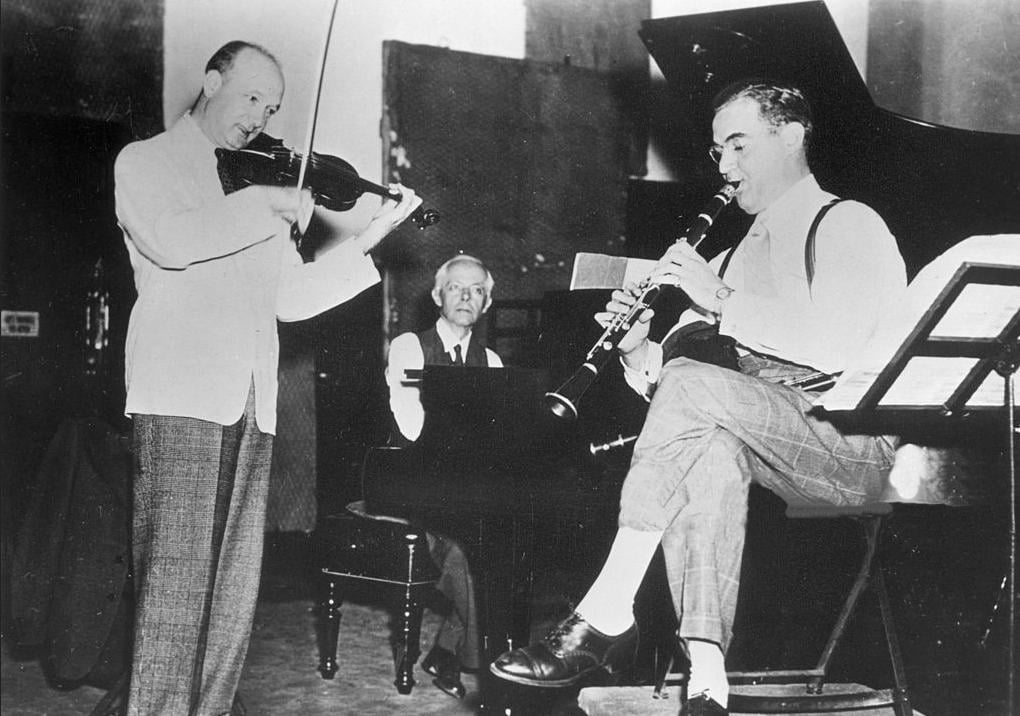
    One of these was Béla Bartók, whose birthday it is today. Bartók composed “Contrasts” in 1938, on a Goodman commission. This trio for clarinet, violin, and piano is a raw, fascinating work, inspired by Hungarian and Romanian dance melodies. It contains passages of bitonality and frenzied scordatura (a deliberate mistuning, or alternate tuning, of the violin). Goodman recorded the work, with violinist Josef Szigeti and the composer at the piano.

    Not your glass of pálinka? By way of “contrast,” check out Bartok’s ballet-pantomime “The Wooden Prince,” composed in 1914-17. Much less frequently performed than his subsequent succès de scandale, “The Miraculous Mandarin,” composed in 1918-24, this musical fairy tale for large orchestra bears the influences of Debussy and Strauss, and yes, Wagner too.

    Never understood why it’s not heard more often. Just because it doesn’t have quite the bite of the composer’s mature masterworks doesn’t mean it isn’t worthwhile.

    https://www.youtube.com/watch?v=vYEijXHFY1w

    From the King of Swing to “The Wooden Prince,” happy birthday, Béla Bartók!


    PHOTO: Bartók at the piano, bookended by Szigeti and Goodman

Tag Cloud

Aaron Copland (92) Beethoven (95) Composer (114) Film Music (119) Film Score (143) Film Scores (255) Halloween (94) John Williams (185) KWAX (229) Leonard Bernstein (99) Marlboro Music Festival (125) Movie Music (134) Opera (198) Philadelphia Orchestra (86) Picture Perfect (174) Princeton Symphony Orchestra (106) Radio (87) Ralph Vaughan Williams (85) Ross Amico (244) Roy's Tie-Dye Sci-Fi Corner (290) The Classical Network (101) The Lost Chord (268) Vaughan Williams (102) WPRB (396) WWFM (881)

DON’T MISS A BEAT

Receive a weekly digest every Sunday at noon by signing up here


RECENT POSTS