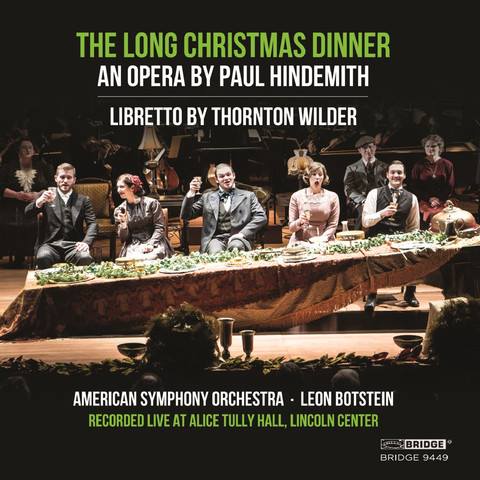
For anyone who’s ever felt like they’ve been stuck on an interminable holiday visit, composer Paul Hindemith has got you licked.
His one-act opera, “The Long Christmas Dinner,” spans 90 years and offers musical snapshots of several generations of the Bayard family as they convene for their annual Yuletide ritual.
The libretto is by Thornton Wilder, based on one his own plays, and shares some of the same concerns as his Pulitzer Prize-winning “Our Town.” Especially characteristic is the passage of time and the human tendency not to savor every precious moment.
Two doors flank the stage, one representative of Birth and the other Death. Family members come and go; historical, political and economic factors impinge on familial relations and the fortunes of the family unit; the specter of war rears its head – all in a 50-minute span.
The work is not without humor, irony, and certainly poignancy. However, it’s all presented in Hindemith’s clean, neoclassical, unsentimental syntax. The opening is a setting of “God Rest Ye Merry, Gentlemen” that suggests anything but unalloyed merriment, sounding somewhat haunted, as if conceived by the Ghost of Christmas Past.
Bridge Records has issued the first English-language recording of the work, captured last year in live performance at Alice Tully Hall at Lincoln Center in New York, and it is satisfying in every way. Of course, seeing the piece live would greatly benefit being able to tell certain characters apart, since some of the singers assume different roles down the generations. Innovatively, it was presented on the second half of the program, preceded by an actual performance of the play.
The conductor, Leon Botstein, has built a career on looking at music through fresh perspectives. Botstein is founder and co-artistic director of the Bard Music Festival. He has been president of Bard College since 1975. He has been music director of the American Symphony Orchestra, heard on this recording, since 1992.
Because of his love of the piece, Maestro Botstein very generously consented to a last-minute phone interview, granted only hours before he had to be on a plane to Budapest. I’ve edited his remarks down to a five-minute spoken introduction. Check back here tonight to hear a more complete version of our conversation, which I will be posting concurrently with the broadcast of the show.
I hope you’ll join me when “Dinner Is Served,” tonight at 10 ET, with a second helping this Wednesday evening at 6; or that you’ll listen to it later as a webcast, at wwfm.org.