Tag: United States Marine Band

  • Lincoln, the Marine Band, and Gettysburg

    Lincoln, the Marine Band, and Gettysburg

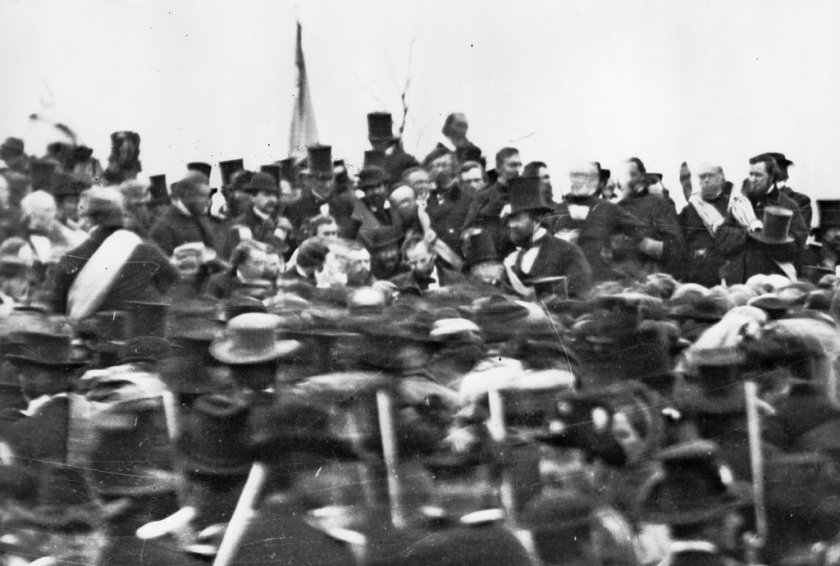
    On November 18, 1863, the United States Marine Band accompanied President Abraham Lincoln to Gettysburg for the dedication of the Soldiers’ National Cemetery there, for which Lincoln was to deliver his celebrated Gettysburg Address.

    Lincoln and the band traveled by train from Washington, by way of Baltimore and Hanover Junction. Directed by Francis M. Scala, the 27-member ensemble, which included trombonist Antonio Sousa, father of John Philip Sousa, serenaded the president on route with a lunchtime concert.

    The next day, November 19th, 157 years ago this afternoon, members of “The President’s Own” performed the “Old Hundred” at the consecration and dedication ceremony, with Lincoln honoring those who fell. According to an article in the Washington Daily Morning Chronicle, the music was played “with great effect, in all its grand and sublime beauty.”

    Lincoln’s Address had a more divided reception – ironic, since this modest, three-minute speech is now ensconced as one of the most hallowed pieces of American oratory. We as Americans have revered Lincoln’s noble sentiments since childhood, for generations, as well we should. It is all the more striking, when viewed through the lens of the present, for not labeling those who laid down their lives as “losers” and for delivering a message of national unity – and respect – at a time of unprecedented national conflict. It doesn’t get more patriotic than that.

    A copy of the Address, signed and dated by President Lincoln, is on display in the Lincoln Room at the White House – a room apparently never visited by the outgoing administration. Here is a reminder of what Lincoln said regarding the sacrifice of those who died.

    “Four score and seven years ago our fathers brought forth on this continent, a new nation, conceived in Liberty, and dedicated to the proposition that all men are created equal.

    “Now we are engaged in a great civil war, testing whether that nation, or any nation so conceived and so dedicated, can long endure. We are met on a great battle-field of that war. We have come to dedicate a portion of that field, as a final resting place for those who here gave their lives that that nation might live. It is altogether fitting and proper that we should do this.

    “But, in a larger sense, we can not dedicate – we can not consecrate – we can not hallow – this ground. The brave men, living and dead, who struggled here, have consecrated it, far above our poor power to add or detract. The world will little note, nor long remember what we say here, but it can never forget what they did here. It is for us the living, rather, to be dedicated here to the unfinished work which they who fought here have thus far so nobly advanced. It is rather for us to be here dedicated to the great task remaining before us – that from these honored dead we take increased devotion to that cause for which they gave the last full measure of devotion – that we here highly resolve that these dead shall not have died in vain – that this nation, under God, shall have a new birth of freedom – and that government of the people, by the people, for the people, shall not perish from the earth.”

    Abraham Lincoln
    November 19, 1863

    https://www.tecom.marines.mil/News/News-Article-Display/Article/527553/the-gettysburg-address-2-minutes-that-changed-a-young-nation-forever/

    The Marine Band at Gettysburg:

    http://tapsbugler.com/wp-content/uploads/2018/11/Lincoln-and-The-Marine-BAnd-at-Gettysburg.pdf

    Copland’s “Lincoln Portrait,” narrated by James Earl Jones:
  • Easter Music White House Egg Roll

    Easter Music White House Egg Roll

    I hope everyone had a good night’s sleep after this year’s maximum food, minimal exercise, isolation Easter.

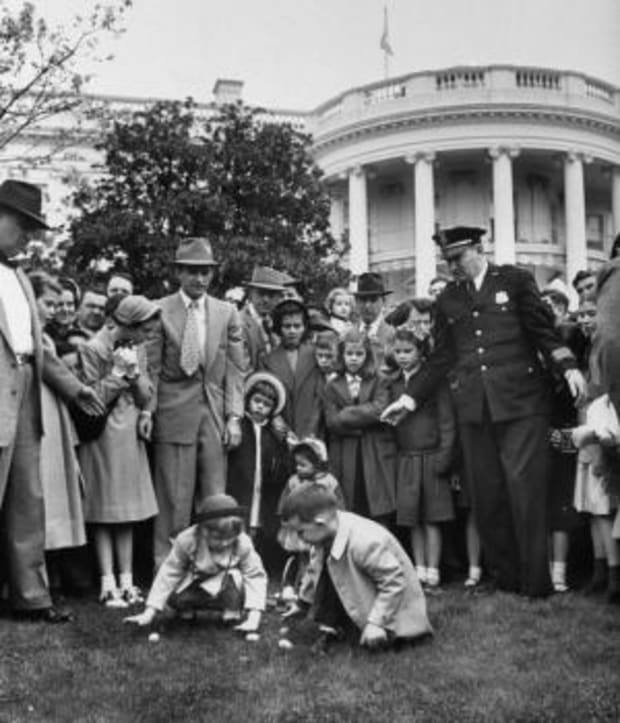
    Ordinarily, I make it a practice never to mention the White House here, if I can help it, but in the interest of music, let us consider the longstanding tradition of Easter Monday and the White House Egg Roll.

    In this case, “Egg Roll” has nothing at all to do with the deep-fried Chinese appetizer (that’s so, so good with hot mustard sauce), but rather the custom, officially instituted by Rutherford B. Hayes in 1878, of springtime celebrations held on the west grounds of the U.S. Capitol. It’s said that similar parties had been held, informally, during the time of the Lincoln administration. Such gatherings were banned, however, under Ulysses S. Grant, because of their destructive impact on the landscaping.

    Children began showing up at the White House gate, and it’s said that President Hayes allowed them in on Easter Monday to continue their deleterious capers. It was Benjamin Harrison who enlisted the participation of the United States Marine Band. Except for two world wars and restoration efforts, which temporarily suspended festivities on the White House lawn, the tradition has continued down to the present day.

    It hardly need be said, even if it weren’t for the torrential rain this morning, this year’s Easter Monday Egg Roll has been cancelled on account of worldwide COVID-19 concerns. Here’s hoping that next year we can again get back to this most ludicrous custom.

    For now, we can still enjoy the music. Here is John Philip Sousa’s “Easter Monday on the White House Lawn,” performed by the United States Marine Band:

    Another piece of music appropriate for the day is Thomas Kerr’s “Easter Monday Swagger.” Kerr, who was born in Baltimore, studied at Howard University (he would have preferred the Peabody Conservatory, but black students were not admitted at that time), then the Eastman School of Music in Rochester, NY. Kerr later taught at Knoxville University, before returning to Howard, where he served for more than 30 years, until his retirement in 1976.

    “Easter Monday Swagger” was recorded by Natalie Hinderas, professor of music at Temple University from 1966 to 1987. In 1971, Hinderas became the first black woman to appear as an instrumental soloist on a regular subscription series of a major symphony orchestra – the Philadelphia Orchestra – when she performed Alberto Ginastera’s Piano Concerto No. 1. This opened the floodgates. After that she received offers from the New York Philharmonic, the Cleveland Orchestra, the Los Angeles Philharmonic, the Atlanta Symphony, the Chicago Symphony, the San Francisco Symphony, and the Pittsburgh Symphony Orchestra.

    Her landmark two-record set, “Natalie Hinderas Plays Music by Black Composers,” was released around the time of her Philadelphia Orchestra debut.

    Thomas Kerr’s “Easter Monday Swagger”:

Tag Cloud

Aaron Copland (92) Beethoven (94) Composer (114) Film Music (117) Film Score (143) Film Scores (255) Halloween (94) John Williams (185) KWAX (228) Leonard Bernstein (99) Marlboro Music Festival (125) Movie Music (132) Opera (197) Philadelphia Orchestra (86) Picture Perfect (174) Princeton Symphony Orchestra (106) Radio (86) Ralph Vaughan Williams (85) Ross Amico (244) Roy's Tie-Dye Sci-Fi Corner (290) The Classical Network (101) The Lost Chord (268) Vaughan Williams (101) WPRB (396) WWFM (881)

DON’T MISS A BEAT

Receive a weekly digest every Sunday at noon by signing up here


RECENT POSTS