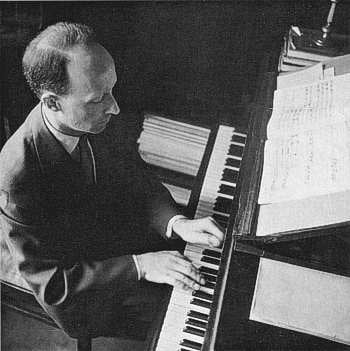
He was regarded by some as the greatest Polish composer since Chopin. He certainly made his mark on music of the 20th century.
Witold Lutoslawski’s early works were influenced by Polish folk music, but as he matured, he began to experiment with twelve-tone and aleatoric techniques. (Aleatoric, broadly speaking, describes a kind of music in which certain aspects of a performance are left to chance.) However, he never wholly abandoned the traditional melodic and harmonic signposts that allowed his music to remain comprehensible to a broader audience.
Several of Lutoslawski’s major works were played in Philadelphia during my peak concertgoing years, back in the ‘80s and ‘90s. I remember seeing Lynn Harrell play the Cello Concerto there. However, I was shut out of the old Academy of Music when the composer himself came to conduct a complete program of his own music. Disappointing, to be sure, but also heartening that so many listeners cared enough to attend a concert of contemporary music by a living composer.
A most enjoyable introduction to Lutoslawski is his “Variations on a Theme by Paganini” (1941). This is a surviving relic of the war years, during which public gatherings in Warsaw were banned by the Nazis. The composer was able to get around it by forming a piano duo with Andrjez Panufnik that played in the local cafes. Here, Princeton’s own Christina and Michelle Naughton perform:
Of the orchestral works, this one is easy enough to follow – the Symphonic Variations (1939):
Then give a listen to the Concerto for Orchestra (1950-54). Just don’t go into it expecting anything like Béla Bartók’s late masterpiece!
Also folk-inflected is “Dance Preludes” for clarinet and piano (1954):
More challenging is the Cello Concerto (1970), with the introduction of chance elements:
Another one of his more frequently performed works – the Symphony No. 3 (1973-83):
And a documentary that begins with a man-on-the-street segment, “Do you know, who is Witold Lutoslawski?”
Happy birthday, W.L.!
PHOTO: The composer at the keyboard in 1952-53