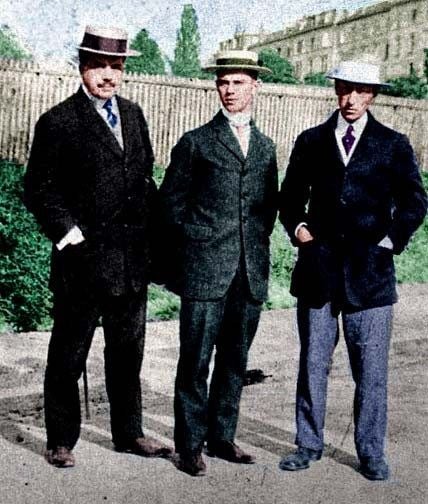
It’s Saturday night! Celebrate by cutting a rug with Sergei Diaghilev. The famed ballet impresario was born on this date 150 years ago.
The company he founded, the Paris-based, world-renowned Ballets Russes, never actually performed in Russia, due to the upheaval of the Russian Revolution. However, from 1909 to 1929, the Ballets Russes performed throughout Europe, and North and South America, collaborating with some of the most-esteemed artists of the time and building a reputation as the most influential ballet company of the 20th century.
Among those commissioned or employed by Diaghilev were composers Igor Stravinsky, Claude Debussy, Maurice Ravel, Sergei Prokofiev, and Erik Satie, choreographers Marius Petipa, Michel Fokine, Vaslav Nijinsky, Bronislava Nijinska, Léonide Massine, and George Balanchine, visual artists Vasily Kandinsky, Alexandre Benois, Pablo Picasso, and Henri Matisse, and costume designers Léon Bakst and Coco Chanel.
The enterprise flourished until the double-blow of the Great Depression and the death of its founder in 1929. In 1932, the Ballet Russe de Monte-Carlo rose from the ashes, reconstituted by Colonel Wassily de Basil, a Russian émigré entrepreneur from Paris, and René Blum, ballet director of the Monte Carlo Opera.
Within four years, the organization was rent by creative differences, and a splinter group, led by Blum, emerged. This ultimately promoted itself as the Original Ballet Russe.
During World War II, the Ballet Russe de Monte Carlo spent significant time touring the Americas. As dancers retired and left the company, they began teaching or founded their own studios – Balanchine started the New York City Ballet – so that Diaghilev’s influence pervaded American dance. Tamara Toumanova, Maria Tallchief, Cyd Charisse, Ann Reinking, and Yvonne Craig were all alumni of the Ballets Russes de Monte Carlo.
Alumni of the Original Ballet Russe, which toured mostly in Europe, were influential in teaching classical Russian ballet technique there.
For the sesquicentennial of Sergei Diaghilev, get your toes tapping with 12 works written or adapted for the Ballets Russes!
MAURICE RAVEL, “DAPHNIS ET CHLOE”
Shepherds, pirates, and Pan!
NIKOLAI TCHEREPNIN, “NARCISSE ET ECHO”
Tcherepnin was actually Diaghilev’s first choice to compose “The Firebird.”
IGOR STRAVINSKY, “PULCINELLA”
Diaghilev produced Stravinsky’s three breakthrough ballets, “The Firebird,” “Petrouchka,” and “The Rite of Spring,” but this one is the most unremittingly joyous.
RICHARD STRAUSS, “JOSEPHSLEGENDE”
Poor Richard Strauss never got paid for his opulent biblical ballet on account of WWI.
MANUEL DE FALLA, “THE THREE-CORNERED HAT”
Ballet meets flamenco.
PETER ILYCH TCHAIKOVSKY, “AURORA’S WEDDING”
Stokowski conducting, at the age of 95!
LORD BERNERS, “THE TRIUMPH OF NEPTUNE”
Sailor Tom Tug’s adventures in Fairy Land.
CONSTANT LAMBERT, “ROMEO AND JULIET”
Not really an adaptation of Shakespeare’s tragedy, but a backstage romantic comedy. Just a clip, with set and costume designs by Max Ernst and Joan Miro.
OTTORINO RESPIGHI, “LA BOUTIQUE FANTASQUE”
“The Fantastic Toybox,” after melodies of Rossini.
SERGEI PROKOFIEV, “THE PRODIGAL SON”
Bad boys get the best music.
ERIK SATIE, “PARADE”
Selections, choreography by Massine and designs by Picasso.
FRANCIS POULENC, “LES BICHES”
Before you get any smart ideas, the title means “The Does,” slang for coquettish young women.
PHOTO: Diaghilev, Vaslav Nijinsky, and Igor Stravinsky
