I was going through some files on my computer yesterday and came across this post written in 2008 for the short-lived WWFM blog. A lot of it still applies, only storage has become much more of an issue!
WWFM blog post, 8/08
How Classical Music Ruined My Life
We’re so used to everyone going on about the benefits of classical music, how Mozart can improve babies’ brains, or how Haydn can reduce crime at train stations. There is a whole sub-genre fostered by the record industry of compilations designed to make us relax. (Never mind the fact that classical music can be one of the least relaxing, indeed most unsettling art forms – witness the recent release on Naxos of John Antill’s Aborigine ballet Corroboree – but we’ll elaborate on that topic another time.) Most recently, the music press, and even 60 Minutes, has been lauding El Sistema, the highly successful program formulated to rescue Venezuelan young people from the hopelessness of living in impoverished neighborhoods, giving them a sense of purpose by handing them an instrument and absorbing them into orchestras. The meteoric rise of Gustavo Dudamel is its most eloquent testament. While personally, I find El Sistema praiseworthy, and certainly a more positive method of reaching out to the international community than the often snarky comments and small-minded policies of the world’s political leaders, and would even like to see something similar implemented in our own country, I’m afraid the mountain of evidence extolling the curative properties of classical music simply does not tell the entire story. Because, good readers, I confess it here for the first time, the shocking truth is that classical music has ruined my life.
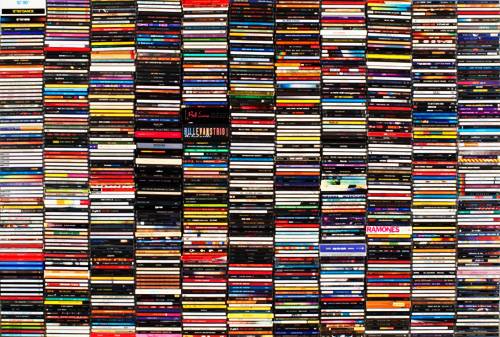
That’s right, if not for the heroin lure of Vaughan Williams, Sibelius, and the rest, I would probably be a wealthy, well-adjusted individual, with weekends free to do normal things, and a healthy savings account, swollen with the tens of thousands of dollars I’ve blown over the years on concerts and recordings. Never mind the fact that by nature, I am thrifty (read: cheap) and seek out bargains in cut-out bins and through remainder outlets whenever possible, or that a sizeable portion of my collection has been assembled from mid-price or budget CDs, second-hand acquisitions, or has been gifted. The truth is, I have dumped thousands. Tens of thousands, I’m sure. In the living room of my cramped apartment are five bookcases of ten shelves each, crammed with recordings, operas and colorful boxed sets arranged alphabetically across the top, with stacks rising like the cromlechs of Stonehenge on top of those. Oh yeah, there are also a few plastic bins secreted away under my bed, full of holiday music and bonus discs from magazines such as BBC. And the archive, on both tape and disc, of my Sunday night program, The Lost Chord. The latter technically didn’t cost me a thing, unless you count the untold man-hours I’ve invested which could have been more productively spent elsewhere.
But no, I’ve squandered both finances and life’s blood on my obsession. Like an addict. Or a laboratory rat who keeps hitting the pleasure button at the expense of food. Or Erasmus, who spent whatever money he acquired on books, a mere pittance left over for life’s necessities. At 42, I stand at the peak of my glorious summer, and have little to show for it. If things continue at this rate, in another twenty years – I’ll be Bill Zagorski.
How did this all start, you ask? Where did I go wrong? Mothers and fathers, gather ‘round, and listen to my cautionary tale. I lay the blame at the feet of, first, John Williams, and his extraordinary soundtrack for Star Wars, which dazzled my ten year-old brain with its romantic pageantry and vibrant colors. And then of my own mother, who provided positive reinforcement, when I acquired my first classical records, encouraging me, if I found something I liked by a specific composer, to collect his other works. She knew next to nothing about classical music. Nor obviously the dissolute path down which she was getting me started. My favorite Easter was the one where I came downstairs and next to a basket filled with chocolate and malt and peanut butter eggs and jelly beans were two Vivaldi records. Vivaldi isn’t even remotely my favorite composer, but I thought that was the best thing ever. Then I latched onto WFLN, Philadelphia’s classical music station for 50 years, and soaked up their programming, I’m tempted to say, like the Iraqi war soaks up the American tax dollar. I remember at first being confused by the multi-movement structure of symphonies and the like, wondering at the end why the announcer didn’t bother to mention what the beautiful piece of music was which had played second or third before last. I smirk condescendingly at my callow, earlier self.
Whenever one discovers a new enthusiasm, the horizons seem boundless. It’s a wonderful thing to know next to nothing about something and to embark on that kind of adventure. I remember hearing A Night on Bald Mountain on record for the first time, which of course I recognized as the music for that segment which both fascinated and scared the hell out of me as a child, in Disney’s Fantasia. When I acquired the LP, with Leonard Bernstein and the New York Philharmonic, I thought Mussorgsky must have been the greatest composer who ever lived. The same with Tchaikovsky, whose Pathetique I listened to incessantly, and Brahms, a very different figure, who nonetheless captivated me with, in succession, his 2nd, 3rd, and 4th Symphonies. I used to listen to the first movement of the 4th every night before bed.
None of this was helped by the fact that, purely by chance, I was surrounded by likeminded friends. Make no mistake, I was always the fanatic, but around me were girlfriends taking piano lessons and comrades who latched onto Beethoven or Gilbert and Sullivan. In high school, my room looked like a grotto lifted out of Tennyson’s “The Lotos-Eaters,” members of my circle strewn about the floor, sleeping or half-asleep, listening to Beethoven’s 7th. Not the most relaxing music, but teenagers can slumber through anything. I remember, vividly, listening to Respighi at a girlfriend’s house, and an old Nonesuch LP of Telemann recorder concertos. Another was studying Chopin’s Nocturne, Op. posth., and Khachaturian’s Toccata. Her father had the first CD collection I had ever seen, an entire closet devoted to this new, mysterious technology. I fell in love with Wynton Marsalis’ recording of the Haydn Trumpet Concerto. Needless to say, it outlasted the relationship.
Even then – particularly then – classical music provided the soundtrack to my life. John Boorman’s Excalibur taught me the power of Wagner, and it stayed with me throughout the remainder of my tragic-heroic teens, only to blossom fully in my tragic-heroic twenties, when I collected my first Ring cycle. I had earlier taken Die Walkure out of the library, but at that stage (I was probably about 15) it was still beyond my ken. I latched onto the Classic Film Scores series on RCA, for my money still the most satisfying undertaking of its kind, and from that day forward, I’ve been nurturing my inner pirate. The Sea Hawk hit me square between the eyes and filled my larcenous soul to overflowing. I’ve been a fan of Erich Wolfgang Korngold ever since.
When I went away to college, naturally I had to haul my record collection back and forth with me. And since Christmas break was a month long, there’s no way I could be without my records. I don’t have to tell you, LPs are heavy, and while I was living in a dormitory, I had to confine my belongings to a car. Three crates of records and a sizeable stereo system left very little room for anything else, aside from one suitcase and both my parents. Whenever I move, to this day, now with likely over 30 boxes of CDs, I reflect, like Jacob Marley, on the chain I’ve forged in life. And slow learner that I am, I’ve been accepting still more LPs from a client with an exceptional collection trying to pare down, things which have never been reissued (including, most recently, an extensive series of pirated – er, private – Havergal Brian recordings). It’s an illness, I tell you. I’m a Hogarthian nightmare.
People who know not of what they speak envy my passion. Apparently, there are some who never find that one thing which creates for them that spark, and they claim to have difficulty determining their life’s direction. My blessing and my curse is that I’ve found several. But classical music reigns supreme as my evil genius. When passion spills over into obsession and obsession borders on mania, well, that’s really the final outpost. I feel myself teetering at the outskirts of society, I feel my tenuous grip on civilization weakening. Classical music has made me irresponsible, lazy, a dreamer, destitute, and nearly monomaniacal. And not sleeping enough on weekends in order to do my radio shift has been punishing to both interpersonal relationships (“Sorry, I can’t go; I have to be up at 4:00”) and my physical and emotional well-being (though thankfully short-term; by Tuesday I am in ship-shape).
Mothers and fathers, do the right thing by your children. They may never know the exhilaration of finding Rudolf Kempe’s recording of Korngold’s Symphony in F-sharp in a cut-out bin for 99 cents. Their souls may never swagger in seven-league boots when they hear the march from Tchaikovsky’s Pathetique or the last of Hindemith’s Symphonic Metamorphoses. Nor wallow in the tragic grandeur of Tristan und Isolde orGotterdammerung. Music inspires powerful emotions. It speaks to the boundless aspirations inside each and every one of us, which can only abrade against the strictures of civilization. Do you really want to send your children out into a world where, in spirit, they will always be the proverbial nail sticking up? Especially in a world where seemingly so few possess even an appreciation of the source.
No, deny them music, and they will grow up to be happy, well-adjusted individuals. And they will have their weekends free.
PHOTO: Amateur!