Sure, it’s artistically satisfying to perform with the New York Philharmonic and to have your works choreographed by Léonide Massine and George Balanchine and all, but a popular hit is guaranteed to keep food on the table.
This Sunday night on “The Lost Chord,” we’ll hear from two composers whose concert music has been overshadowed by their works for the musical theater.
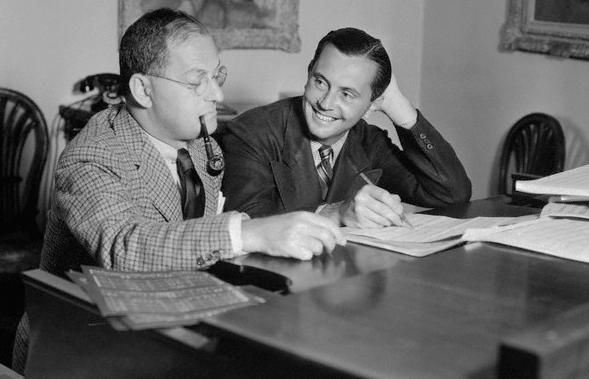
Vernon Duke lives on through his standards “April in Paris” and “Autumn in New York,” with his greatest stage success the Broadway musical “Cabin in the Sky.”
However, his early ambition was to become a “serious” composer. Born Vladimir Dukelsky in what is now Belarus in 1903, Duke studied composition with Reinhold Gliere. His music was championed by Serge Koussevitzky and admired by Sergei Prokofiev. Indeed, Duke continued to write works for the concert hall (as Dukelsky) right up through the mid-1950s.
In 1921, he came to New York. There, he was befriended by George Gershwin. It was Gershwin (born Jacob Gershowitz) who suggested the name change. Thereafter, Duke/Dukelsky lived a double-life, Duke writing for popular consumption and Dukelsky composing symphonies and concertos.
Dukelsky’s Piano Concerto was requested by none other than Arthur Rubinstein, who recognized the 19 year-old’s promise.
Allegedly, Rubinstein and Gershwin were delighted with the piece when they heard it in its two-piano form. Unfortunately, so was impresario Serge Diaghilev. When Diaghilev heard Dukelsky play through it in Paris (with Georges Auric on the second piano), he immediately offered the talented young man a commission to compose “Zephyr et Flore” for the Ballets Russes. This led to further offers from London’s West End. As a result, Dukelsky never got around to orchestrating the piece. It was left to pianist Scott Dunn to do so, in time for some Gershwin centennial concerts in 1999.
Meredith Willson is best-remembered for “The Music Man” and “The Unsinkable Molly Brown.”
However, prior to his success in musical theater, he had been a flutist in the Sousa band and with the New York Philharmonic. He worked as an orchestrator on Charlie Chaplin’s “The Great Dictator.” He was also a gifted conductor, author, librettist, and humorist. His autobiography, “And There I Stood with my Piccolo,” became a bestseller.
Willson composed two symphonies, both of them extended love letters to specific California sites. His Symphony No. 1 pays tribute to San Francisco. The Symphony No. 2, the one we’ll be listening to, is evocative of the missions of Southern California. In contrast to Professor Harold Hill, Willson clearly “knew the territory.”
I hope you’ll join me for “Broad Talents from Broadway,” this Sunday night at 10 ET, with a repeat Wednesday evening at 6; or that you’ll enjoy it later as a webcast at http://www.wwfm.org.
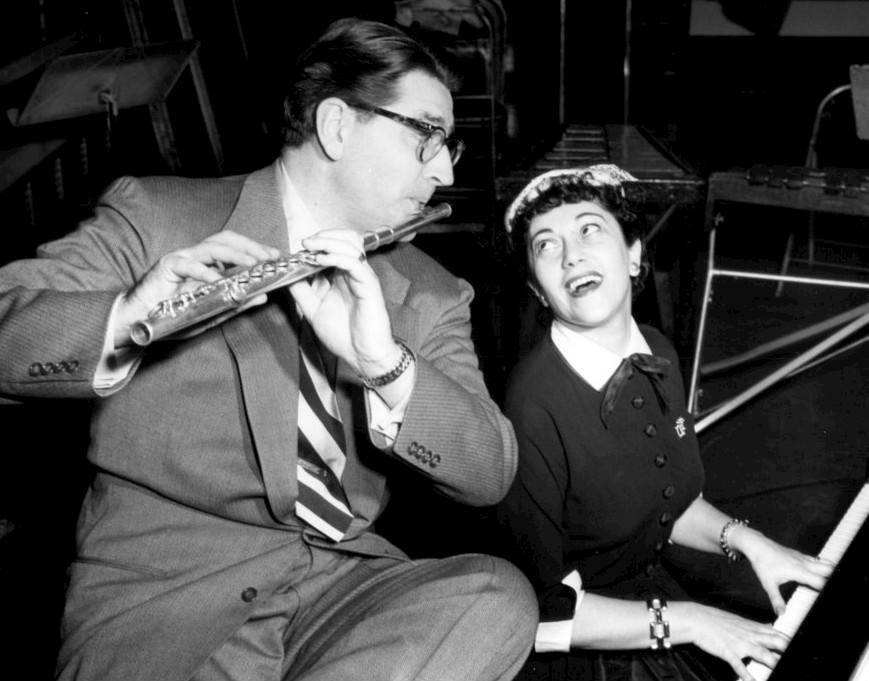
PHOTO: Meredith and Rini Willson make beautiful music together