This Saturday morning on “Sweetness and Light,” it’s April in Paris.
We’ll hear April-and-Paris themed songs by Charles Trenet (“En avril, à Paris”) Georges Bizet (“Chanson d’avril”) and, of course, Vernon Duke (“April in Paris”), alongside a symphony for wind instruments by Charles Gounod (first performed in Paris in April 1885), a love song by Erik Satie, a suite (“Paris”) by British light music master Haydn Wood, and a work by Darius Milhaud as good as spring itself.
It will be an hour of cafés and croissants, blossoms and bisous, on “Sweetness and Light,” this Saturday morning at 11:00 EDT/8:00 PST, exclusively on KWAX, the radio station of the University of Oregon!
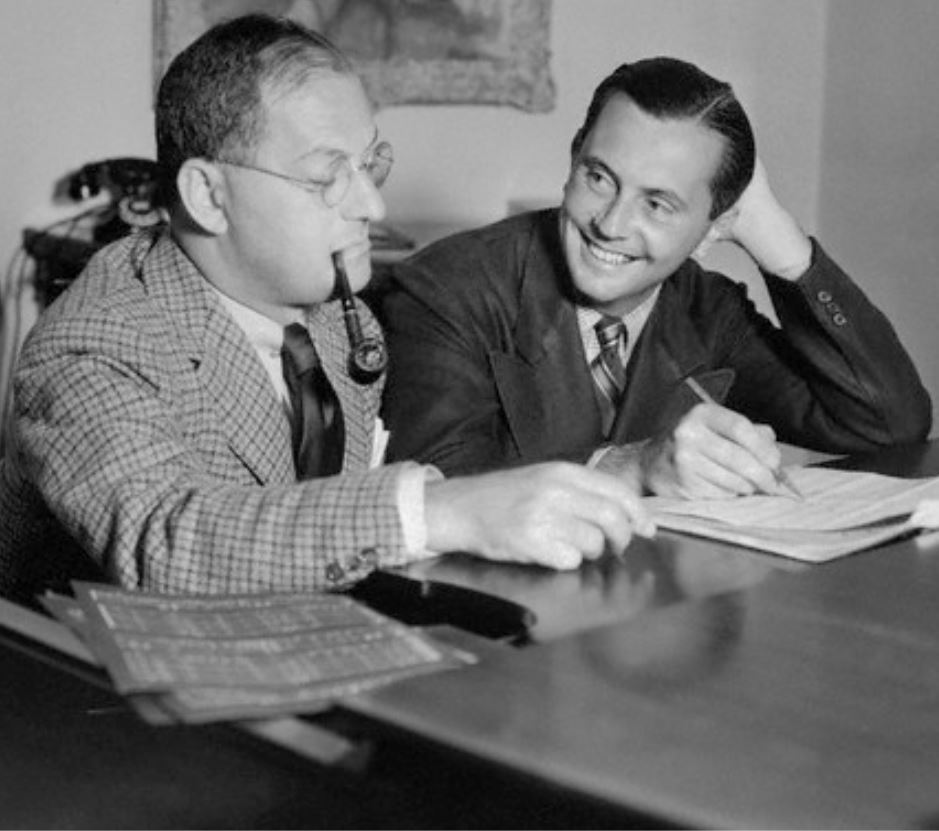
Vernon Duke (né Vladimir Dukelsky) was born in what is now Belarus on this date in 1903. In Kyiv, he studied composition under Reinhold Gliere. He left the USSR in 1920, traveling to New York, where he was befriended by George Gershwin. In fact, it was Gershwin who suggested a name-change to something a bit more comprehensible to American audiences. (Gershwin himself was born Jacob Gershowitz.)
For a time, Duke ping-ponged back and forth to Europe, where he fulfilled a commission by Serge Diaghilev (for the ballet “Zephyr and Flora”). The work impressed Sergei Prokofiev, and the two became fast friends. Dukelsky’s Symphony No. 1 was given its premiere in Paris, under Serge Koussevitzky, on the same program as excerpts from Prokofiev’s “The Fiery Angel.”
Around the same time, Duke began contributing material to musical comedies in London. This laid the groundwork for a return to New York in 1929. There, he continued to composed “serious” works, while insinuating himself into the Broadway scene. A number of his songs – “April in Paris,” “Autumn in New York,” “Taking a Chance on Love,” “I Can’t Get Started” – have since become standards.
When Gershwin died in 1937, Duke stepped in to complete his unfinished score for “The Goldwyn Follies,” for which he contributed a couple of ballets (choreographed by George Balanchine) and the song, “Spring Again.” His greatest success came in 1940, with the Broadway show, “Cabin in the Sky.”
Here’s a rare concert broadcast of his Symphony No. 3:
A number of his concert works have been recorded in recent years, including this Piano Concerto for Arthur Rubinstein:
His Cello Concerto, performed by Samuel Magill, then of the Metropolitan Opera Orchestra:
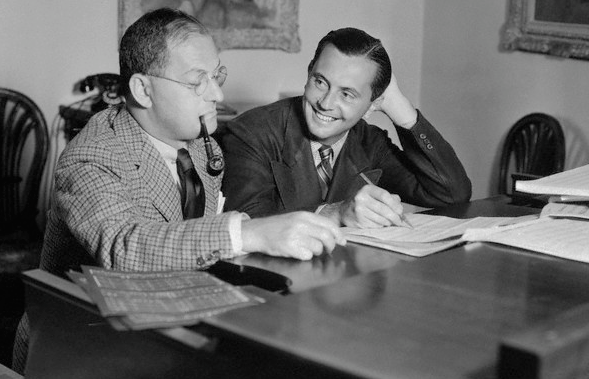
Vernon Duke (né Vladimir Dukelsky) was born in what is now Belarus on this date in 1903. In Kiev, he studied composition under Reinhold Gliere. He left the USSR in 1920, traveling to New York, where he was befriended by George Gershwin. In fact, it was Gershwin who suggested a name-change to something a bit more comprehensible to American audiences. (Gershwin himself was born Jacob Gershowitz.)
For a time, Duke ping-ponged back and forth to Europe, where he fulfilled a commission by Serge Diaghilev (for the ballet “Zephyr and Flora”). The work impressed Sergei Prokofiev, and the two became fast friends. Dukelsky’s Symphony No. 1 was given its premiere in Paris, under Serge Koussevitzky, on the same program as excerpts from Prokofiev’s “The Fiery Angel.”
Around the same time, Duke began contributing material to musical comedies in London. This laid the groundwork for a return to New York in 1929. There, he continued to composed “serious” works, while insinuating himself into the Broadway scene. A number of his songs – “April in Paris,” “Autumn in New York,” “Taking a Chance on Love,” “I Can’t Get Started” – have since become standards.
When Gershwin died in 1937, Duke stepped in to complete his unfinished score for “The Goldwyn Follies,” for which he contributed a couple of ballets (choreographed by George Balanchine) and the song, “Spring Again.” His greatest success came in 1940, with the Broadway show, “Cabin in the Sky.”
Here’s a rare concert broadcast of his Symphony No. 3:
A number of his concert works have been recorded in recent years, including this Piano Concerto for Arthur Rubinstein:
The Metropolitan Opera’s Samuel Magill is soloist in Duke’s Cello Concerto:
Sure, it’s artistically satisfying to perform with the New York Philharmonic and to have one’s works choreographed by Léonide Massine and George Balanchine – but at the end of the day, there’s really nothing like a good popular hit to keep food on the table.
This Sunday night on “The Lost Chord,” we’ll enjoy concert music by two artists more frequently associated with the musical theater.
Vernon Duke may be remembered for standards like “April in Paris” and “Autumn in New York,” with his greatest stage success being the Broadway musical “Cabin in the Sky.” However, his early ambition was to become a “serious” composer.
Born Vladimir Dukelsky in what in now Belarus in 1903, Duke studied composition with Reinhold Gliere. His music was championed by Serge Koussevitzky and admired by Sergei Prokofiev. Indeed, Duke continued to write works for the concert hall (as Dukelsky) right up into the 1950s.
In 1921, he arrived in New York City, where he was befriended by George Gershwin. It was Gershwin – himself born Jacob Gershowitz – who suggested Dukelsky’s nom de plume. Thereafter, Duke/Dukelsky lived a double-life, Duke writing for popular consumption and Dukelsky composing symphonies.
Dukelsky’s Piano Concerto was requested of the 19 year-old by none other than Arthur Rubinstein. Allegedly, Rubinstein and Gershwin were delighted with the piece when they heard it in its two-piano form. Unfortunately, so was impresario Serge Diaghilev. When Diaghilev heard Dukelsky play through it in Paris (with Georges Auric on the second piano), he immediately offered the talented young man a commission to write “Zephyr et Flore” for the Ballets Russes. This led to further offers from London’s West End. As a result, Dukelsky never got around to orchestrating the piece. It was left to pianist Scott Dunn to do so, in advance of some Gershwin centennial concerts in 1999.
Meredith Willson is best remembered for “The Music Man” and “The Unsinkable Molly Brown.” However, before his success in musical theater, he had been a flutist in the Sousa Band and with the New York Philharmonic. He worked as an orchestrator on Charlie Chaplin’s “The Great Dictator.” He was also a gifted conductor, author, librettist, and humorist. His autobiography, “And There I Stood with my Piccolo,” became a bestseller.
Willson composed two symphonies, both of them extended love letters to California landmarks. His Symphony No. 1 pays tribute to San Francisco. The Symphony No. 2, the one we’ll hear this evening, is evocative of the missions of Southern California, with individual movements devoted to Junipero Serra, San Juan Bautista, San Juan Capistrano, and El Camino Real.
I hope you’ll join me for “Broad Talents from Broadway” – musical theater composers hang on to their day jobs – this Sunday night at 10:00 EDT, on WWFM – The Classical Network and wwfm.org.
Dawn Upshaw sings “Autumn in New York”
Count Basie performs “April Paris”
Basie welcomes Sheriff Bart
“The Music Man,” Overture/Rock Island
“76 Trombones” – for 76 trombones!
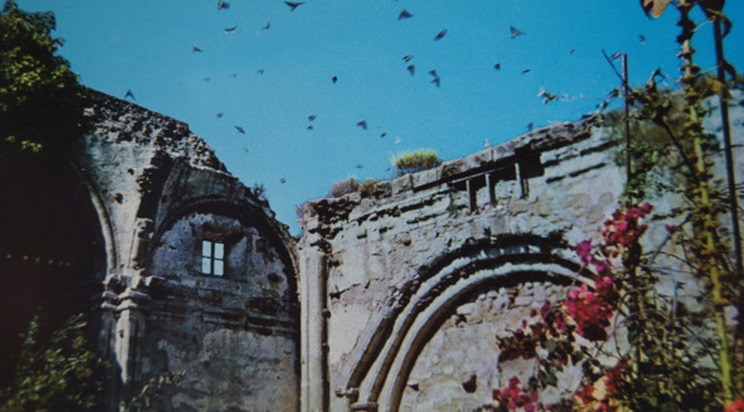
PHOTO: Are these menacing vampire bats, flittering about the ruins of Castle Dracula? No, they’re just the swallows, come back to Capistrano.
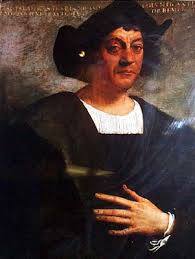
It’s a great day for Italians. Not only is it Columbus Day, it’s also the anniversary of the births of Giuseppe Verdi and American composer Giuseppe Guttoveggio (better known as Paul Creston). Tune in this afternoon for music honoring all three, in addition to Vernon Duke, from 4 to 7 EDT, on WWFM – The Classical Network and at wwfm.org.
Sons of Italy (clockwise from left): Columbus, Creston and Verdi