He was expelled from the Paris Conservatory for being “the laziest student in the world.”
He maintained a filing cabinet filled with drawings of imaginary medieval buildings, the properties of which he would periodically put up for sale in local journals by way of anonymous ads.
He claimed to eat only foods that were white: eggs, sugar, shredded bones, the fat of dead animals, veal, salt, coconuts, chicken cooked in white water, moldy fruit, rice, turnips, sausages in camphor, pastry, cheese (only white varieties), cotton salad (whatever that is), and certain kinds of fish.
He founded his own church – Église Métropolitaine d’Art de Jésus Conducteur (Metropolitan Art Church of Jesus the Conductor) – of which he was the only member, and for which he promptly composed a mass.
He carried a hammer for protection.
When he died, his friends produced umbrella after umbrella after umbrella from his room.
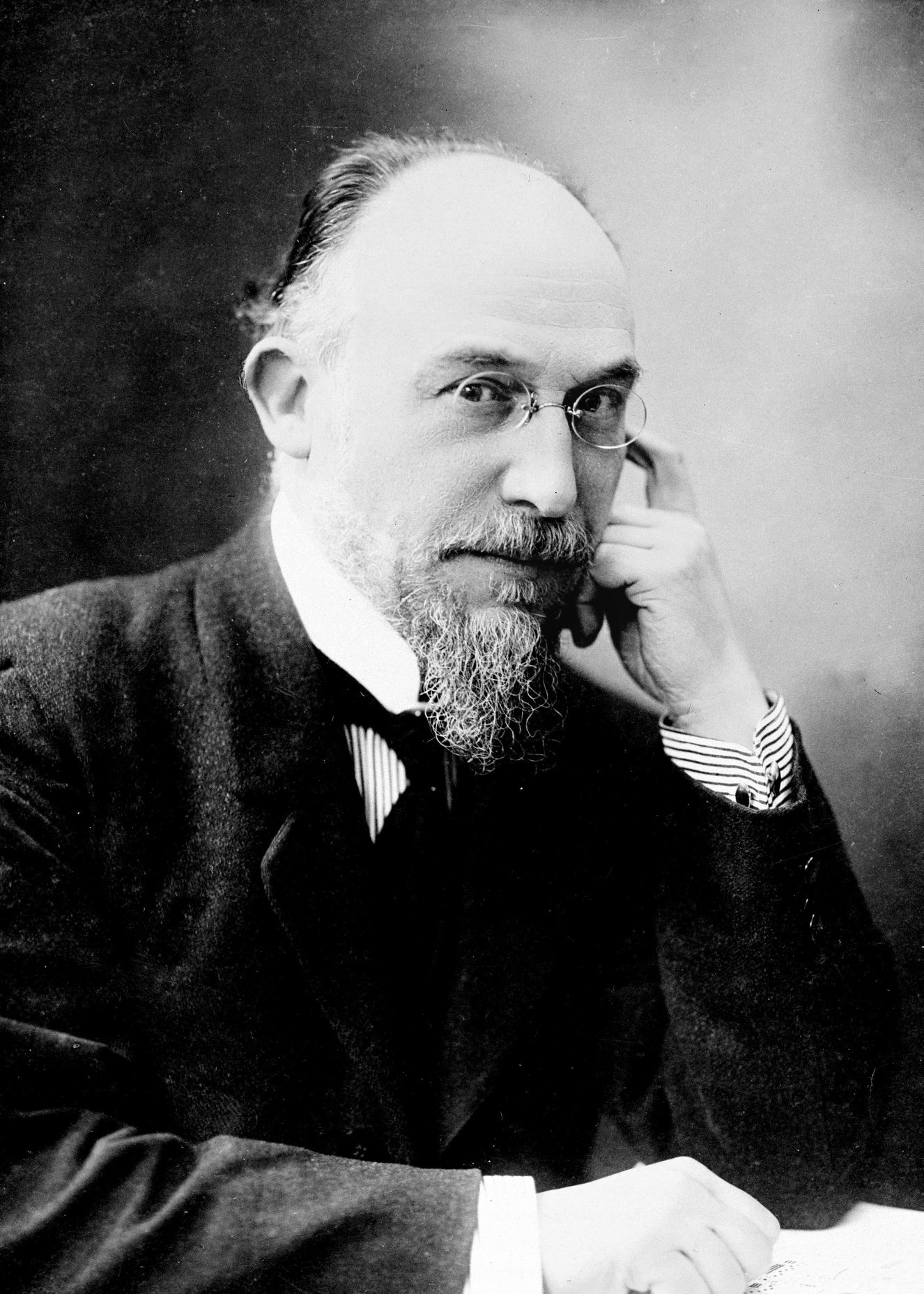
Erik Satie was an artist whose life was full of enigmas and ambiguities. Often misclassified as an Impressionist, he was viewed by some (including Maurice Ravel) as a precursor to Debussy, even as he felt a greater affinity with the younger generation of composers who made up Les Six.
In practice, he elevated salon and cabaret music, of which he spoke slightingly. After he went back to school at mid-life in order to bone up on classical counterpoint, he stopped using bar lines in his manuscripts. He blazed trails later rediscovered by Morton Feldman and John Cage. He was a minimalist more than half a century before Minimalism.
Satie rejected the concept of musical development, believing it to be an unconscionable imposition on the public’s time. Yet he requested that his piano piece, “Vexations,” be put through 840 repetitions. A typical performance spans 18 to 24 hours. Of course, its single thematic cell is probably only about 50 seconds long. For him, brevity was the soul of wit.
He could be profoundly ironic. Many of his piano works bear titles like “Trois Morceaux en forme de poire” (“Three Pieces in the Shape of a Pear”), “Embryons desséchés” (“Desiccated Embryos”), and “Véritables préludes flasques pour un chien” (“Veritable Flabby Preludes for a Dog”).
A friend of Jean Cocteau, the two collaborated on the surrealist curio “Parade,” written for the Ballets Russes, with choreography by Léonide Massine and costumes and set design by Picasso. The scenario involves three circus acts trying to attract an audience to an indoor performance.
It was one of a number of works that were introduced in the ‘Teens that attempted to whip up a scandal by incorporating low-brow elements into what was perceived as a high-brow art form. Hoping for a strong reaction, Cocteau pushed for the inclusion of such provocative “instruments” as a typewriter, a foghorn, a siren, milk bottles, gunshots, and boots sloshing around in a wash tub. The work bore the subtitle “A Realist Ballet.” The opening night audience responded, as hoped, by rioting energetically.
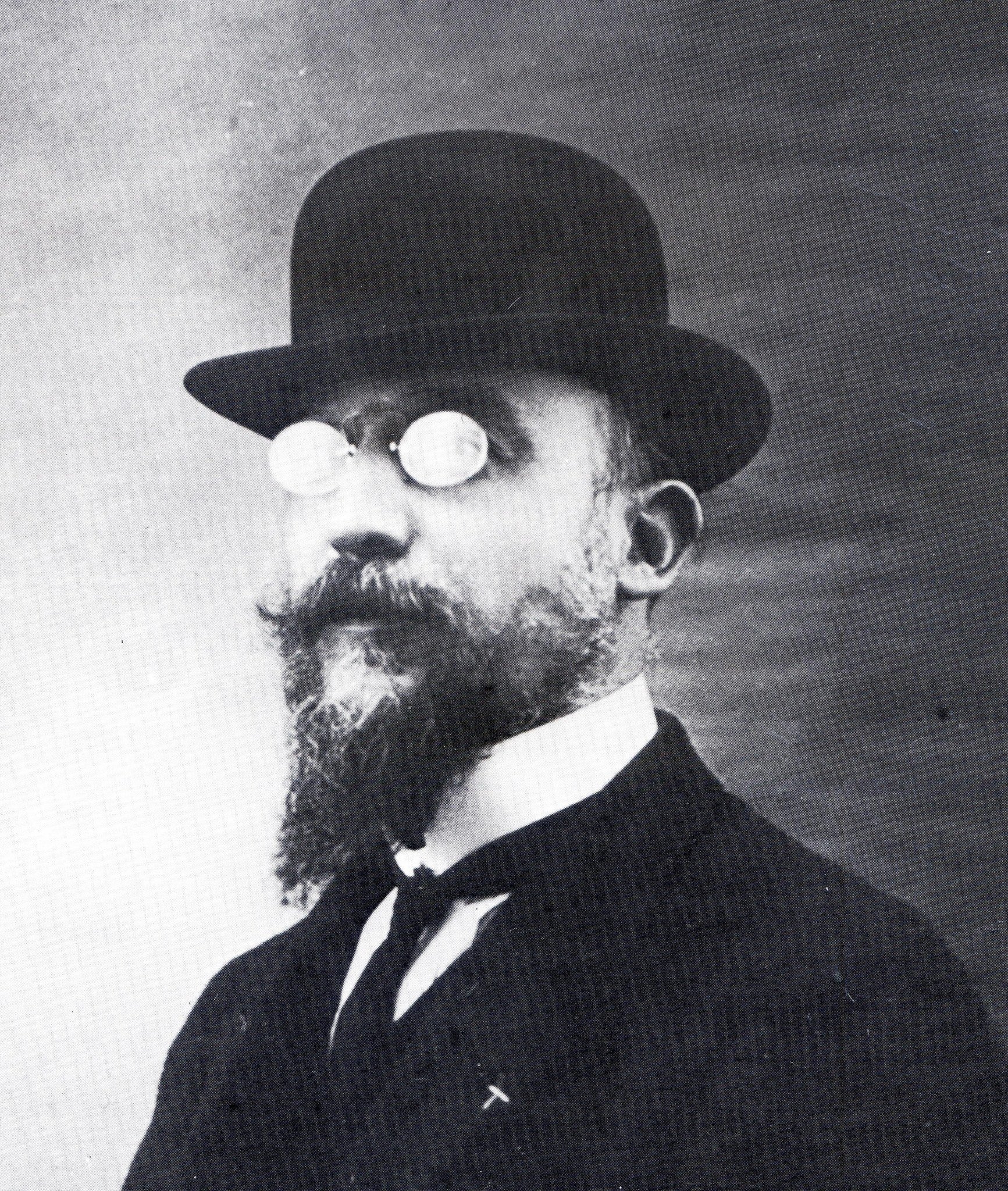
Politically, Satie was a radical socialist, who eventually teetered over into Communism. For a time, his wardrobe consisted of seven identical grey suits. During his quasi-religious phase, he went about in a priest-like habit. Then he became a “velvet gentleman.” Finally, during his communist period, he assumed the appearance of a bourgeois functionary, never to be seen without a bowler and an umbrella.
No one would have guessed that such an impeccable dresser would have lived out his life in clutter and squalor. When Satie died, his friends, who had never been invited back to his place in 27 years, were aghast at the piles of newspapers, the unending collection of umbrellas (100 in all), and most prominently, the stacked grand pianos, the uppermost of which had been used by the composer as a repository for papers and parcels. Among these, and in the pockets of Satie’s wardrobe, were discovered a number of manuscripts that the composer had believed long lost.
For anyone who ever wanted to see Satie fire a cannon, here’s the Velvet Gentleman himself, in trademark bowler and carrying an umbrella, with Francis Picabia. Picabia provided the scenario and designs for Satie’s ballet, “Relâche.” The film, titled “Entr’acte,” was made in 1924, the year before the composer’s death. As the title suggests, it was shown between the two acts of Satie’s ballet, with the cannon sequence used as prologue. The music, appropriately enough, is titled “Cinéma.”
Satie appears only in the first 90 seconds or so of the film, so it’s up to you how much beyond that you’ll want to watch. Marcel Duchamp and Man Ray play chess around 4-5 minutes in; there’s a bearded ballerina around the 7-minute mark; and you may chuckle at a falling SCTV-style dummy around 9:30. Somewhere along the way you may also spot composers Georges Auric and Darius Milhaud.
It certainly is a Dadaist romp. “Relâche,” by the way, is a word used on posters to indicate that a show is canceled or that the theater is closed.
“Je te veux” (“I want you”)
Selections from “Parade,” with the Picasso designs. Love the horse!
Satie in “My Dinner with André”
Bon anniversaire, Erik Satie (1866-1925)!