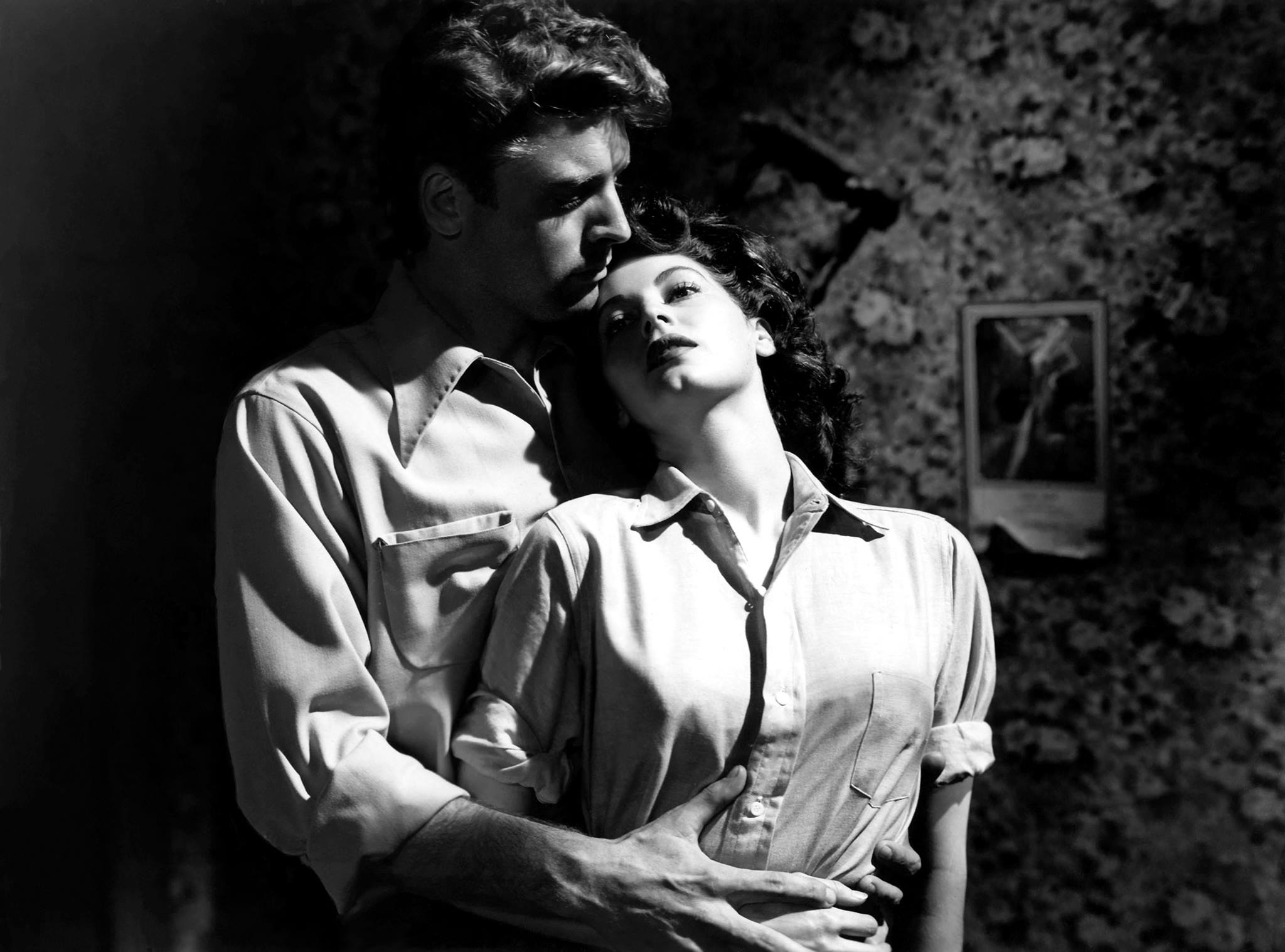
Nick sat down against the charred stump and smoked a cigarette. He lit a match and watched it burn and as it burned he thought of boxers and marlins and the Spanish Civil War. The stories were brave and strong and good. He ordered a mojito and prepared to face the music.
This week on “Picture Perfect,” the focus is on Ernest Hemingway.
Seemingly at odds with Hemingway’s minimalist, “iceberg” style, big screen adaptations of the writer’s work show what the stories don’t tell. In the case of 1946’s “The Killers,” the screenwriters unapologetically just made stuff up, an entire back story explaining the motivations for the hit of boxer “Swede” Anderson. Fortunately, those screenwriters happened to include an uncredited John Huston, who virtually codified noir with “The Maltese Falcon.”
“The Killers” provided Burt Lancaster with his break-out role. It also features a knock-out score by Miklós Rózsa, in which he uses the dum-dee-dum-dum motto later made famous by the television series “Dragnet.”
In 1977, George C. Scott reunited with his “Patton” director, Franklin J. Schaffner, for an adaptation of Hemingway’s posthumously published novel, “Islands in the Stream.” Scott gives one of his best performances as a Hemingway-like figure living on a Caribbean island. “Patton” composer Jerry Goldsmith wrote the music. Goldsmith spoke of it often as his favorite score.
Hemingway himself handpicked the leads for the 1943 adaptation of “For Whom the Bell Tolls,” with Gary Cooper and Ingrid Bergman falling in love against the backdrop of the Spanish Civil War. The music was by the prolific and versatile Victor Young.
And finally, Spencer Tracy is the whole show, as he faces off against a large marlin, in the 1958 version of “The Old Man and the Sea.” Dimitri Tiomkin’s music earned him his fourth Academy Award.
Join me for an hour of laconic grace and stoic manliness on “Picture Perfect,” music for the movies, now in syndication on KWAX Classical Oregon!
———-
Clip and save the start times for all three of my recorded shows:
PICTURE PERFECT, the movie music show – Friday at 8:00 PM EDT/5:00 PM PDT
SWEETNESS AND LIGHT, the light music program – Saturday at 11:00 AM EDT/8:00 AM PDT
THE LOST CHORD, unusual and neglected rep – Saturday at 7:00 PM EDT/4:00 PM PDT
Stream them, wherever you are, at the link!
https://kwax.uoregon.edu/
Tag: Victor Young
-
Raising a Pint to Barry Fitzgerald for St. Patrick’s Day
I try to watch “The Quiet Man” every year on St. Patrick’s Day, whether I need it or not. If, already a quarter of the way into the 21st century, this confirms that I am hopelessly out of touch, so be it. Someday, someone will pry this twee, politically-incorrect Irish fable from my cold dead hand.
I’m working my way through the recent John Williams biography by Tim Greiving, and although I am having some major issues with it (the book, published by Oxford University Press, reads like a first draft, to put it kindly), it is obviously written with love and chock full of valuable information. I know Williams always speaks fondly of Victor Young, but it was interesting to learn that Young’s music for “The Quiet Man,” which Williams saw in the theater in 1953, was one of the first film scores that really made him sit up and take notice and made him consider the possibility of writing for the movies.
I guess this makes sense, especially with having everything laid out chronologically in a biography. Progressions become clearer, and from the start Williams was always a gifted arranger. I mean, his first Academy Award was for his arrangements for Norman Jewison’s film of “Fiddler on the Roof,” and it was far from his first musical. Even apart from the movies, Williams was arranging for and accompanying Frank Sinatra, Vic Damone, Frankie Laine, and so many others. So he would have had a connoisseur’s appreciation of what Young achieved in his score for “The Quiet Man,” which positively overflows with inspiring arrangements of folk and popular song and sentimental ballads.
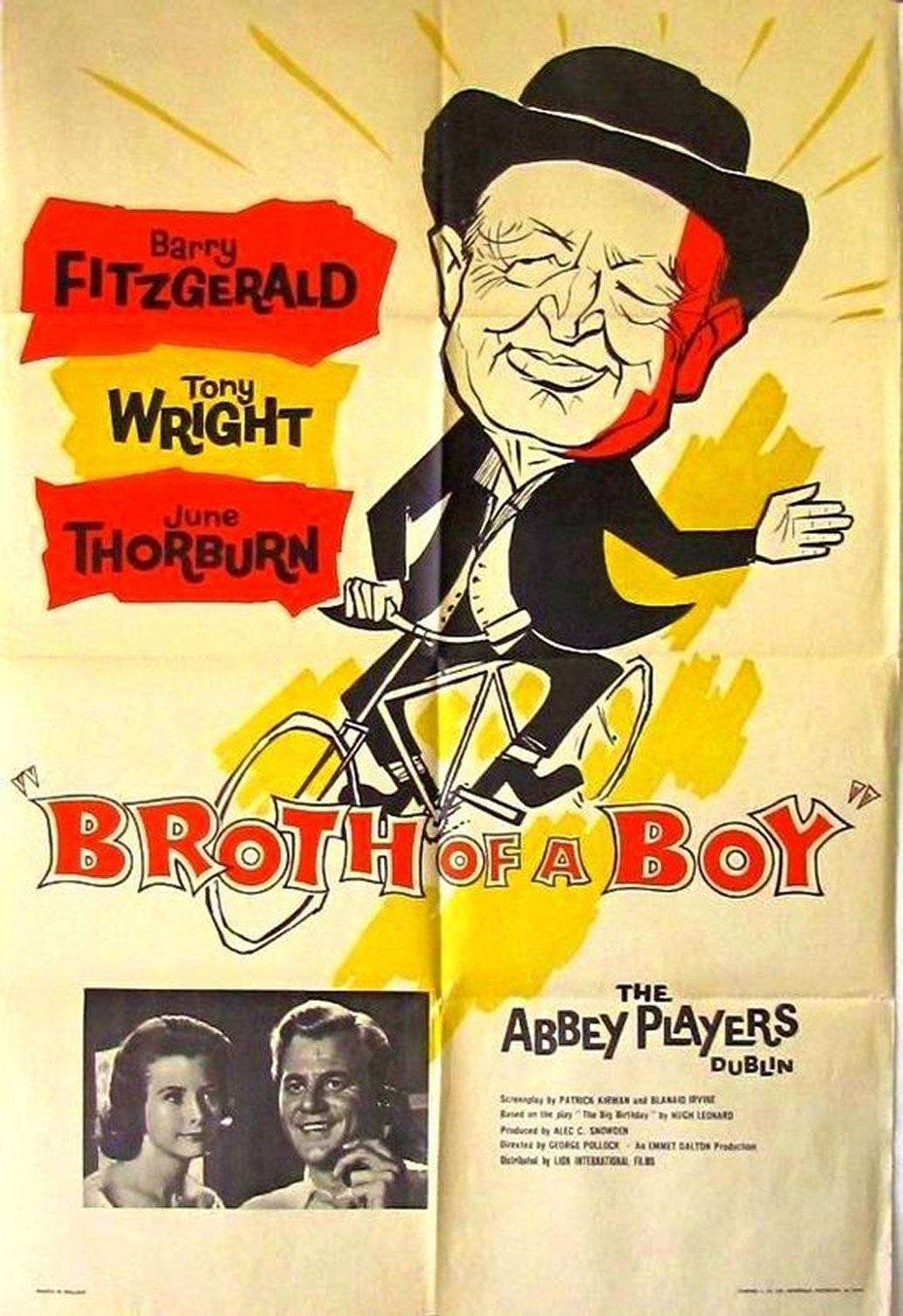
On a related note, for a long time, after having run across some clips, probably on YouTube, I’ve wanted to see a film called “Broth of a Boy.” It stars Barry Fitzgerald (who plays the “Quiet Man’s” insatiably thirsty Michaeleen Oge Flynn) as the oldest man in the world. With that premise, how could it miss? Unfortunately, the film is seemingly unavailable in the United States – only intensifying my desire to see it – and the reviews I’ve read ranged from mildly charmed to middling. So I certainly knew not to expect a classic.
Every year, around St. Patrick’s Day, I search for it, and what do you know, last night I found it on YouTube! The transfer is barely adequate, but you know how old movies are from the United Kingdom. Even the Alastair Sim version of “A Christmas Carol” (released in the U.K. as “Scrooge” in 1951 – a year before “The Quiet Man!”) looks like it was made in the 1930s. I don’t blame the technology; I blame post-war austerity.
Anyway, “Broth of a Boy” looks older than its years, as for that matter, does Barry Fitzgerald. His character is supposedly 110. Fitzgerald died in 1961 at the age of 72. But here, in 1959, he looks tired. Or maybe he was just hammered the whole time.
Be that as it may, if you’re a “Quiet Man” fan, I think you will find much to enjoy. The humor and characterizations are of the same cloth, and both films employ actors from Dublin’s Abbey Players – the National Theatre of Ireland – although, as far as I can tell, Fitzgerald is the only common denominator between the two.
Alas, the screenplay isn’t as consistent or sharp, and the scenes are not always the most imaginatively captured. I sure do miss John Ford’s direction and Technicolor. The score, by Stanley Black, will never be mistaken for Victor Young. The film feels longer than its 77 minutes, but if you are a “Quiet Man” die-hard, you might want to give it a shot. Or have a few yourself, if you know what’s good for you. -

Gulliver’s Travels Movie Music & More on KWAX
I haven’t had time to post today, because I had some deadlines to meet and then I had to hightail it up to the Bard Music Festival for the opening night of “Martinů and His World” — music of Bohuslav Martinů and friends at Bard College. So I’ll just interject briefly that today is the birthday of film composer Victor Young. Some of my favorite Young scores include those for “Scaramouche,” “The Quiet Man,” and “Around the World in 80 Days.”
This week on “Picture Perfect,” however, we’ll enjoy selections from his score to the Fleischer Brothers’ production of “Gulliver’s Travels” (1939). Based on the novel by Jonathan Swift, the film was given the greenlight thanks to the success of Walt Disney’s “Snow White and the Seven Dwarfs.” The brothers, responsible for those classic “Popeye,” “Betty Boop,” and “Superman” cartoon shorts, here may have bitten off more than they could chew with this, their only animated feature.
Victor Young’s music will be bookended by that of Bernard Herrmann for “The Three Worlds of Gulliver” (1960), a film also notable for its special effects by legendary stop-motion animator Ray Harryhausen, and John Addison’s riotous score for Tony Richardson’s picaresque romp “Tom Jones” (1963), based on the novel by Henry Fielding.
You don’t have to be Lilliputian to find these big shoes to fill. It’s music from movies inspired by two beloved 18th century British literary classics, on “Picture Perfect,” music for the movies, now in syndication on KWAX, the radio station of the University of Oregon!
Clip and save the start times for all three of my recorded shows:
PICTURE PERFECT, the movie music show – Friday at 8:00 PM EDT/5:00 PM PDTSWEETNESS AND LIGHT, the light music program – Saturday at 11:00 AM EDT/8:00 AM PDT
THE LOST CHORD, unusual and neglected rep – Saturday at 7:00 PM EDT/4:00 PM PDT
Stream them, wherever you are, at the link!
-

Irish Movie Music The Quiet Man and More
Bad luck for Victor McLaglen. Still three days away, but John Wayne will pound his face so hard that he’ll still be spitting teeth on St. Patrick’s Day.
McLaglen gets his lathering in the epic climax of John Ford’s “The Quiet Man.” Victor Young’s score will be one of the highlights this week, on “Picture Perfect,” which will be devoted to films with Irish settings and Irish themes.
“The Luck of the Irish” (1948) stars Tyrone Power as an American journalist who travels to Ireland, where he gets in touch with his roots – and a full-size leprechaun, played by Cecil Kellaway.
No “Darby O’Gill”-style special effects here. Kellaway is just some guy in a leprechaun hat. When Power comments, “Say, aren’t you rather large for a leprechaun?,” Kellaway responds, “That’s a page of me family history I’d rather we not go into.” It was hoped that Barry Fitzgerald would have taken the role – and how perfect would that have been? – but he couldn’t be secured. In the event, Kellaway was nominated for an Academy Award for Best Supporting Actor.
The music is by the English-born Cyril J. Mockridge, who was Alfred Newman’s assistant at 20th Century Fox. Mockridge is probably best known for his score to “Miracle on 34th Street.” “The Luck of the Irish” is full of Celtic-style folk melodies and some shimmering leprechaun music, but why it quotes “Greensleeves” is anybody’s guess. Probably at the request of a producer. (Green = Irish, right?)
John Williams wrote a gorgeous, melancholy score for “Angela’s Ashes” (1999), adapted from Frank McCourt’s bestselling memoir. It’s refreshing to hear Williams give free rein to his lyrical side, beyond the context of lightsabers, magic wands and rampaging dinosaurs. The recording we’ll hear is from the difficult-to-acquire international release. The version issued stateside was marred by dialogue from the film. (Why do they do that?)
You can’t have an hour of Irish film music without including something with The Chieftains. “Circle of Friends” (1995) is based on the novel by Maeve Binchy, about three childhood friends, who reunite in college, and their adventures with the young men they find there. The film stars Minnie Driver, Chris O’Donnell, Alan Cumming and Colin Firth. Michael Kamen wrote the score, but it’s The Chieftains, obviously, that lend it an air of authenticity.
Finally, Victor Young’s palette is all green in “The Quiet Man” (1952). John Wayne, Maureen O’Hara, Barry Fitzgerald, Victor McLaglen, Mildred Natwick, Ward Bond, and a Mulligan stew of American and Irish character actors flesh out what must be John Ford’s most delightful film. It earned him his fourth Academy Award for Best Director, and the film itself was nominated for Best Picture.
The alternately romantic and boisterous, folk-inflected score perfectly complements Ford’s tone of sustained whimsy, for what is essentially a love story unfolding in the face of cultural differences. Also the face of Victor McLaglen.
Shamrocks will shake amidst the blarney rubble, on “Picture Perfect,” music for the movies, now in syndication on KWAX, the radio station of the University of Oregon!
Clip and save the start times for all three of my recorded shows:
PICTURE PERFECT, the movie music show – Friday at 8:00 PM EDT/5:00 PM PDT
SWEETNESS AND LIGHT, the light music program – Saturday at 11:00 AM EDT/8:00 AM PDT
THE LOST CHORD, unusual and neglected rep – Saturday at 7:00 PM EDT/4:00 PM PDT
Stream them, wherever you are, at the link!
-

Victor Young Forever The Composer Remembered
He may have died in 1956, but his music is forever Young. Victor Young was born in Chicago on this date in 1900.
The composer of “Stella by Starlight” and “When I Fall in Love” was classically trained and thoroughly drilled: a violinist from the age of 6, he studied at the Warsaw Imperial Conservatory and found employment (following further training on the piano at the Paris Conservatory) while still a teen in the Warsaw Philharmonic Orchestra.
His talent was admired by Czar Nicholas II, but his ability to capitalize on the connection was sharply curtailed as Russia boiled over into revolution, and Young barely escaped with his life. He fled to Warsaw and then Paris, and he didn’t stop running until he reached the United States.
Here, he acted as a conductor and arranger of popular music. He was responsible for transforming Hoagy Carmichael’s “Stardust,” which had previously been played as an up-tempo dance number, into a romantic ballad, which secured its status as a mega-hit. “Stardust” went on to become one of the most-recorded songs of all time.
In the mid-‘30s, Young made the move to film, where his gift for melody served him well. Over the course of the next two decades, he received 22 Academy Award nominations. Twice, he was nominated four times within a single year. Young holds the record for the most nominations prior to a win.
Unfortunately, the honor of Oscar gold would be bestowed posthumously. His score for “Around the World in 80 Days” was recognized in 1957. Young died of a cerebral hemorrhage in November of 1956.
In 20 years, he managed to compose 300 scores, among them those for “Reap the Wild Wind,” “The Glass Key,” “The Palm Beach Story,” “For Whom the Bell Tolls,” “The Uninvited,” “State of the Union,” “A Connecticut Yankee in King Arthur’s Court,” “Sands of Iwo Jima,” “Samson and Delilah,” “Rio Grande,” “The Greatest Show on Earth,” “Scaramouche,” “The Quiet Man,” “Shane,” “Three Coins in a Fountain” and “Johnny Guitar.”
In 1960, he received a star on the Hollywood Walk of Fame. In 1970, he was inducted into the Songwriters Hall of Fame.
Happy birthday, Victor Young. What you might have accomplished had you lived to be old!
Nat King Cole singing “When I Fall in Love”
“Scaramouche” (1952)
“The Quiet Man” (1952)
https://www.youtube.com/watch…“Around the World in 80 Days” (1956):
PHOTO: Orson, Bing and Young
Tag Cloud
Aaron Copland (94) Beethoven (95) Composer (114) Film Music (148) Film Score (143) Film Scores (255) Halloween (97) John Williams (196) KWAX (232) Leonard Bernstein (105) Marlboro Music Festival (125) Movie Music (163) Mozart (91) Opera (215) Philadelphia Orchestra (90) Picture Perfect (174) Princeton Symphony Orchestra (110) Radio (90) Ross Amico (244) Roy's Tie-Dye Sci-Fi Corner (290) The Classical Network (101) The Lost Chord (269) Vaughan Williams (107) WPRB (397) WWFM (881)