Tag: Villa-Lobos

  • Vivaldi and Villa-Lobos for the Birds

    Vivaldi and Villa-Lobos for the Birds

    Because I squandered yesterday in shameless self-promotion on account of the appearance of my newspaper article about Julian Grant’s new harpsichord concerto (which will be introduced on this weekend’s concerts of the Princeton Symphony Orchestra), I neglected to mark the birthday of Baroque luminary Antonio Vivaldi. Since today happens to be the anniversary of the birth of Brazilian master Heitor Villa-Lobos, let’s hear it for the V’s, as I juxtapose avian inspirations by Vivaldi and Villa-Lobos.

    Happy birthday, boys!

    ———


    Vivaldi, “Il Gardellino” (“The Goldfinch”)

    https://www.youtube.com/watch?v=QfZGSeRwEO0


    Villa-Lobos, “Uirapuru,” folkloric rainforest piece named for Brazilian bird

    https://www.youtube.com/watch?v=p1sPSAD9SEc

    And in case you missed it

    https://www.communitynews.org/princetoninfo/artsandentertainment/grant-goes-for-baroque-in-new-harpsichord-concerto/article_94cf66e3-ae6b-4c7f-b193-2dc7fcdc2592.html

  • Villa-Lobos’s Amazonian Hollywood Tale

    Villa-Lobos’s Amazonian Hollywood Tale

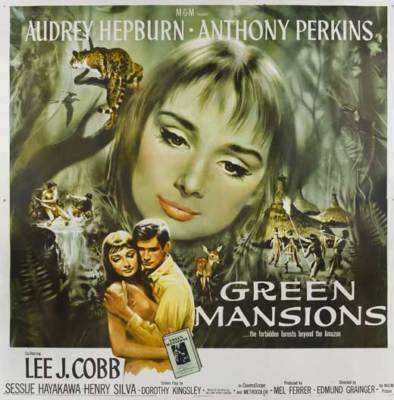
    When Heitor Villa-Lobos was contracted by M-G-M to write music for a big screen adaptation of W.H. Hudson’s novel “Green Mansions” (1959), expectations ran high on both sides. The Brazilian master began immediately, diving into the project with characteristic gusto. After all, he had been writing music inspired by the rain forest for his entire career.

    Unfortunately, he had very little affinity for the practicality of the filmmaking process, turning in musical impressions of scenes from the book. The studio was befuddled. Since Villa-Lobos was unable to adapt to the customary way of doing things, he was replaced by M-G-M house composer Branislau Kaper, who used the Villa-Lobos material as a springboard for his own dramatic conception. The result is part Villa-Lobos, part Kaper, and all M-G-M gloss.

    Villa-Lobos was a little embittered by his Hollywood experience. He promptly assembled a multi-movement symphonic poem, “Forest of the Amazon” (1958), some 75 minutes in length, which employed his rejected sketches. He made a recording of 45 minutes of the music in 1959, for which the soprano Bidu Sayão came out of retirement.

    This week on “Picture Perfect,” we’ll have selections from both versions of “Green Mansions,” as well as from the Mayan adventure “Kings of the Sun” (1963), composed by Elmer Bernstein, and “The Night of the Mayas” (1939), by Mexican composer Silvestre Revueltas.

    I hope you’ll join me for cinematic evocations of the indigenous peoples of Latin America, on “Picture Perfect,” music for the movies, now in syndication on KWAX, the radio station of the University of Oregon!


    Clip and save the start times for all three of my recorded shows:

    PICTURE PERFECT, the movie music show – Friday at 8:00 PM EDT/5:00 PM PDT

    SWEETNESS AND LIGHT, the light music program – Saturday at 11:00 AM EDT/8:00 AM PDT

    THE LOST CHORD, unusual and neglected rep – Saturday at 7:00 PM EDT/4:00 PM PDT

    Stream them, wherever you are, at the link!

    https://kwax.uoregon.edu/


    PHOTO: The project that left Villa-Lobos feeling green around the gills

  • Villa-Lobos’s Hollywood Rainforest

    Villa-Lobos’s Hollywood Rainforest

    When Heitor Villa-Lobos was contracted by M-G-M to write music for a big screen adaptation of W.H. Hudson’s novel “Green Mansions” (1959), expectations ran high on both sides. The Brazilian master began immediately, diving into the project with characteristic gusto. After all, he had been writing music inspired by the rainforest for his entire career.

    Unfortunately, he had very little affinity for the practicality of the filmmaking process, turning in musical impressions of scenes from the book. The studio was befuddled. Since Villa-Lobos was unable to adapt to the customary way of doing things, he was replaced by M-G-M house composer Branislau Kaper, who used the Villa-Lobos material as a springboard for his own dramatic conception. The result is part Villa-Lobos, part Kaper, and all M-G-M gloss.

    Villa-Lobos was a little embittered by his Hollywood experience. He promptly assembled a multi-movement symphonic poem, “Forest of the Amazon” (1958), some 75 minutes in length, which employed his rejected sketches. He made a recording of 45 minutes of the music in 1959, for which the soprano Bidu Sayão came out of retirement.

    This week on “Picture Perfect,” we’ll hear selections from both versions of “Green Mansions,” as well as from the Mayan adventure “Kings of the Sun” (1963), by Elmer Bernstein, and “La noche de los Mayas” (“The Night of the Mayas,” 1939), by Mexican composer Silvestre Revueltas.

    If you can’t beat the heat, join it! It’s an hour of tropical inspirations from films centered on the indigenous peoples of Latin America, on “Picture Perfect,” music for the movies, now in syndication on KWAX, the radio station of the University of Oregon!


    Clip and save the start times for all three of my recorded shows:

    PICTURE PERFECT, the movie music show – Friday at 8:00 PM EDT/5:00 PM PDT

    SWEETNESS AND LIGHT, the light music program – ALL NEW! – Saturday at 11:00 AM EDT/8:00 AM PDT

    THE LOST CHORD, unusual and neglected rep – Saturday at 7:00 PM EDT/4:00 PM PDT

    Stream them, wherever you are, at the link!

    https://kwax.uoregon.edu/


    PHOTO: The project that left Villa-Lobos feeling green around the gills

  • Villa-Lobos’ Rainforest Sound on KWAX

    Villa-Lobos’ Rainforest Sound on KWAX

    We’re having a heat waaaave… a tropical heat wave…

    What better conditions than these in which to enjoy some of the rainforest inspirations of Heitor Villa-Lobos?

    Happily, there will be no vaccinations or machetes required for this particular expedition, when you join me for “The Lost Chord” on KWAX.

    Heitor Villa-Lobos held a unique position in Brazilian music, blazing many trails, both figuratively and literally, to create a distinctive national sound, materials for which he found in the streets and jungles of his native land.

    He turned his back on European models, learning much of his craft through osmosis. Through experiment and exploration, he arrived at his own unique harmonic language.

    Around 1905, he began physically to explore the Brazilian rainforest, where he came into contact with and absorbed the traditions of its indigenous cultures. The expeditions continued for the better part of a decade. He was fond of relating a story about how he once escaped from a pack of hungry cannibals.

    He used this field work to form the basis of two works he wrote in 1916, which draw from Brazilian legends and so-called primitive folk material. Both have been variously described as ballets and symphonic poems: “Amazonas,” about an Indian maiden’s encounter with a metaphorical monster, and its companion piece of sorts, “Uirapuru,” about a legendary bird that sings its song in an enchanted forest. We’ll have a chance to hear both.

    In between, we’ll also listen to the “Danses Africaines” (or “Characteristic African Dances,” so-called), based on tribal music of the Caripunas Indians, in its original version for piano, from 1914-16, AND in its later orchestration, from 1953. The piano set was condemned by uptight critics as “degenerate” at its first performance in 1922.

    These formative “jungle pieces” all date from the same era of the composer’s development. Though their first performances took place over many years, collectively their exotic allure brought Villa-Lobos to international celebrity.

    Villas-Lobos once commented, “I don’t use folklore, I am folklore.” He remains Brazil’s most famous composer. For that matter, all of Latin America’s.

    It’s not much of a stretch to imagine ourselves in the forests of the Amazon this week, as we travel off the beaten path with Heitor Villa-Lobos. Join me for “A Night in the Tropics” on “The Lost Chord,” now in syndication on KWAX, the radio station of the University of Oregon!


    Keep in mind, KWAX is on the West Coast, so there’s a three-hour difference for the Trenton-Princeton area. Here are the respective air-times of my recorded shows (with East Coast conversions in parentheses):

    PICTURE PERFECT, the movie music show – Friday on KWAX at 5:00 PACIFIC TIME (8:00 PM EDT)

    THE LOST CHORD, unusual and neglected rep – Saturday on KWAX at 4:00 PACIFIC TIME (7:00 PM EDT)

    Stream them here!

    https://kwax.uoregon.edu/

  • Villa-Lobos: Joan Baez Sings Bachianas Brasileiras

    Villa-Lobos: Joan Baez Sings Bachianas Brasileiras

    On the birthday of Brazil’s most celebrated composer, Heitor Villa-Lobos, here’s an interesting curio: his most famous music, the “Aria” from Bachianas Brasileiras No. 5, sung by none other than Joan Baez.

    It was the composer’s aim in his nine suites for various instrumental combinations (and this one with voice) to fuse the folk spirit of his native land with the forms of Johann Sebastian Bach.

    No. 5 consists of two movements. The “Aria (Cantilena)” is one of the most famous pieces of classical music to come out of the 20th century. Here’s an English translation of the text, a poem by Ruth Corrêa, which is sung in Portuguese:

    “In the evening, a dreamy, pretty cloud, slow and transparent, covers outer space with pink. In the infinite the moon rises sweetly, beautifying the evening, like a friendly girl who prepares herself and dreamily makes the evening beautiful. A soul anxious to be pretty shouts to the sky, the land, all of Nature. The birds silence themselves to her complaints, and the sea reflects all of Her [the moon’s] wealth. The gentle light of the moon now awakens the cruel saudade [nostalgic or melancholic longing] that laughs and cries. In the evening, a dreamy, pretty cloud, slow and transparent, covers outer space with pink.”

    For some reason, the “Aria” is mostly performed separately from the brief, contrasting “Dança (Martelo)” that follows (on a nostalgic poem by Manuel Bandeira about the birds of the Cariri Mountains).

    In this performance, among the eight cellists that accompany the singer is David Soyer, he of Guarneri String Quartet fame. Soyer would have been 100 on February 24. The conductor is Maurice Abravanel, longtime music director of the Utah Symphony Orchestra.

    Baez’s “Bachianas” appeared on her fifth album, “Joan Baez/5,” released in 1964 (the year the Guarneri Quartet was founded). The content was divided between contemporary and folk material. Interestingly, the liner notes were by Langston Hughes.

    When released as a 45, the notes (which can be magnified at the link) were by musicologist and Beethoven and Mozart biographer Maynard Solomon.

    https://www.45cat.com/record/tfe18014

    The material on the B-side consists of the Neapolitan song “‘Nu Bello Cardillo” and the Mexican song, “El Preso Numero Nueve.”

    Thanks, Joan, and happy birthday, Heitor Villa-Lobos!


    The classic recording of Bachianas Brasileiras No. 5, both the “Aria” and “Dansa,” with Victoria de los Angeles and the composer conducting:

    Villa-Lobos conducts the complete set of Bachianas Brasileiras… and more! Consult the index under the video for direct links.

Tag Cloud

Aaron Copland (92) Beethoven (94) Composer (114) Film Music (117) Film Score (143) Film Scores (255) Halloween (94) John Williams (185) KWAX (228) Leonard Bernstein (99) Marlboro Music Festival (125) Movie Music (132) Opera (197) Philadelphia Orchestra (86) Picture Perfect (174) Princeton Symphony Orchestra (106) Radio (86) Ralph Vaughan Williams (85) Ross Amico (244) Roy's Tie-Dye Sci-Fi Corner (290) The Classical Network (101) The Lost Chord (268) Vaughan Williams (100) WPRB (396) WWFM (881)

DON’T MISS A BEAT

Receive a weekly digest every Sunday at noon by signing up here


RECENT POSTS