Victoria de los Angeles was born 100 years ago today. For me, her rendition of Joseph Canteloube’s “Songs of the Auvergne” has always been one of the great rainy day records. I recommend the entire album, of course, but this is probably the most famous selection.
Tag: Vocal Music
-

Rita Streich’s 100th & Forgotten Christmas Music
Today is the 100th anniversary of the birth of soprano Rita Streich. I’ve been listening to her recording of Josef Rheinberger’s “The Star of Bethlehem” a lot this year.
Sadly, it’s the kind of music you don’t hear much on the radio anymore. Most of the grand and contemplative Christmas works (Franz Liszt’s “Christus,” Vaughan Williams’ “Hodie,” Saint-Saëns’ “Christmas Oratorio,” Casals’ “El Pessebre,” Charpentier’s “Messe de Minuit,” Respighi’s “Laud to the Nativity,” Schütz’s “Christmas Story”) – basically, those that aren’t “Messiah” – are slipping away, as playlists pander to an increasingly A.D.D. society. When the listenership is trained to expect little more than consumer-friendly arrangements of the less-demanding carols, and even Beethoven symphonies are broadcast less and less frequently in their entirety (except perhaps the shorter ones), what are you going to do?
It all seems to have gone away so quickly.
But of course, Streich sang the carols beautifully, too.
-

Dominick Argento A Remembrance
American composer Dominick Argento died on February 20 at the age of 91. Acclaimed particularly for his vocal works, Argento was awarded the Pulitzer Prize for Music for his song cycle, “From the Diary of Virginia Woolf,” in 1975. This Sunday night on “The Lost Chord,” I’ll offer a remembrance of the man and his achievements.
Argento was born in York, PA, to Sicilian immigrant parents, who were inn-keepers and restaurateurs. However, it was in the Twin Cities that he would flourish. He became a professor of music at the University of Minnesota and one of the founders of what is now Minnesota Opera.
He was recognized as a master of modern opera, the most significant American operatic composer between Gian Carlo Menotti in the 1950s and Philip Glass in the 1970s. His success is all the more remarkable, considering Argento spent virtually his entire career very far away from the artistic centers on either coast.
Largely self-taught as a child, he was accepted into the Peabody Conservatory, after service in WWII. There, among his teachers, were Nicolas Nabokov and Hugo Weisgall. Later, he continued his studies with Luigi Dallapiccola in Florence. Howard Hanson, Bernard Rogers, and Alan Hovhaness were also important mentors. Argento received his doctorate from the Eastman School in 1958. He then moved to Minneapolis, where he lived for the next six decades, summering in Florence with his wife, the soprano Carolyn Bailey.
In Minneapolis, he worked closely with the newly-formed Guthrie Theatre. His local successes attracted national nation and led to commissions from major opera houses from all over the country. His song cycles were championed by some of the great singers, including Frederica von Stade, Janet Baker, and Håkon Hågegard. “Casa Guidi,” a song cycle on texts of Elizabeth Barrett Browning, was recorded by Von Stade and received a Grammy Award in 2004 for Best Contemporary Classical Composition.
Beginning in the early ‘70s, Argento also devoted himself to choral music, in large part because of his association with Philip Brunelle and the Plymouth Music Series of Minneapolis’ Plymouth Congregational Church.
In common with Benjamin Britten, Argento’s musical language could be, on occasion, a little quirky, yet always he strove for accessibility. Among his own students were Libby Larsen and Stephen Paulus.
We’ll hear music from one of his 14 operas, “The Dream of Valentino,” from 1993. Accordionist William Schimmel will strut and slither in “Valentino Dances.”
That will be followed by “Six Elizabethan Songs” from 1958. Originally scored for voice and piano, it was subsequently arranged by the composer in 1962 for voice and Baroque ensemble. The added colors of flute, oboe, violin, cello, and harpsichord lend the work a kind of refracted authenticity, conjuring a loosely apposite sound world to the individual texts by Thomas Nash, Samuel Daniel, William Shakespeare, Henry Constable, and Ben Johnson. The performance will be by Patrice Michaels and the Rembrandt Chamber Players.
Finally, Argento was composer laureate of the Minnesota Orchestra, having been commissioned to write no less than seven works for the ensemble. We’ll hear “A Ring of Time,” conceived for the 1972-73 season, the orchestra’s 70th anniversary. Argento considers different measurements of the passage of time – the seasons of the year and the times of the day – in the work’s four movements: “Spring,” “Summer,” “Fall,” and “Winter.” The Minnesota Orchestra will be conducted by Eiji Oue.
Time has passed for Domenick Argento. I hope you’ll join me for an hour of musical remembrances on “Argento Mementos,” this Sunday night at 10:00 EST, on WWFM – The Classical Network and wwfm.org.
-
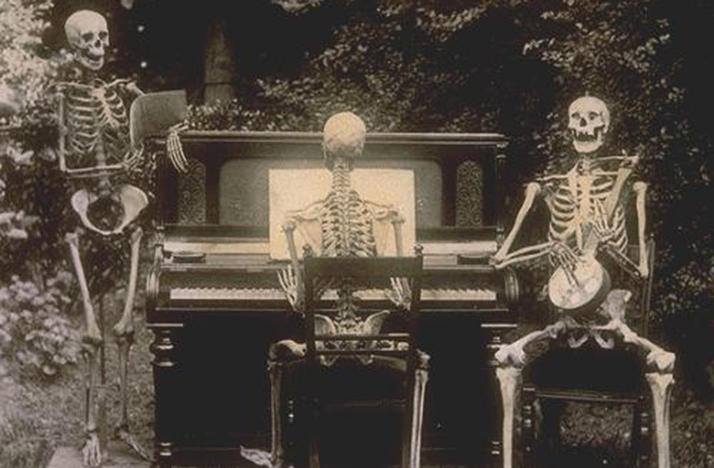
Skeleton on the Rock Obscure Schubert Gem
Not to be outdone by Franz Schubert. Why is it not better known? “The Skeleton on the Rock” for voice, piano and banjo.
Tag Cloud
Aaron Copland (92) Beethoven (94) Composer (114) Film Music (117) Film Score (143) Film Scores (255) Halloween (94) John Williams (185) KWAX (228) Leonard Bernstein (99) Marlboro Music Festival (125) Movie Music (132) Opera (197) Philadelphia Orchestra (86) Picture Perfect (174) Princeton Symphony Orchestra (106) Radio (86) Ralph Vaughan Williams (85) Ross Amico (244) Roy's Tie-Dye Sci-Fi Corner (290) The Classical Network (101) The Lost Chord (268) Vaughan Williams (101) WPRB (396) WWFM (881)