I’m still determined to finish rereading Michael Chabon’s “The Amazing Adventures of Kavalier and Clay” before seeing Mason Bates’ operatic adaptation at the Met next week – which won’t be hard to do honestly, though it’s seriously going to cut into my Halloween reading. (I’ve still got 250 pages to go.) But Halloween can run into November, as far as I’m concerned. And winter is made for ghost stories. With that in mind, this is what I’m planning to have on my bedside table for the month of October.
Somehow, I missed the fact that in 2014, Penguin put out a series of paperback reissues of once-popular novels that became classic movies. I’m not really slavering over Edna Ferber or Fannie Hurst, but I was poking around a used bookstore last week and stumbled across a copy of R.A. Dick’s “The Ghost and Mrs. Muir.” I’ve never read it, but having seen the film many times and watched the TV series when I was a kid, I am familiar with the story: a widow moves into a seaside cottage once owned by a salty sea captain who never really moved out. It’s not going to have a lot in it to really make the skin crawl, so it’s the kind of book I could put off reading until winter or even Valentine’s Day, but I’m moving it up to the top of the list because the Princeton Garden Theatre happens to be showing the movie next Wednesday. Anyway, at 192 pages, it looks like it’s going to be a swift read. Blood and Swash!
(Parenthetically, if you’re interested, here are the other novels in the series: https://www.penguinrandomhouse.com/series/VMO/a-vintage-movie-classic/.)
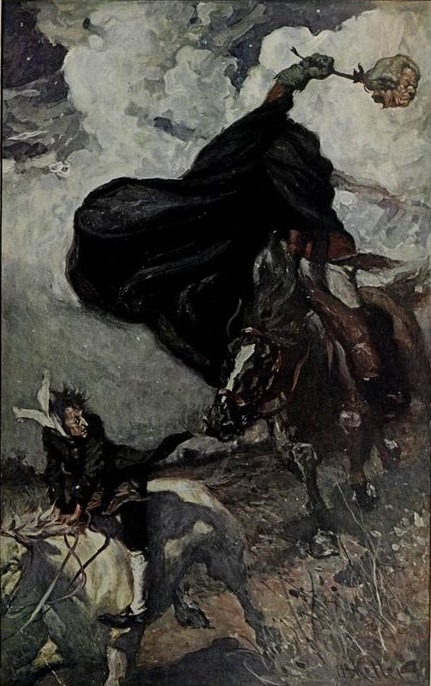
A while ago, I was up in Tarrytown, NY, where I visited Washington Irving’s house (on my way to see Percy Grainger Home & Studio in White Plains), and also Sleepy Hollow, which is not so sleepy anymore. But it does have some decent cemeteries, and I paid my respects at Washington Irving’s grave. There’s also a bridge there on what is alleged to have been the site that inspired “The Legend of Sleepy Hollow.” I’ve read the story a few times over the years (“Rip Van Winkle” too), starting all the way back in seventh grade, but it’s been a while. In recent Octobers, I reacquainted myself with the stories of Edgar Allan Poe (2023) and Nathaniel Hawthorne (2021), so I figured this year I could go back to Irving and cherry-pick some of his supernatural tales, which are often interleaved in his story collections with material that has nothing whatsoever to do with ghosts. I know it’s been a long, long time since I read “The Adventure of the German Student” (though I remember it well) and “The Devil and Tom Walker,” but I find he’s written a great deal else of a supernatural bent beside.
Posting yesterday about Walter Huston reminded me of his scenery-devouring performance as Mr. Scratch in “The Devil and Daniel Webster.” I mentioned in a comment that when I first saw the film, I didn’t love it, despite Huston’s performance and the fact that it looks like an Orson Welles movie. The reason was that the indelible short story by Stephen Vincent Benét (born in Fountain Hill, outside Bethlehem, PA) was still fresh in my head. I have since grown to love the film, but it occurs to me that I have not read the story for many, many years. So I’m adding it to the list.
Another recent, happy discovery while used book-shopping is a work by Philadelphia-born Charles Brockden Brown, who has been called the Father of the American Novel, especially celebrated for his gothic tales. He’s probably best-known for “Wieland,” which is kind of an 18th century precursor to “The Shining,” in some respects, with the added ingredients of religious fanaticism, ventriloquism, and spontaneous combustion. A Brown novel that is new to me is “Edgar Huntly, or Memoirs of a Sleep-Walker.” I picked it up not really knowing anything about it, but after I got it home I learned it’s set where the Delaware and Lehigh Rivers meet – essentially in my hometown of Easton, PA (only in 1787)! Of course, there’s somnambulism, murder, and Lenni Lenape, so not much has really changed. Not sure if I’ll have time for this one before Halloween – maybe – but it’s definitely on the list for November or after Christmas.
You may recall, last year I finally made the commitment to tackle “Varney the Vampyre,” attributed to James Malcolm Rymer. Rymer is also thought to have written “The String of Pearls,” which introduced the character of Sweeney Todd. One of the most notorious of the Victorian penny dreadfuls, “Varney” detailed the villain’s blasphemous rampages for 109 weekly installments from 1845 to 1847. Combined, they add up to 1166 pages in a Wordsworth Edition paperback I was delighted to acquire after decades of searching for a complete collection. In the early ‘70s, “Varney” had also been compiled by Dover, in two volumes, and last year I was able to get a hold of a reprint of that edition, as well. The reproduction of the text is not always of the finest quality, with parts of the individual letters murky or even missing, but it does have the original illustrations. As you can imagine, reading a 1100-page vampire serial in lurid, stodgy prose can be a bit like going back and binge-watching “Dark Shadows.” In time, you risk becoming one of the undead yourself. So at the end of Volume 1, for my own welfare, I decided I needed a rest. I’m hoping to sit down with Volume 2 and finish my descent to the nadir of this anti-Everest of vampire fiction.
I admit, it sounds like a lot, but if I push “Edgar Huntly” to another month, I bet I could do it. It would be a lot easier if not for “Kavalier and Clay,” which I am loving, but am revisiting mostly because I want it fresh in my head for the opera.
By all means, let me know what you’re reading, especially if it’s seasonal and horrible. Happy Halloween!
BONUS! Today is Paul Dukas’ birthday. Maybe a good time to trot out Goethe’s ballad of “The Sorcerer’s Apprentice.” And to watch Mickey stir up a world of trouble here:
https://video.disney.com/watch/sorcerer-s-apprentice-fantasia-4ea9ebc01a74ea59a5867853
PAINTING: “The Devil and Tom Walker” (1843), by Charles Deas