Somehow, I am the last to learn of the passing of Joan Lippincott. But just in case I’m not, Lippincott, who was so much a part of the fabric of the local music community, as a student and later a professor of organ at Westminster Choir College and the Curtis Institute of Music and, for a time, principal organist at Princeton University, died on May 31 at the age of 89.
Here’s an appreciation, with reminiscences and an obituary, shared by one of her former students.
The Municipality of Princeton has used eminent domain to take over the Westminster Choir College campus. Seems like a positive development, though I don’t pretend to know the finer points. The damage to the institution itself is done. However, if these nonprofit arts organizations can continue to operate on the campus, I suppose it’s something. Hopefully we won’t see any more apartment buildings cropping up like the abominations around Princeton Shopping Center (among other locations).
Though Whitbourn enjoyed an international reputation as a composer of choral music – the voices sometimes in combination with orchestra or instrumental ensemble – he had especially close ties to Princeton, by way of Westminster Choir College, where he served for a time as composer-in-residence, and his working relationship with conductor James Jordan.
Whitbourn’s music has frequently been heard here, and more widely, thanks to Jordan’s recordings with Westminster Williamson Voices for the Naxos label.
Perhaps the most ambitious of their collaborations is “Annelies,” a full-length choral work inspired by “The Diary of Anne Frank.” The work was given its U.S. premiere at Westminster in April 2007. Jordan’s recording was nominated for a 2014 Grammy Award for Best Choral Performance.
Another notable work is “Luminosity,” a Jordan commission, performances of which incorporated the black-light dance company Archedream.
Whitbourn’s final work, “Requiem,” yet another Westminster commission, will receive its world premiere, with Jordan conducting the Westminster Choir, at Carnegie Hall on April 13.
The “Processional” from Whitbourn’s “Missa Carolae” is well-known in the community from its inclusion in Westminster’s annual Readings and Carols ceremony at Princeton University Chapel.
The cause of death was cancer. Whitbourn was 60 years-old.
R.I.P.
“Processional and Kyrie” from “Missa Carolae”
Whitbourn discusses “Annelies” with Princeton Pro Musica’s Ryan Brandau
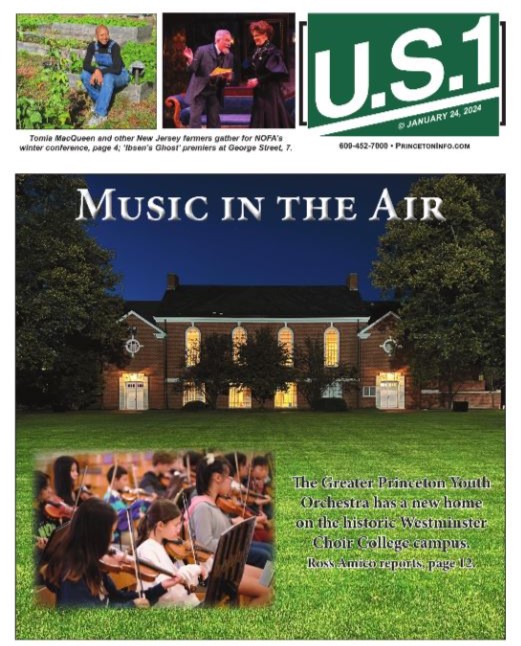
There was an awful lot to absorb and distill about Greater Princeton Youth Orchestra, which moved into its new digs on Westminster Choir College campus this past summer. Witness my struggle with information overload and learn more about the orchestra’s founder Matteo Giammario, Princeton’s protean Portia Sonnenfeld, and the history of Westminster Choir, among other things, in my whirlwind cover story in this week’s U.S. 1, out today.
GPYO musicians will perform music by Rossini, Fauré, Mahler, Tchaikovsky, and Andrew Lloyd Webber on a concert to be held at Princeton University’s Richardson Auditorium on Saturday, February 3, at 7 p.m.
How do you like that? In 1970-71, Malcolm Williamson was composer-in-residence at Westminster Choir College in Princeton, NJ.
In 1975, Williamson would succeed Sir Arthur Bliss as Master of the Queen’s Music, a position he held until his death in 2003. Today is his birthday anniversary.
Williamson, born in Sydney, Australia, in 1931, was the first non-Briton to be appointed Master. From the start, the decision was not without controversy. Sir William Walton quipped that they had given the job to the wrong Malcolm. He was implying that Malcolm Arnold would have been a better choice – a bold statement, since Arnold was prone to alcoholism, promiscuity, manic-depression, and possible bi-polar disorder. He once shot himself in the foot to get out of war service and attempted suicide several times. Still, he did manage to churn out much delightful music-to-order, often lickety-split, and in an immediately accessible idiom. So who knows, maybe Arnold would have been a good choice.
Williamson was always an establishment outlier. Though he arrived in England in his late teens, his antipodean origins led to sotto voce grumblings that his Royal appointment was but a utilitarian one, “cementing the cracks in the Commonwealth,” as Walton put it.
Whether or not a sense of alienation contributed to a kind of paralysis in the face of overwhelming pressure, Williamson developed an unfortunate reputation of being very bad with deadlines. Most particularly, he failed to complete a symphony in time for the Queen’s Golden Jubilee in 1977. His ambitious “Mass for Christ the King,” also intended for the occasion, was also delivered late. Significantly, he was the first Master of the Queen’s (or King’s) Music in over a century not to be knighted.
Following the Jubilee debacle, his output slowed, though he was seldom unproductive. In all, he wrote seven completed symphonies, concertos for piano, violin, organ, harp, and saxophone, and numerous other orchestral, choral, chamber, and instrumental works.
Williamson suffered from ill health in his later years. He too may have turned to the bottle as a means to numb himself against stress and depression. However, those close to him assert that, toward the end of his life, he never drank, but rather struggled with aphasia, the effect of a series of strokes.
Be that as it may, following his death in 2003, the parameters of the Royal appointment were revised. The position is no longer one for life, but rather a fixed, ten-year term.
What’s puzzling is that, for someone who had a reputation for being unable to meet deadlines, Williamson was able to write a fair amount of music for the cinema. The films were admittedly of varying quality. It’s always amusing to find his name in the opening credits of Hammer horror movies. But it proves that he could write to order, and he could write very quickly, perhaps when he wasn’t under the microscope.
Williamson was not the only future Master of the Queen’s Music to spend time in Princeton, by the way. His eventual successor, Peter Maxwell Davies, who served as Master from 2004 to 2014, attended Princeton University as a Harkness Fellow, studying under Roger Sessions and Earl Kim, and received his PhD here in 1967. Max would be the first to hold the office under the new guidelines. He was succeeded in 2015 by Judith Weir, the first woman to hold the post (and yes, she is still referred to as “Master”).
Happy birthday, Malcolm Williamson!
Williamson plays his attractive Piano Concerto No. 2
Rare recording of his Symphony No. 6
“Mass of the Feast of Christ the King”
Ballet “The Display” (inspired by Robert Helpmann’s dream of a naked Katherine Hepburn!)
“With Proud Thanksgiving”
Two Christmas Hymns
“Vision of Christ-Phoenix” for Coventry Cathedral (organ)
“Autumn Idyll”
Lento for Strings
Theme music for “The Brides of Dracula”
“The Horror of Frankenstein”
“Nothing But the Night,” starring Christopher Lee and Peter Cushing
Spoken observations on Pär Lagerkvist, Nobel prize winning author of “Barabbas” and “The Dwarf”