I devoted one of my posts the other day to news of a limited-time revival of “Ben-Hur,” back on the big screen, courtesy of Fathom Entertainment. The film has been showing at select theaters across the country over the past four days, with today being the last. If you’re at all interested in seeing it in its new 4K restoration, search for theaters in your area by clicking on “get tickets” at https://www.fathomentertainment.com/releases/ben-hur-2026/. Screenings tonight will likely begin sometime between 6:00 and 7:00.
And let me tell you, the film looks great. Also, I don’t know that it’s ever sounded better. Miklós Rózsa’s fanfares and choruses soar, the clatter, thundering horse hoofs, and roar of the crowd during the chariot race thrill, and the earthquake following Jesus’ crucifixion terrifies.
Granted, the film is four hours long (presented with a brief intermission), but it is an absorbing story told on a grand scale. Why, then, was I the ONLY PERSON IN THE THEATER when I saw it last night? I mean, this was the most-decorated film of all-time, with a record-breaking 11 Academy Awards. It was also the highest grossing picture since “Gone with the Wind.” Everything about it is immaculately rendered (no pun intended).
Were people put off because it’s an old movie? By the length? By the religion? Because it was a work night? Here, the film was over by 9:50.
Most likely, they stayed away because it doesn’t have Ryan Gosling in a spaceship. Also, it’s less demanding to stay home and stream “content” as background to scrolling on the phone and texting friends.
If any of these is the case, I feel sorry for those people. But I am also concerned for the future of everything I hold dear. A large segment of the population, it seems, possibly a majority, lacks the curiosity and the attention spans of our parents and grandparents, who might have considered this a deeply satisfying, even transformative night out.
Concerning the religion, “Ben-Hur” is a peculiar movie. On the surface, it has a Christian outlook (Lew Wallace’s book bears the subtitle “A Tale of the Christ”), but the hero, blue-eyed Charlton Heston as the Judean prince Judah Ben-Hur, is proudly Jewish. Of course, the conflict in the film is more political than religious. Ethnic distinctions are drawn mainly along the lines of those in occupied lands who bristle under their Roman conquerors. There’s one scene wherein the Romans make a sneering remark about a proposed chariot race with Judah. “A Jew?” one remarks, incredulously (sponsored by an Arab, no less). But the Romans, in general, are a proud, supercilious lot.
The other day, I mentioned an alleged gay subtext (according to Gore Vidal) in the establishing scene between Judah and his childhood friend, Messala (played by Stephen Boyd), which does exude a certain, unusually ardent quality, though things very quickly go south as the men’s allegiances drive a wedge between them. However, given that Judah’s later relationship with the Roman general Arrius (played by Jack Hawkins) deepens into an equally unguarded affection, it would be easy to chalk it up to simple phileō. This was, after all, the ancient world.
That said, if there’s a more homoerotic mainstream American movie, I can’t think of it. There are half-naked, well-oiled men everywhere. They stop just short of snapping each other with their towels. And if it’s an historical or Biblical epic, you can bet Heston will be standing around in a loin cloth for at least some of it. It must have been in his contract.
The film is adapted from a bestselling novel by Civil War general Lew Wallace, the most-read American novel in the period between “Uncle Tom’s Cabin” and “Gone with the Wind.” Wallace claimed not to be particularly religious at the time he took up his pen, but on completion of the manuscript, he found he had become a believer.
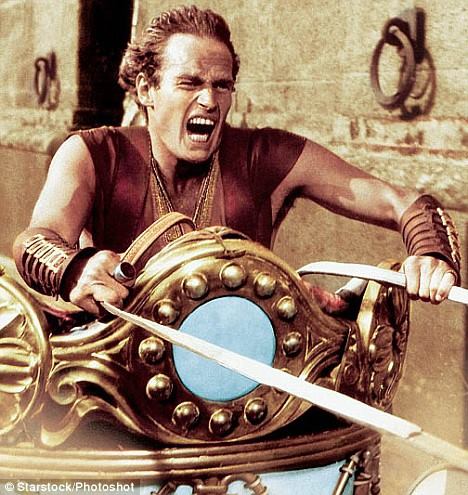
The story is really a mash-up of “The Count of Monte Cristo” and a Jesus movie. Jesus pops in every once in a while, always viewed from the back of the head, as Rózsa’s score strikes a mystic tone. But the film is not really about Jesus, or rather it isn’t JUST about Jesus, as much as it is about getting in touch with your own humanity and embracing your better angels. Yes, the ideals advocated by Jesus point the way, but Judah himself, as a good and thoughtful person, grapples with the complexity and corrupting nature of the impulse to revenge. Heston delivers a nuanced performance, a career best, that conveys much of his character’s conflict and evolution through his thoughts, facial expressions, and physical bearing, as much of it is not explicit in the dialogue, though certainly supported by the compassionate exchanges in Judah’s encounters with Jesus.
Interestingly, Judah recognizes the extraordinary in these silent encounters, but he remains a Jew to the end (as opposed to converting to Christianity). Throughout the film he touches his mezuzah reverently, even tenderly, when entering his house. When his family’s fortunes plummet, still he adjusts the scroll and carefully tends to this symbol of his identity and faith. At a point, he covers his head and prays for forgiveness for his desire to seek vengeance. Whether or not he embraces Christianity beyond the action of the movie is unclear, but I think not. Nevertheless, he is transformed.
In a way, Jesus is an external symbol of Judah’s inner goodness. Or perhaps, putting it another way, Jesus becomes a catalyst for Judah’s self-awareness. A Roman early in the film remarks that Jesus teaches that God exists inside every one of us. (“It’s quite profound, actually,” he adds, with a far-away look.) Whether or not you are a “religious” person, whether you are Jewish or Christian, the film should still work for you. It’s interesting that, for such an earnest, at times histrionic presentation, it manages to satisfy when viewed from multiple perspectives.
Judah’s journey leads him through physical trials and into the emotional abyss. But he does believe in a higher power. He makes it clear several times throughout the film, most especially when he tells Arrius he cannot believe that God would keep him alive in the galleys for three years only to have him drowned at the bottom of the sea.
It’s an inspiring movie, not least of all for all the craftsmanship that went into it. The starfield in the film’s prologue, as the Three Magi travel to Bethlehem to pay homage at the manger, is magical. The kings, captured in profile, are like a Rembrandt brought to life. The stable scene is touchingly reverent, but the chance cavorting of a rambunctious calf saves it from stiffening into sanctimonious kitsch. And then the credits! My god, Miklós Rózsa’s music!
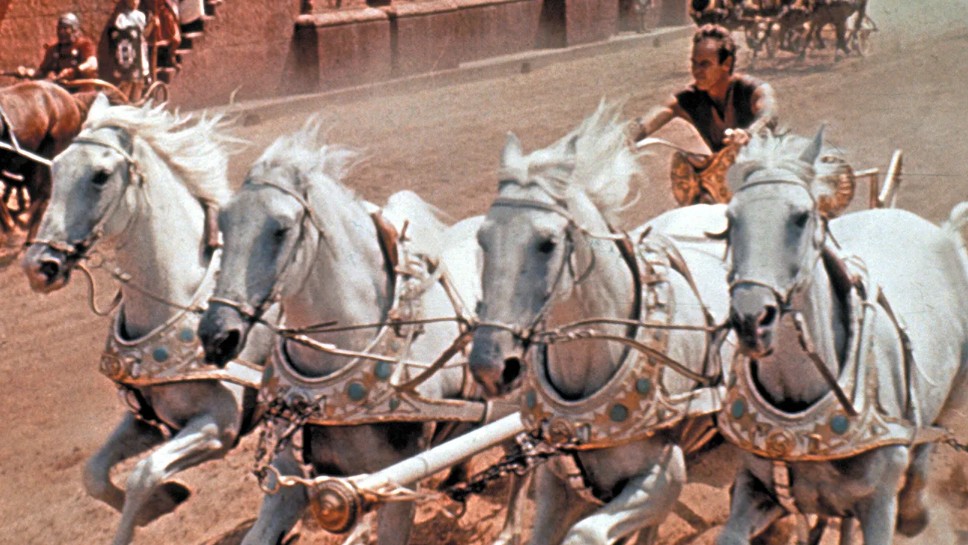
There were no computers back then, remember, so everything you see was made by hand. The sets, the expert matte paintings, the costumes on the cast of thousands. Those nine chariots racing around the arena with their teams of frothing horses are real. Stuntmen risked life and limb, and Heston and Boyd can be seen in some of the shots actually maneuvering their rigs. I know it’s a hackneyed phrase, but they really don’t make ‘em like this anymore!
I should add, the film is not for ironists. It is absolutely in earnest from beginning to end, but as I suggest, it’s open to a range of interpretations. It is the visual equivalent of reading a book. It feels like a literary experience. Whether or not it reflects Wallace’s original in that regard, I cannot say. I have yet to read it, but I’ll get around to it one of these days. For now, and as has been the case for decades, I hold the movie very close.
Heston, Boyd, Hawkins, Finlay Currie (as the king Balthasar), and Frank Thring (who plays Pilate as a consummate politician) have never been better. William Wyler (who was Jewish) was one of the most skilled Hollywood directors of all time. Google him and just look at his credits. He directed all kinds of pictures, from “Wuthering Heights” and “The Heiress” to “Roman Holiday” and “Funny Girl,” with very few of them being less than wholly satisfying. Several of them, including “The Best Years of Our Lives” and “The Big Country,” are among my all-time favorites.
You have one more chance to catch “Ben-Hur” on the big screen in its 4K restoration. I don’t care how good your system is at home. Watching it on your couch with distractions of the phone, the refrigerator, and easy access to a bathroom is not the same experience. Go, and prepare to be overwhelmed.
Tag: William Wyler
-
Is There Still an Audience for “Ben-Hur”?
-
Ben-Hur: Bigger Than Jesus
When asked to name my favorite movies, my top-10 list is probably more like top-50 or 60. But one film I do love dearly is “Ben-Hur” (1959). So imagine my excitement when I saw the trailer – in an honest to goodness theater – this weekend when attending the Met “Live in HD” simulcast of Wagner’s “Tristan und Isolde.” It turns out it’s going to be given the Fathom Events treatment, shown in select theaters in a brand new 4K restoration, March 29 & 30 and April 1 & 2.
The winner of a record 11 Academy Awards, “Ben-Hur” was also a stunning popular success, at the time, becoming the second-highest grossing film in history, after “Gone with the Wind” (adjusting for inflation, STILL the all-time box office champ).
The score, by Miklós Rózsa, is a prime example of the kind of masterly music you rarely, if ever, encounter at the movies anymore. It was also the longest ever composed for film – and, before the soundtrack for “Star Wars” became a bestselling phenomenon, “Ben-Hur” found a home in record collections of folks who didn’t ordinarily seem to pay too much attention to film music. I love it. Surely, it’s in my top-10 film scores of all time. But there we go again.
In fact, I have nothing but superlatives to heap on this film. Its detractors might dismiss it as risible, histrionic, Hollywood religioso kitsch, but I’m glad I lack their cynicism. The film is actually beautifully acted, with Charlton Heston, often way over the top in everyman parts, perfect for this kind of grandiose canvas. He winds up giving one of his best performances. The tragedy of the soured friendship between Judah Ben-Hur, a Jewish prince, and his childhood friend Messala (played by Stephen Boyd), now an ambitious Roman tribune, is beautifully modulated.
Gore Vidal was fond of sharing an anecdote about their introductory scene, which, after many takes, just wasn’t working. As he told it, the director William Wyler grew increasingly frustrated, until Vidal suggested playing it with a gay subtext, an idea Boyd found fascinating. Wyler considered it for a few moments, before remarking, “Okay. But don’t tell Chuck!” Whether or not it’s true – and who cares? – the scene establishes the characters’ deep bond, soon to be dashed against the rocks of their political differences. The look Judah casts upon his friend at the end of the chariot race gets me every time. It conveys the humanity at the center of this big, big film, full of very big themes.Is it overdone? Did I mention, Jesus is in it too?
Regardless of your religious convictions, it’s a beautiful movie, with lots of painterly shots and the aforementioned chariot race, with a cast of thousands and an arena actually built, as opposed to computer generated (some of the sets were extended using matte paintings), and staged, with galloping horses and death-defying stuntmen. They just don’t make ‘em like this anymore!
For classic movie buffs, it’s also fun to spend time with Jack Hawkins, Sam Jaffe, Finlay Currie, and the always supercilious Frank Thring, who specialized in debauched rulers – and, okay, even Hugh Griffith in brown-face, ouch! (He plays an Arab sheik.)
William Wyler had an incredible batting average. Hardly any of his films rate less than four stars, and three of them – this one, “The Best Years of Our Lives,” and “The Big Country” – are among my all-time favorites.
“Ben-Hur” is a four-hour movie, presented in the grand ‘50s tradition, complete with overture and intermission music, but Fathom will be screening it at sensible hours – in most theaters, beginning at 6:00 for weekday showings and 2:00 on the weekend – but do double-check the listings for your area.
It won’t be projected from film, and you’re unlikely to be able to catch it in an old-fashioned movie palace, but for now, it’s the best we can hope for. The only other challenge is finding someone who will be willing to watch it with you!
Tickets and information available at https://www.fathomentertainment.com/releases/ben-hur-2026/ -

Copland’s Hollywood Struggles & Triumphs
The star-spangled glare of American music doesn’t just end with the Fourth of July fireworks. This week, on “Picture Perfect,” we’ll bask in the pyrotechnic after-glow of Independence Day with an hour of film music by Aaron Copland.
Despite his reputation as the “Dean of American Composers,” and the eventual acceptance into concert halls of his film music classics “Our Town” and “The Red Pony,” Copland’s experiences in Hollywood were not all peaches and cream. After all, if you want to work in the film industry, you’ve got to expect that once in a while somebody’s going to mess with your work, even if you’re a Pulitzer Prize winner.
In particular Copland was not very happy with what they did to his music for “The Heiress.” Carefully-crafted cues were chopped to ribbons, dialed down and rescored without his approval. William Wyler (“Wuthering Heights,” “Friendly Persuasion,” “The Big Country,” “Ben-Hur”) was a brilliant director, but he must have had a tin ear. His films consistently sported some of the best scores of their respective eras, and yet he mostly underappreciated, if not outright disliked, their music.
“The Heiress” was made fresh off of Wyler’s runaway success with “The Best Years of Our Lives.” The film, based on Henry James’ “Washington Square,” was nominated for eight Academy Awards. It won four, including Oscars for Olivia De Havilland and for Copland’s score, which is so strong it manages to maintain its integrity despite all of the studio tinkering.
Wyler insisted Copland work the song “Plaisir d’Amour” into the fabric of his music, which he artfully did in three cues. But that wasn’t good enough. Without Copland’s knowledge, the main title was replaced with a garish arrangement of “Plaisir,” which was also looped in for some of the love music. André Previn, in 1949 already one of Hollywood’s bright young talents, likened the return of Copland’s original thoughts following these interpolations to “suddenly finding a diamond in a can of Heinz beans.”
When Copland’s contribution was recognized by the Academy, it was the only instance up to that time of a score being honored after being shorn of its main title, the part of a score that generally makes the biggest impression. Copland never bothered to collect his award. “The Heiress” would be the last time he would work in Hollywood.
He did compose one more film score, however, for the 1961 independent film, “Something Wild,” which contains some of his most insistently non-commercial music. Occasionally brutal and often thrilling, its character is worlds away from the pastoral tranquility of “Appalachian Spring.” It’s a brilliant piece of work, yet it did not receive a commercial release until 2003.
We’ll sample music from these two underappreciated classics, as well as from the controversial pro-Soviet film “The North Star;” also a bit from the 1939 World’s Fair documentary “The City.”
Extend your holiday weekend with a cold cone of Aaron Copland classics on “Picture Perfect,” music for the movies, this Friday evening at 6:00 EDT, on WWFM – The Classical Network and wwfm.org.
-
Copland’s Hollywood Ice Cream Social
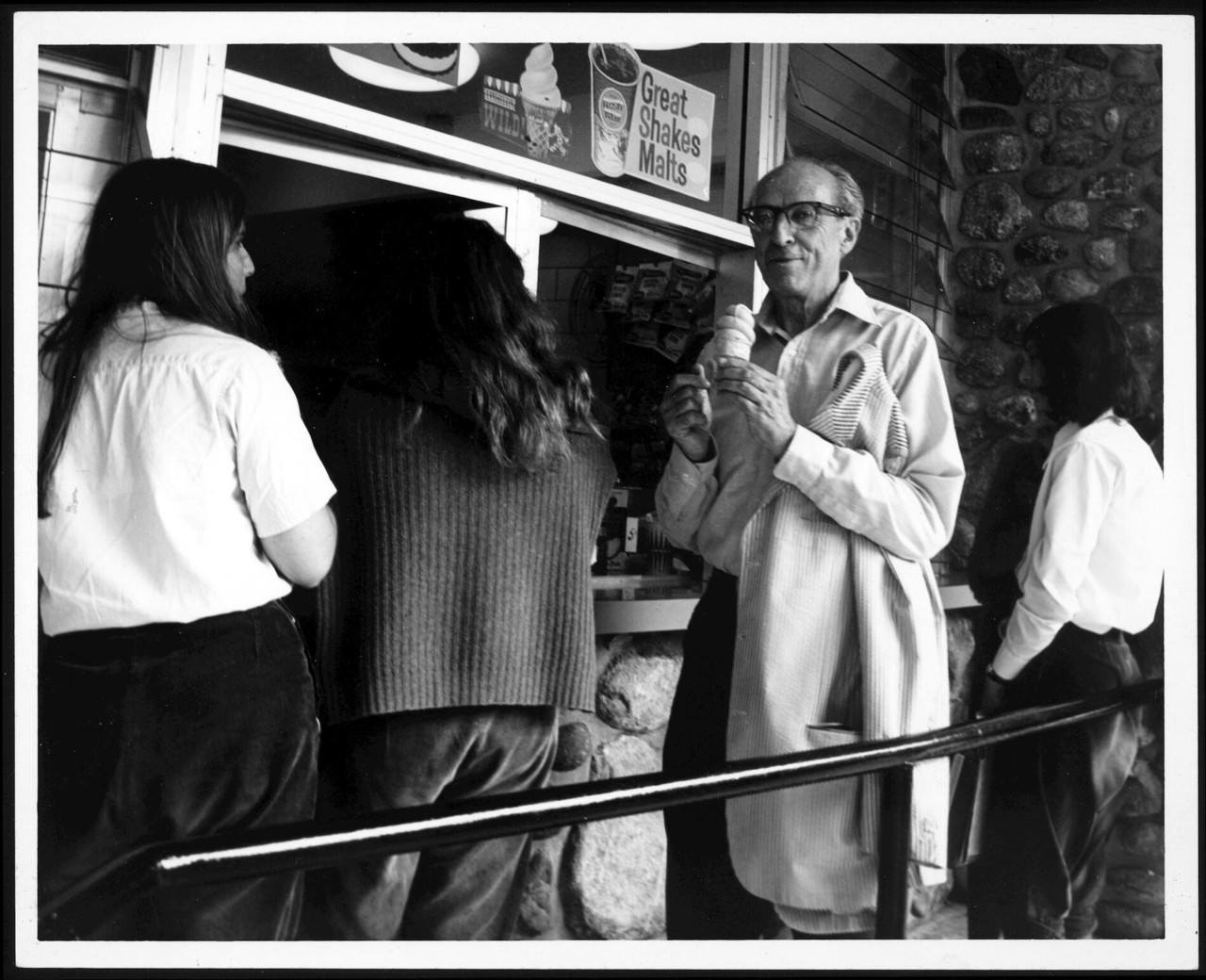
Life isn’t so bad when there’s ice cream.
Perhaps that was what was going through Aaron Copland’s head, decades after getting jerked around by Hollywood. After all, if you want to work in the film industry, you’ve got to expect that once in a while somebody’s going to mess with your things – even if you’re a Pulitzer Prize winner, lauded as the “Dean of American composers.”
Copland was not very happy when his music for “The Heiress” was chopped to ribbons, dialed down and rescored without his approval. William Wyler (“Wuthering Heights,” “Friendly Persuasion,” “The Big Country,” “Ben-Hur”) was a brilliant director, but he had a tin ear. His films consistently sported the best scores of their era, and yet he mostly underappreciated, if not outright disliked, the music.
“The Heiress” was made fresh off Wyler’s runaway success with “The Best Years of Our Lives.” The film, based on Henry James’ “Washington Square,” was nominated for eight Academy Awards, winning four, including Oscars for Olivia De Havilland and for Copland’s score, which is so strong it manages to maintain its integrity despite all of the studio tinkering.
Wyler insisted Copland work the song “Plaisir d’Amour” into the fabric of his music, which he artfully did in three cues. But that wasn’t good enough. Without Copland’s knowledge, the main title was replaced with a garish arrangement of “Plaisir,” which was also looped in for some of the love music. André Previn, in 1949 already one of Hollywood’s bright young talents, likened the return of Copland’s original thoughts following these interpolations to “suddenly finding a diamond in a can of Heinz beans.”
When Copland’s contribution was recognized by the Academy, it was the only instance up to that time of a score being honored after being shorn of its main title, the part of a score that generally makes the biggest impression. Copland never bothered to collect his award. “The Heiress” would be the last time he would work in Hollywood.
He did compose one more film score, however, for the 1961 independent film, “Something Wild,” which contains some of his most insistently non-commercial music. Occasionally brutal and often thrilling, its character is worlds away from the pastoral tranquility of “Appalachian Spring.” It’s a brilliant piece of work, yet it did not receive a commercial release until 2003.
This week on “Picture Perfect,” we’ll sample music from “The Heiress” and “Something Wild,” as well as from the controversial pro-Soviet film “The North Star.” We’ll even hear a little bit from the 1939 World’s Fair documentary “The City.”
Get your Labor Day weekend off to a good start with a cold cone of Aaron Copland classics, this Friday evening at 6:00 EDT, on WWFM – The Classical Network and wwfm.org.
-

Aaron Copland’s Hollywood Battles & Brilliance
If you want to work in Hollywood, you’ve got to expect once in a while somebody’s going to mess with your things – even if you’re a Pulitzer Prize winner, lauded as the “Dean of American composers.”
Aaron Copland was not very happy when his music for “The Heiress” was chopped to ribbons, dialed down and rescored without his approval.
William Wyler (“Wuthering Heights,” “Friendly Persuasion,” “The Big Country,” “Ben-Hur”) was a brilliant director, but he had a tin ear. His films consistently sported the best scores of their era, and yet he mostly underappreciated, if not outright disliked them.
“The Heiress” was made fresh off Wyler’s runaway success with “The Best Years of Our Lives.” The film, based on Henry James’ “Washington Square,” was nominated for eight Academy Awards, winning four, including Oscars for Olivia De Havilland and for Copland’s score, which is so strong it manages to maintain its integrity despite all of the studio tinkering.
Wyler insisted Copland work the song “Plaisir d’Amour” into the fabric of his music, which he artfully did in three cues. But that wasn’t good enough. Without his knowledge, the main title was replaced with a garish arrangement of “Plaisir,” which was also looped in for some of the love music. André Previn, in 1949 already one of Hollywood’s bright young talents, likened the return of Copland’s original thoughts following the interpolations to “suddenly finding a diamond in a can of Heinz beans.”
When Copland’s contribution was recognized by the Academy, it was the only instance up to that time of a score being honored after being shorn of its main title, the part of a score that generally makes the biggest impression. Copland never bothered to collect his award. “The Heiress” would be the last time he would work in Hollywood.
He did compose one more film score, however, for the 1961 independent film, “Something Wild,” which contains some of his most insistently non-commercial music. Occasionally brutal and often thrilling, its character is worlds away from the pastoral tranquility of “Appalachian Spring.” It’s a brilliant piece of work, yet it did not receive a commercial release until 2003.
This week on “Picture Perfect,” we’ll sample music from “The Heiress” and “Something Wild,” as well as from the controversial pro-Soviet film “The North Star,” and even a little bit from the 1939 World’s Fair documentary “The City.”
Join me for the film music of Aaron Copland, this Friday evening at 6 ET, or catch the show later as a webcast, at http://www.wwfm.org.
Tag Cloud
Aaron Copland (92) Beethoven (94) Composer (114) Film Music (116) Film Score (143) Film Scores (255) Halloween (94) John Williams (185) KWAX (228) Leonard Bernstein (99) Marlboro Music Festival (125) Movie Music (131) Opera (197) Philadelphia Orchestra (86) Picture Perfect (174) Princeton Symphony Orchestra (106) Radio (86) Ralph Vaughan Williams (85) Ross Amico (244) Roy's Tie-Dye Sci-Fi Corner (290) The Classical Network (101) The Lost Chord (268) Vaughan Williams (99) WPRB (396) WWFM (881)