Poland is in bloom! This Saturday on “The Lost Chord,” find refreshment in musical discoveries by four Polish composers.
We’ll hear a Fantasy for Cello and Piano by Alexandre Tansman. Tansman spent most of his career in Paris, with an interlude during the war years in the United States. Here, he met Arnold Schoenberg, wrote film scores, and developed an affection for American jazz. Still, his most enduring influences were those of his Polish and Jewish roots.
Hyper-romantic Mieczyslaw Karlowicz lived his life at such a heightened emotional pitch that he was perhaps fated to die young. His music certainly tends in that direction, occupied as most of it is with ecstasy and death. “A Sad Tale,” his last completed work, is a contemplation of suicide. Karlowicz himself was killed in an avalanche while hiking in the Tatras. He was 32 years-old.
On a lighter note, we’ll enjoy choral music by Andrzej Koszewski – his “Kaszuby Suite,” steeped in folk traditions of northwestern Poland – and a neoclassical woodwind quintet by Wojciech Kilar, who is probably best known in the West for his film scores, including those for “Bram Stoker’s ‘Dracula,’” “The Portrait of a Lady,” and “The Pianist.”
It’s a flowering of Polish music on “Poland Spring,” on “The Lost Chord,” now in syndication on KWAX Classical Oregon!
——-
Clip and save the start times for all three of my recorded shows:
PICTURE PERFECT, the movie music show – Friday at 8:00 PM EDT/5:00 PM PDT
SWEETNESS AND LIGHT, the light music program – Saturday at 11:00 AM EDT/8:00 AM PDT
THE LOST CHORD, unusual and neglected rep – Saturday at 7:00 PM EDT/4:00 PM PDT
Stream them, wherever you are, at the link!
https://kwax.uoregon.edu See less
Tag: Wojciech Kilar
-

“Poland Spring” on “The Lost Chord”
-
Kilar’s Exodus Passover and a Klezmer Motif
Chag Sameach! Passover begins at sunset.
Wojciech Kilar (1932-2013) is probably best-known in this country for his film scores. He composed music for well over 100 movies, gaining a toehold in international cinema fairly late in his career. American audiences may recognize his work for “Bram Stoker’s Dracula” (1992), “The Portrait of a Lady,” (1996), and “The Pianist” (2002).
But in his native Poland, he was also a major concert composer, of the same generation as Krzysztof Penderecki and Henryk Górecki. My own first exposure to Kilar was on a concert of the Philadelphia Orchestra, given back in 1987, when Witold Rowicki conducted a fascinating work titled “Krzesany” (1974), a symphonic poem evocative of a Polish mountain dance that employs aleatoric elements.
In 1979-81, Kilar composed “Exodus,” a 23-minute crescendo, after the manner of Ravel’s “Boléro,” only crowned by the entrance of a chorus, which sings “Domine ecce venit populus tuus” (“Lord, behold, your people come”), in a spirit of mounting exultation.
Though it is by no means film music, its genesis was in Kilar’s research in writing music for Peter Lilienthal’s film, “David” (1979). The composer stumbled across a klezmer motif in a Jewish songbook, and it basically took him over. He dedicated the finished piece to Krzysztof Zanussi, another filmmaker.
Interestingly, Kilar’s “Exodus” did enjoy a brief vogue in the movies, in trailers, such as the one for “Schindler’s List.”
You can view a live performance of it here:
Be sure to stick around for a golf clap from the clergy at the end (except for the guy at the far end of the pew, who seems to have genuinely enjoyed it).
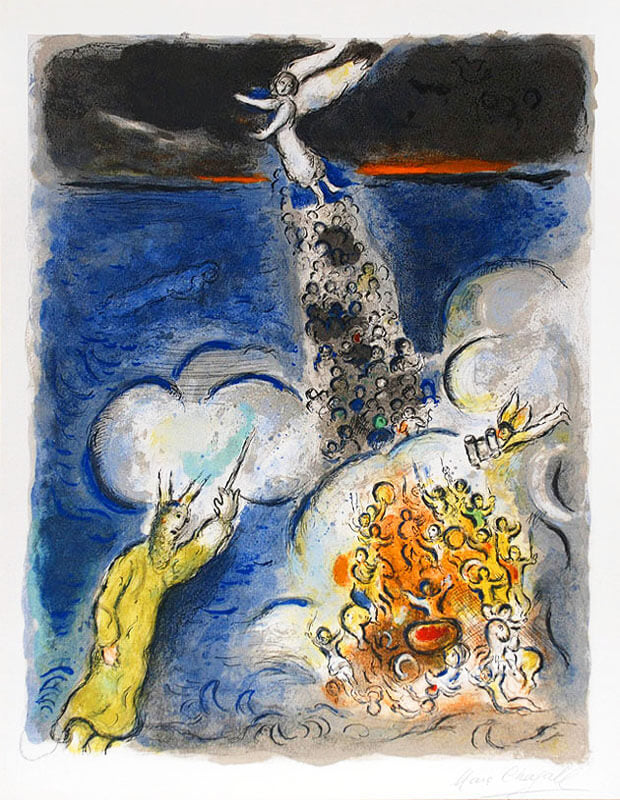
Marc Chagall, “The Train Crossed the Red Sea” from “Exodus” (1966)
-

Discover Polish Composers on The Lost Chord
Poland is in bloom! This Sunday night on “The Lost Chord,” find refreshment in musical discoveries by four Polish composers.
We’ll hear a Fantasy for Cello and Piano by Aleksander Tansman. Tansman spent most of his career in Paris, with an interlude during the war years in the United States. Here, he met Arnold Schoenberg, wrote film scores, and developed an affection for American jazz. Still, his most enduring influences were those of his Polish and Jewish roots.
Hyper-romantic Mieczyslaw Karlowicz lived his life at such a heightened emotional pitch that he was perhaps fated to die young. His music certainly tends in that direction, occupied as most of it is with ecstasy and death. “A Sad Tale,” his last completed work, is a contemplation of suicide. Karlowicz himself was killed in an avalanche while hiking in the Tatras. He was 32 years-old.
On a lighter note, we’ll enjoy choral music by Andrzej Koszewski –
his “Kaszuby Suite,” steeped in folk traditions of northwestern Poland – and a neoclassical woodwind quintet by Wojiech Kilar, who is probably best known in the West for his film scores, including those for “Bram Stoker’s ‘Dracula,’” “The Portrait of a Lady,” and “The Pianist.”It’s a flowering of Polish music on “Poland Spring.” I hope you’ll join me, this Sunday night at 10:00 EDT, on WWFM – The Classical Network and wwfm.org.
-

9/11 Music of Remembrance and Reflection
Where has the time gone? Has it really been been 17 years since the terrorist attacks of September 11, 2001? On the one hand, we should definitely be thankful that the catastrophe hasn’t been repeated. On the other, it sure does seem like yesterday.
Not surprisingly, September 11 has inspired a lot of music, and this afternoon on The Classical Network, I thought we’d listen to just some of it.
Wojciech Kilar is probably best known in this country for his film scores, including those for “Bram Stoker’s Dracula,” “Portrait of a Lady,” and “The Pianist.” He was more prolific in Polish cinema, but his concert output has been equally fruitful, if not more so. Kilar emerged from the Polish avant-garde movement of the 1960s. He is of the same generation as Henryk Gorecki and Krzysztof Penderecki. Like those composers, he eventually reconciled his experimental impulses with a more accessible language.
Kilar emphasizes that his musical response to 9/11, his “September Symphony,” was not an act of opportunism, but a heartfelt response written for a country he has always loved. In the finale, he draws on familiar quotations from Gershwin and “America the Beautiful,” as well as gospel, blues, and American westerns.
Closer to home, Philadelphia composer Robert Moran’s “Trinity Requiem” was named for Trinity Wall Street, the so-called “Ground Zero” church in Lower Manhattan. Moran’s approach to the Requiem Mass is akin to that of Gabriel Fauré, a work of solace and consolation. The substantial role sung by children’s chorus only lends to the work’s innocent and ethereal qualities.
New York composer and Juilliard professor Eric Ewazen’s “A Hymn for the Lost and the Living” was originally composed for the United States Air Force Heritage of America Band, but has since widely circulated in a version for trumpet and piano. Ewazen writes, “It is intended to be a memorial for those lost souls, gone from this life, but who are forever cherished in our memories.” Even so, I think you’ll find a lot of resilience in this music.
Along the way, we’ll also hear works by Fauré and Aaron Copland. David Osenberg will include further 9/11 reflections as part of his programming, later in the day.
The afternoon will begin with a Noontime Concert, brought to us from indomitable New York by Gotham Early Music Scene, or GEMS. The duo Hollingshead & Bass (mezzo-soprano Barbara Hollingshead and lutenist Howard Bass) will present “Time, Cruell Time!” Selections by John Dowland and his contemporaries will be performed as sets organized into subcategories such as “Passing Time,” “Crabbed Age and Youth,” “ Earthly Folly,” and “Time and the Court.” The program took place on January 11 at St. Bartholomew’s Church, 50th Street and Park Avenue, in Midtown Manhattan.
GEMS is a non-profit corporation that supports and promotes artists and organizations in New York City devoted to early music – music of the Middle Ages, Renaissance, Baroque, and early Classical periods. For more information about St. Bart’s free lunchtime concerts, presented on Thursdays at 1:15 p.m., and other GEMS’ events, look online at gemsny.org.
Experience the music, remember the past, and give thanks for the present, this afternoon, from 12 to 4 p.m. EDT, on WWFM – The Classical Network and wwfm.org.
-

Polish Music Hike Vistula Sounds Lost Chord
This week on “The Lost Chord,” we go hiking in the Tatras and drifting down the Vistula, as we enjoy an hour of musical discoveries from Poland.
We’ll hear a Fantasy for Cello and Piano by Aleksander Tansman, who spent most of his career in Paris, with an interlude during the war years in the United States. Here, he met Arnold Schoenberg, wrote film scores, and developed an affection for American jazz. Still, his most enduring influences were those of his Polish and Jewish roots.
Mieczyslaw Karlowicz was one of those hyper-romantic figures whose emotional life was lived at such a high pitch that he seemed fated to die young. His music certainly tends in that direction, occupied as most of it is with ecstasy and death. “A Sad Tale,” his last completed work, is a contemplation of suicide. Karlowicz himself was killed in an avalanche while hiking in the Tatras. He was 32 years-old.
We’ll round out the hour with choral music by Andrzej Koszewski – his “Kaszuby Suite” – steeped in folk traditions of northwestern Poland, and a neoclassical woodwind quintet by Wojiech Kilar, who is probably best known in the West for his film scores, including those for “Bram Stoker’s ‘Dracula,’” “The Portrait of a Lady,” and “The Pianist.”
I hope you’ll join me for “Poland Spring” – refreshing musical discoveries from Poland – tonight at 10 ET, with a repeat Wednesday evening at 6; or that you’ll listen to it later as a webcast, at http://www.wwfm.org.
Tag Cloud
Aaron Copland (94) Beethoven (95) Composer (114) Film Music (150) Film Score (143) Film Scores (255) Halloween (102) John Williams (198) KWAX (233) Leonard Bernstein (105) Marlboro Music Festival (125) Movie Music (165) Mozart (91) Opera (215) Philadelphia Orchestra (90) Picture Perfect (174) Princeton Symphony Orchestra (110) Radio (90) Ross Amico (244) Roy's Tie-Dye Sci-Fi Corner (290) The Classical Network (101) The Lost Chord (269) Vaughan Williams (107) WPRB (397) WWFM (881)