Chag Sameach! Passover begins at sunset.
Wojciech Kilar (1932-2013) is probably best-known in this country for his film scores. He composed music for well over 100 movies, gaining a toehold in international cinema fairly late in his career. American audiences may recognize his work for “Bram Stoker’s Dracula” (1992), “The Portrait of a Lady,” (1996), and “The Pianist” (2002).
But in his native Poland, he was also a major concert composer, of the same generation as Krzysztof Penderecki and Henryk Górecki. My own first exposure to Kilar was on a concert of the Philadelphia Orchestra, given back in 1987, when Witold Rowicki conducted a fascinating work titled “Krzesany” (1974), a symphonic poem evocative of a Polish mountain dance that employs aleatoric elements.
In 1979-81, Kilar composed “Exodus,” a 23-minute crescendo, after the manner of Ravel’s “Boléro,” only crowned by the entrance of a chorus, which sings “Domine ecce venit populus tuus” (“Lord, behold, your people come”), in a spirit of mounting exultation.
Though it is by no means film music, its genesis was in Kilar’s research in writing music for Peter Lilienthal’s film, “David” (1979). The composer stumbled across a klezmer motif in a Jewish songbook, and it basically took him over. He dedicated the finished piece to Krzysztof Zanussi, another filmmaker.
Interestingly, Kilar’s “Exodus” did enjoy a brief vogue in the movies, in trailers, such as the one for “Schindler’s List.”
You can view a live performance of it here:
Be sure to stick around for a golf clap from the clergy at the end (except for the guy at the far end of the pew, who seems to have genuinely enjoyed it).
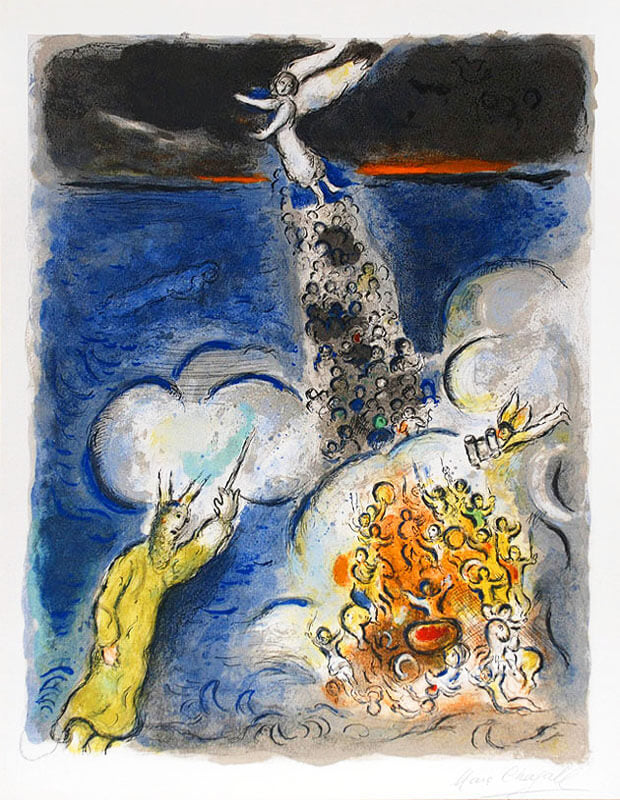
Marc Chagall, “The Train Crossed the Red Sea” from “Exodus” (1966)
Leave a Reply