It’s Presidents Day, so schools are closed. Even so, one should try to learn something, or at any rate, do a little thinking every day. In between practicing my arithmetic on the back of a coal shovel and hurling silver dollars across the Potomac (for physical fitness), I pause to contemplate the Oxford comma.
Anyone who’s ever noted my exasperating fondness for punctuation of all sorts would assume that I’d be fallow ground for the Oxford comma. But the truth is it’s only been within the past couple of years that I actually started to use it, if not consistently.
If you have no idea what I’m talking about the “Oxford comma,” also referred to as the “serial comma,” is the comma you will sometimes encounter after the second item in a series of three (for example, “Manny, Moe, and Jack,” as opposed to “Manny, Moe and Jack”).
To me, the insertion of an Oxford comma can wind up making the page look a little cluttered. It also creates an extra, annoying caesura in my head, interrupting the flow of a sentence. It does, however, to some extent, cut down on ambiguity. Of course, in some instances, it can also create ambiguity, as in “my father, Margaret Thatcher, and a plucked chicken.” Is my father indeed Margaret Thatcher?
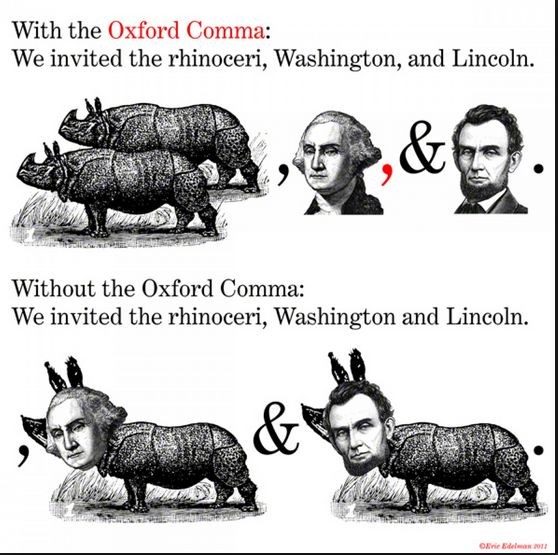
But, I think you’ll agree, the risk is negligible alongside “the rhinoceri, Washington and Lincoln.”
Expressing myself in writing has always been as intuitive as it has been dictated by any formal guidelines. It’s as much about the “sound” of the words and the flow of a sentence, and how everything looks on the page, as it is about being absolutely correct.
Which is why I don’t mind the occasional sentence fragment, the insertion of a dash where it feels appropriate – or two around what could very easily be a parenthetical phrase (as here) – if the curved brackets seem to be a little much.
Fun fact: the serial comma is often called the Oxford comma because it is the standard promulgated by Oxford University Press and, by extension, the Oxford Style Manual. It’s been a while since I’ve been in school, but in American English it seems as if we can either take it or leave it.
Wasn’t the whole reason the Founding Fathers wanted to toss out the British to begin with because of their confounded, pedantic Oxford commas?
Friends, I think enough time has passed that we can now, in good conscience, distinguish my father from Margaret Thatcher and a plucked chicken.
Happy Presidents Day!