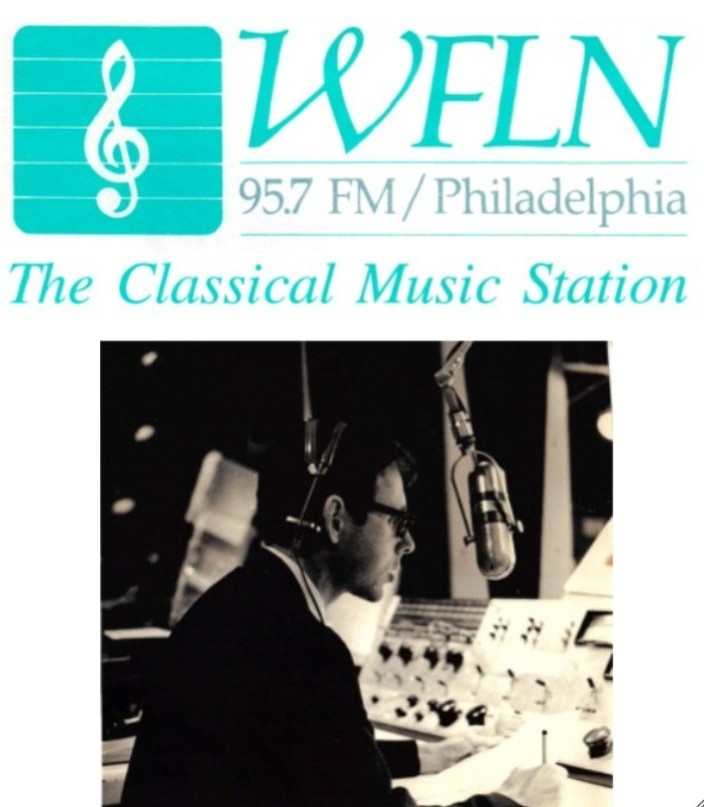
Whenever one of the old WFLN roster dies, it makes me horribly nostalgic for the better days of classical radio. Signed on by Frank Kastner in 1949 (the two-hour inaugural program, he told me, included Brahms’ “Academic Festival Overture,” Rachmaninoff’s Piano Concerto No. 2, and Sibelius’ Symphony No. 2), WFLN was Philadelphia’s classical music radio station for nearly 50 years. Over time, Kastner, Henry Varlack, Taylor Green, Bill Shedden, and Ralph Collier all passed into the beyond. Now, I’m sorry to learn, they are joined by Jill Pasternak, who died on Saturday at the age of 91.
Although I met her several times while working at WRTI, I don’t have any good Jill Pasternak stories. I only really knew her, like most people, as a listener. In house, I followed her at the microphone on a few occasions, as the station transitioned from classical to jazz at 6 p.m. But we really didn’t get to too much chit-chat. I defer to some of her other colleagues for their colorful reminiscences, which you’ll find at one of the links below. I found especially amusing Mark Pinto’s recollection of Jill’s penchant for Michel Legrand’s music for “The Go-Between” and what that led to behind the scenes.
From time to time, I’ll google WFLN and its hosts to see if I can come up with any fresh information. Last night, I came across a report from 1986 that bore out what I had always heard about the station: WFLN was one of a dwindling number of commercial classical music stations that always turned a profit. (Nowadays, with few exceptions, if you hear classical music on the radio, it is usually from a public or community source.)
Unfortunately, when the license was sold, that wasn’t good enough. You know how it is. It’s not enough to make money. You have to make a LOT of money. As in, squeeze it for as much as you possibly can.
What followed is painful to remember, as the new owners gave this longstanding cultural oasis an ultimatum to pull bigger numbers, or else. The strategy? Bust up all those symphonies and concertos into bite-sized pieces to be spoon-fed to the populace. No more complete Brahms symphonies. Certainly no more Bruckner. Just individual movements of old favorites.
This was especially painful when someone tried to program an excerpt from a piece like Liszt’s Piano Concerto No. 1, which has an innovative structure, intended to be played through without break. On such occasions, the music would stop, jarringly, interrupted like clicking an “off” button in the middle. It did not make for good radio.
Again, WFLN proved profitable, but I think everyone knew, once the ultimatum had been issued, that its fate was inescapable. The station was merely being put through the motions to demonstrate, “Well, we tried.”
Finally, on September 5, 1997 (with only 24-hours’ public notice), WFLN’s classical music format was replaced, again jarringly – both from a programming but also an emotional standpoint – with modern “adult contemporary hits,” as WXXM. Reflecting the kind of world we now live in, the “new” station shifted format every few years, in contrast to the anchor WFLN had been. (Its current call letters are WBEN-FM.) The last voice heard before the transition was that of Jill Pasternak, who bid farewell to a half-century of excellence with Fritz Kreisler’s “Schön Rosmarin.” Her humanity was never more evident. Audibly choked-up, she reflected what we all felt. It was loss. You could hear it in her voice. Just like that, five decades had come to an end.
For months after, there was no classical music programming being broadcast from Philadelphia. Temple University stepped up with an imperfect solution: WRTI, which had built its own following as a 24-hour jazz station, would divide its schedule, with classical music during the daytime hours hosted by a handful of WFLN exiles. Jill was one of these.
With all respect to WRTI, it never has been a substitute for WFLN. You could turn on 95.7 at any time during the day or night and find the consolation of Haydn or Grieg or Fauré. Now, after 6:00, you’re out of luck. Nearly 30 years later, America’s sixth largest city is still without a full-time classical music station.
Of course, times have changed, and classical music can be found elsewhere, especially via internet streaming. But that kind of old-school classical music radio, with playlists of complete recordings of great performances, introduced by knowledgeable, friendly-without-being-inane hosts is increasingly rare.
How many times have I had on a classical music station and been transported by the music, only to be slapped awake at the end of a movement by some vacuous chit-chat. What happened to the rest of the piece? It’s jarring, and very upsetting, and I doubt very much it does anything to build listenership beyond the music-as-wallpaper crowd. I can’t even deal with it as wallpaper. There’s too much talk to be able to use it as background. You can’t even get lost in the fantasy of the music.
It’s happening all across the country. Increasingly, local hosts are falling away as owners, general managers, and even universities that run these stations find that it’s more economical to drop community-connected voices, who over time have become like family for local listeners, to become, essentially, affiliates for larger, syndicated, satellite-distributed behemoths like Classical 24, a service out of Minnesota that’s now being carried by classical music stations across the U.S., so that as a listener, when you drive for great distances, you jump from frequency to frequency, and it’s the same soul-deadening slop.
WFLN was as solid as the Rock of Gibraltar. As a kid, I was able to learn the entire standard repertoire by listening to the radio.
The greatest investment I made in the last several years was that for my internet radio. Yeah, you can get decent speakers and you can stream anything on your computer; but the internet radio allows me to continue to live in a world in which I can turn on a tabletop console and enjoy beautiful music with hosts who are real people who say relevant things without getting bogged down in chat or being so didactic that you start to wonder what kind of station you’re even listening to. In short, classical radio the way it used to be.
The one thing that shatters the illusion is when I have to step outside the bubble and drive someplace and again I am at the mercy of “local” radio. Of course, there’s a workaround for that too, but I haven’t progressed to the point where I’m plugging in my phone in the car. It’s easier for me just to carry a few CDs.
I realize this isn’t an awful lot about Jill, but there are some nice remembrances to be gleaned in reading from the WRTI website. (See the links below.) Already, I’d forgotten her warm greeting: “How ARE you today?”
I keep hoping to uncover more airchecks from WFLN broadcasts from those pre-internet days. If you’ve got any, please consider sharing them. I would love to hear them! Over the years, I’ve only been able to find a few online, and one of them is morning drive-time, not really representative of the rest of the day’s programming.
It’s astonishing to me that I had the opportunity to actually work with so many of these voices that were unwitting mentors to me over the years. Dave Conant, Bill Shedden, Ralph Collier, Jack Moore, Michael Carter, Jill. I talked to Henry Varlack on the telephone during his air shift in the middle of the night, many, many times. I met Terry Peyton and Taylor Green when I visited the WFLN studios in Roxborough (an hour’s bus-ride from Center City), when I auditioned to get on the air there when I was still in college. I did not succeed, although Dave Conant was very kind, recording my voice as I read copy and offering critiques (“You sound like you’re announcing the races!”) and inviting me to come back and try again. Which I did. Years later, as he neared retirement, I finally did wind up working with him, as an on-call classical host mostly doing overnight jazz at WRTI.
Jill, a regular presence and a beloved one, retired from WRTI in 2015. I am grateful to her for helping to make life a little more pleasant. She shared a lot of beautiful music and always kept it human.
R.I.P.
Bruce Hodges’ obituary on the WRTI website
https://www.wrti.org/wrti-spotlight/2025-07-27/jill-pasternak-longtime-classical-host-at-wrti-has-died-at-91
WRTI staff memories of Jill
https://www.wrti.org/wrti-spotlight/2025-07-27/here-are-our-memories-of-jill-pasternak-what-are-yours
1986 radio report, affirming the solidity of WFLN’s finances and revenue
https://www.worldradiohistory.com/Archive-Mediatrix/Mediatrix-Philadelphia-1986.pdf
Philadelphia Inquirer article on the last gasp of WFLN
https://www1.udel.edu/nero/Radio/readings/Classical/lastclass.html