Tag: WWII Film Scores

  • John Williams’ WWII Film Scores on KWAX

    John Williams’ WWII Film Scores on KWAX

    I won’t put too fine a point on it, because I feel it would be disrespectful to those who made the ultimate sacrifice to use Memorial Day to sharpen my bayonet. But here’s an example of programming you WON’T hear on WWFM this weekend.

    You will hear it, however, on KWAX, the radio station of the University of Oregon, where “Picture Perfect” will continue, as I prepare to produce and distribute fresh programs.

    This week, we’ll revisit some of John Williams’ music for films set during World War II.

    Only six months after Pearl Harbor, America struck back, devastating the Japanese fleet in a battle regarded as one of the war’s turning points. “Midway” (1976) was a belated big-screen dramatization of the event, featuring an all-star cast of war movie standbys, including Charlton Heston, Henry Fonda, James Coburn, Glenn Ford, Hal Holbrook, Toshiro Mifune, Robert Mitchum, and Cliff Robertson.

    Unfortunately, the assembly of old-timers, combined with abundant stock footage from “Tora! Tora! Tora!” and actual period newsreels, may have saddled the film with an all-too-palpable sense of been-there-done-that. Williams does his best to freshen things up with a rousing, patriotic score and a crackerjack victory march. Fun fact: “Midway” was one of only four films ever to be presented in theater-rumbling Sensurround.

    Frank Sinatra starred in – and directed – “None But the Brave” (1965), the only time the Chairman of the Board sat in the director’s chair. This time, Japanese and American units are forced to coexist, and even cooperate, after they are stranded on a Pacific island. The film is also noteworthy for being the first Japanese-American co-production and bears a somewhat forward-looking anti-war message. The music is a fascinating glimpse of Williams’ work from ten years before his mega-success with “Jaws,” and “Star Wars” yet to come.

    “1941” (1979) is just plain weird. Steven Spielberg’s too-big-to-fail gamble stumbles pretty badly, following his back-to-back blockbusters, “Jaws” and “Close Encounters of the Third Kind.” The premise – a Japanese u-boat sighting off the coast of California triggering an overabundance of slapstick panic – posits, just because you’re paranoid doesn’t mean they’re not out to get you. It’s a mad, mad, mad, mad war.

    “1941” employs a staggering amount of talent, from its behind-the-scenes effects artists, to screenwriters Robert Zemeckis and Bob Gale, to its dream cast pushing as hard as it possibly can. It also features a once-in-a-lifetime opportunity to see Toshiro Mifune and Slim Pickens in the same scene. But for the most part, perhaps unsurprisingly, it fails to deliver the laughs. What it does deliver is the most rousing of John Williams’ neglected scores.

    Spielberg actually approached John Wayne about appearing in the film. Wayne was too ill to participate, but offered the following advice: “You know, that was an important war, and you’re making fun of a war that cost thousands of lives at Pearl Harbor. Don’t joke about World War II.” Whether or not audiences agreed, they didn’t exactly queue up as they had for Spielberg’s previous successes.

    We’ll strike a more reverent tone with Spielberg’s “Saving Private Ryan” (1998). Spielberg’s war-is-hell narrative yet manages to honor the sacrifice of the fighting men of World War II. The opening – a sustained “you-are-there” battle sequence on Omaha Beach – is unforgettable. Remarkably, it is presented wholly without music, Williams preferring to allow the tension of the mise-en-scène to speak for itself. Spielberg picked up his second Academy Award for Best Director. The film, however, inexplicably, lost to “Shakespeare in Love.” We’ll hear “Hymn to the Fallen,” of the hour’s selections, easily the most appropriate to Memorial Day.

    Sadly, we’re not talking about “Star Wars” here, but a real war that killed tens of millions and destroyed the lives of countless others.

    John Williams looks at World War II from four different angles this week, on “Picture Perfect” – music for the movies – this Friday evening, syndicated on KWAX. Stream it at the link below.


    Keep in mind, the station is on the West Coast, so there’s a three-hour time difference – actually rather convenient for those of us located in the vicinity of WWFM. Here are the conversions of the respective air-times:

    PICTURE PERFECT – Fridays on KWAX at 5:00 PACIFIC TIME (8:00 PM EDT)

    THE LOST CHORD – Saturdays on KWAX at 4:00 PACIFIC TIME (7:00 PM EDT)

    https://kwax.uoregon.edu/


    PHOTO: War has a way of putting one’s problems in perspective

  • WWII Film Scores for Memorial Day

    WWII Film Scores for Memorial Day

    While you’re sitting in traffic heading into your three-day weekend, take a moment to consider that you’ve got it easy compared to what Allied soldiers went through in Europe, the Pacific and North Africa to keep the world free from tyranny.

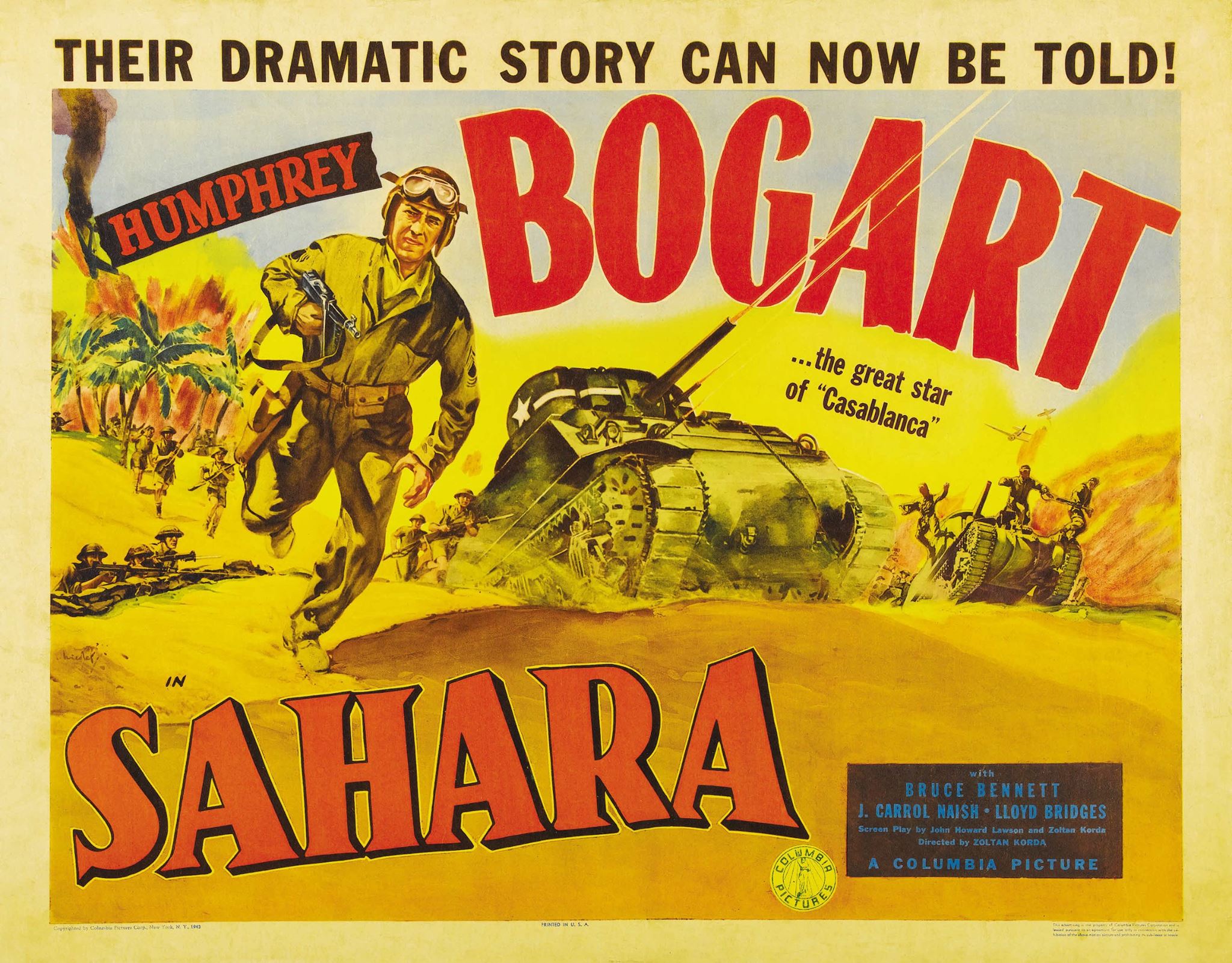
    This week on “Picture Perfect,” we’ll have music from two films of the World War II era that exemplify Hollywood’s morale-boosting approach. “Sahara” (1943) pits Humphrey Bogart as a tank commander who defends a watering hole against a superior force of parched Nazis. “Objective: Burma!” (1945) drops Errol Flynn behind enemy lines to take out a Japanese radar station.

    Neither film shuns the reality that war is hell (with some particularly suggestive gruesomeness in the latter), yet the filmmakers rose above the kind of nihilistic edge that underscores so many movies made today. When all was said and done, war movies in the 1940s sold America on hope and sacrifice and the promise of final victory.

    The conflict cast a long shadow, and in the 1950s and ‘60s Hollywood continued to churn out WWII films at an impressive rate, selling tickets to the generation that had “been there.” “The Guns of Navarone” (1961) features Gregory Peck (exempt from service during the actual war because Martha Graham injured his back), David Niven (Lieutenant Colonel in the British Commandos at Normandy) and Anthony Quinn (born in Mexico and not naturalized until 1947) as a special unit of Allied military specialists on a mission to blow up some big Nazi guns trained over the Aegean Sea.

    Efforts to get “Patton” (1970) off the ground had been in motion since 1953! The filmmakers wanted access to Patton’s diaries, but displayed horrible timing in approaching the late general’s family the day after the death of his widow. Not surprisingly, the family was completely turned off and withheld its cooperation. In the end Franklin J. Schaffner directed from a script by Francis Ford Coppola and Edmund H. North. Patton’s colleague, Omar Bradley, served as an advisor on the film. (He’s played on screen by Karl Malden.)

    “Patton” likely would have been a knockout on any level (Rod Steiger turned down the lead, much to his later regret), but it is really George C. Scott that pushes it over the top. And how much more over the top can it get than that opening monologue, assembled from Patton’s speech to the Third Army, delivered in front of an enormous American flag? Only a larger-than-life actor such as Scott could have done it justice and not been dwarfed by both the subject and the iconography. Scott won a much-deserved Academy Award for his performance – which he famously refused to accept.

    I hope you can join me for equally outsized music by Miklós Rózsa (“Sahara”), Franz Waxman (“Objective: Burma!”), Dimitri Tiomkin (“The Guns of Navarone”) and Jerry Goldsmith (“Patton”), as we look forward to Memorial Day with classic films set during World War II, this Friday evening at 6 EDT, with a repeat Saturday morning at 6; or that you’ll listen to it later as a webcast at wwfm.org.

  • WWII Film Scores Memorial Day Special

    WWII Film Scores Memorial Day Special

    Today is Richard Wagner’s birthday. Perhaps in his honor, I am going to go his megalomania one better by completely ignoring the fact and using the space for shameless self-promotion!

    This week on “Picture Perfect,” as we near Memorial Day, the focus will be on music from World War II classics.

    Among the selections will be a new release – and a very fine one – on the Intrada label of music by Miklós Rózsa. The album is called “The Man in Half Moon Street,” and includes re-recordings of some of his underrepresented though certainly deserving scores, among them, “Valley of the Kings,” “The Strange Love of Martha Ivers,” and “Sahara.”

    In “Sahara,” Humphrey Bogart plays a WWII tank commander who holes up at a desert well and uses his apparent position of power to delay a parched German battalion from participating in the First Battle of El Alamein. Allan Wilson conducts the Royal Scottish National Orchestra, in what is truly the best project of its kind I have encountered in quite some time. Re-recordings so often lack the punch of the originals, but here is Rózsa is all his glory, sounding wholly idiomatic and presented in vivid digital splendor.

    Jerry Goldsmith’s music for “Patton” should require no introduction. The film is a bona fide classic, a winner of seven Academy Awards, including Best Picture. Unfortunately for Goldsmith, at that stage of his career, he was always a bridesmaid but never a bride. George C. Scott notoriously rejected his Oscar for Best Actor; he should have given it to Goldsmith.

    Errol Flynn may seem an unlikely choice to play a U.S. Army captain, but he does just that in “Objective, Burma!” Flynn received criticism for remaining in Hollywood during the war, but the Warner Brothers publicity machine did what it could to hush up the fact that the world’s most famous swashbuckler had tried to enlist but was rejected on medical grounds. “Objective, Burma!” infuriated Churchill, and the film was actually banned in Britain for what was perceived as the Americanization of a largely British, Indian and Commonwealth conflict. The rousing score, also nominated for an Oscar, was by Franz Waxman.

    “The Guns of Navarone,” adapted from the novel of Alistair MacLean, is one of the all-time great adventure films. A team of Allied military specialists – played by Gregory Peck, David Niven and Anthony Quinn, among others – undertake a mission to blow up some very big Nazi guns trained over the Aegean Sea. Dimitri Tiomkin pulled out all the stops for his Oscar-nominated music. The recording features a spoken introduction by James Robertson Justice, who plays Commodore Jensen in the film.

    Join me for these scores from World War II classics on “Picture Perfect,” music for the movies, this Friday evening at 6:00 ET, or listen to it as a webcast, at http://www.wwfm.org.

Tag Cloud

Aaron Copland (92) Beethoven (94) Composer (114) Film Music (117) Film Score (143) Film Scores (255) Halloween (94) John Williams (185) KWAX (228) Leonard Bernstein (99) Marlboro Music Festival (125) Movie Music (132) Opera (197) Philadelphia Orchestra (86) Picture Perfect (174) Princeton Symphony Orchestra (106) Radio (86) Ralph Vaughan Williams (85) Ross Amico (244) Roy's Tie-Dye Sci-Fi Corner (290) The Classical Network (101) The Lost Chord (268) Vaughan Williams (101) WPRB (396) WWFM (881)

DON’T MISS A BEAT

Receive a weekly digest every Sunday at noon by signing up here


RECENT POSTS