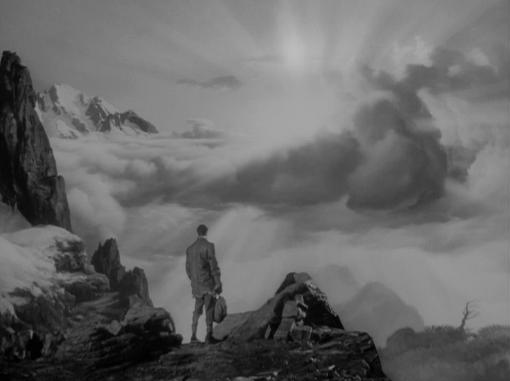
This week on “Picture Perfect,” we journey through the awe-inspiring landscapes of India and Tibet, even as we feel our way to the inner realms of spirit and psyche, with an hour of Himalayan adventures.
The Himalayas, in film, have frequently been the source of enlightenment; though occasionally their overwhelming influence has also led to madness. Intriguingly, the latter is the case in the Powell-Pressburger classic, “Black Narcissus” (1947). Psychological and emotional tensions abound in this tale of repressed nuns struggling to maintain their composure in a voluptuous Himalayan valley.
The stunning cinematography was by Jack Cardiff, and Brian Easdale (of “The Red Shoes” fame) wrote the music. Incredibly, the entire film was shot in England, mostly at Pinewood Studios. From a purely visual standpoint, “Black Narcissus” must be one of the most beautiful films ever made. It’s also one of the craziest, with unlikely object-of-desire Mr. Dean driving the sisters to the brink.
The Himalayas also form the backdrop to “Seven Years in Tibet” (1997), based on a memoir of Austrian mountaineer Heinrich Harrer. Harrer escapes from a British internment camp in India during the Second World War. He travels across Tibet to its capital, Lhasa, where he eventually becomes the tutor of the 14th Dalai Lama. In the film, Brad Pitt plays Harrer. John Williams wrote the music, and Yo-Yo Ma performs the cello solos.
“The Razor’s Edge” (1946) tells the story of a traumatized World War I veteran, who sets off in search of some kind of transcendent meaning to his existence. He finds it in India, at a Himalayan monastery. The 1946 adaptation of W. Somerset Maugham’s novel (which he claimed was thinly-veiled fact) features Tyrone Power, Gene Tierney, and Ann Baxter. The music is by Alfred Newman, who will conduct a selection from his score.
Finally, we’ll hear a suite from the Frank Capra classic, “Lost Horizon” (1937). Based on the book by James Hilton, the film stars Ronald Colman and an outstanding supporting cast, including Jane Wyatt, Thomas Mitchell, Edward Everett Horton, H.B. Warner, and Sam Jaffe. The novel, and the film, brought the term “Shangri-La” into popular usage, a Utopian paradise hidden in a secluded Himalayan valley, a place of ageless beauty and serenity.
“Lost Horizon” provided composer Dimitri Tiomkin (a pupil of Alexander Glazunov) with his first major project. The result is one of his most colorful scores. The recording is one of the gems of RCA’s Classic Film Scores series, originally issued in the early 1970s. Made in the presence of the composer, it features 157 performers, with the chorus standing on a platform behind the conductor, Charles Gerhardt, and the various percussionists stationed in the encircling balcony.
I can’t guarantee that you’ll find enlightenment, but there will be plenty to awe and inspire in these Himalayan adventures, on “Picture Perfect,” music for the movies, now in syndication on KWAX Classical Oregon!
——–
Clip and save the start times for all three of my recorded shows:
PICTURE PERFECT, the movie music show – Friday at 8:00 PM EST/5:00 PM PST
SWEETNESS AND LIGHT, the light music program – Saturday at 11:00 AM EST/8:00 AM PST
THE LOST CHORD, unusual and neglected rep – Saturday at 7:00 PM EST/4:00 PM PST
Stream them, wherever you are, at the link!
https://kwax.uoregon.edu
Tag: Yo-Yo Ma
-

Yo-Yo Ma at 70 A Musical Journey
As you may have read here before, Yo-Yo Ma turned 70 this week. Arguably the most visible and charismatic cellist of his generation, Ma was born on October 7, 1955. We follow up on our salute to this beloved figure and his work in film, heard on Friday’s “Picture Perfect” (on which was featured music from “Seven Years in Tibet,” “Memoirs of a Geisha” and “Crouching Tiger, Hidden Dragon”), by programming two of his more unusual recordings on “The Lost Chord.”
Ma has long been acclaimed for his performances of the Bach Cello Suites, chamber music by Beethoven and Brahms, and most of the major concertos for cello and orchestra. However, his first commercial recording, believe it or not, was of music by the English composer Gerald Finzi.
Nor is Finzi’s Cello Concerto likely what we would expect from a composer largely known for his wistful, though innocuous choral works and endlessly melodic string miniatures. In fact, there’s an urgency to the first movement of the piece that seems to predict his diagnosis with leukemia, of which he learned just before his 50th birthday. The slow movement of the work unfolds in the composer’s characteristically straightforward and easily assimilated musical language. The third movement fulfills audience expectations of an optimistic and buoyant finale.
The completed concerto was given its first performance in July of 1955. It would be the last music Finzi ever heard, when, a little over a year later, he listened to a concert broadcast of a performance from his hospital room the night before he died.
Ma recorded the piece while in his early 20s, with the Royal Philharmonic Orchestra, conducted by Vernon Handley.
More recently, having conquered the classical concert hall and established his mastery of the standard repertoire, Ma has proved increasingly restless and exploratory, with forays into Baroque music on period instruments, American bluegrass, Argentinean tango, improvisatory duets with Bobby McFerrin, and several musical journeys along the Silk Road.
The excitement and purity of working out musical ideas with artists from diverse cultures color his album titled “Silk Road Journeys.” We’ll hear Ma on an instrument called the morin khuur, performing with Mongolian vocalist Ganbaatar Khongorzul, in “Legend of Herlen,” built on a traditional long-song about the Herlen River, by Byambasuren Sharav. They’ll be joined by trombonists and percussionists of The Silk Road Ensemble, a group assembled by Ma to satisfy his curiosity about musical traditions existing beyond the confines of Western culture.
I hope you’ll join me for “Yo-Yo, around the World.” It’s more than just a party trick. Our heart belongs to Ma, on “The Lost Chord,” now in syndication on KWAX, the radio station of the University of Oregon!
Clip and save the start times for all three of my recorded shows:
PICTURE PERFECT, the movie music show – Friday at 8:00 PM EDT/5:00 PM PDT
SWEETNESS AND LIGHT, the light music program – Saturday at 11:00 AM EDT/8:00 AM PDT
THE LOST CHORD, unusual and neglected rep – Saturday at 7:00 PM EDT/4:00 PM PDT
Stream them, wherever you are, at the link!
-

Yo-Yo Ma at 70 Celebrating His Film Music
It’s very hard to believe, but the eternally youthful Yo-Yo Ma turned 70 on Tuesday. This week on “Picture Perfect,” we honor one of the most famous classical musicians in the world with music from three of his film projects.
Ma played cello solos in two scores by John Williams – those for “Seven Years in Tibet” (1997) and “Memoirs of a Geisha” (2005). Of course, Williams being Williams, both scores were nominated for Academy Awards.
But it was Ma’s contribution to Tan Dun’s “Crouching Tiger, Hidden Dragon” (2000) that struck Oscar gold. Dun’s music contributed to what might be termed “The Year of the Dragon,” as Ang Lee’s film received 10 Academy Award nominations, including one for Best Picture. “Crouching Tiger” would slink away with awards for Best Foreign Language Film, Best Art Direction, Best Cinematography, and of course Best Original Score.
In addition, Ma recorded a very popular album in 2004 of arrangements for cello and orchestra of film music by Ennio Morricone, with the composer conducting. We’ll round out the hour with one of these, from Morricone’s beloved score to “The Mission” (1986).
I hope you’ll join me, as we salute Yo-Yo Ma at 70, on “Picture Perfect,” music for the movies, now in syndication on KWAX, the radio station of the University of Oregon!
Clip and save the start times for all three of my recorded shows:
PICTURE PERFECT, the movie music show – Friday at 8:00 PM EDT/5:00 PM PDT
SWEETNESS AND LIGHT, the light music program – Saturday at 11:00 AM EDT/8:00 AM PDT
THE LOST CHORD, unusual and neglected rep – Saturday at 7:00 PM EDT/4:00 PM PDT
Stream them, wherever you are, at the link!
BONUS: Ma and Williams on “The Tonight Show,” playing a selection from “Memoirs of a Geisha”
-

Yo-Yo Ma at 70 a Musical Legend
The years, they do fly by. How can Yo-Yo Ma be 70? It seems only yesterday we were celebrating his 60th birthday.
Arguably the most visible and charismatic cellist of his generation, Ma was born on October 7, 1955. He’s recorded more than 90 albums and been recognized with 19 Grammy Awards. In addition, among innumerable other honors, he has been the recipient of the National Medal of the Arts and the Presidential Medal of Freedom. As recently as 2020, he was included in Time Magazine’s “100 Most Influential People.”
Ma began playing cello at the age of 4. That’s when he “put away childish things” – that is to say, a juvenile pursuit of the violin, viola, and piano! At 5, he began performing in public, and at 7, played for Presidents Dwight D. Eisenhower and John F. Kennedy. At 8, he was introduced to American television audiences courtesy of Leonard Bernstein. The next year, Isaac Stern brought him along to “The Tonight Show with Johnny Carson.”
This was all before Ma attended Juilliard, where he studied with Leonard Rose. He dropped out of Columbia – only to attend Harvard. He spent four summers at the Marlboro Music Festival, where he played under the direction of legendary cellist and conductor Pablo Casals. He’s been friends with Emanuel Ax, a regular chamber music partner, since their student days.
Ma has long been acclaimed for his interpretations of the Bach Cello Suites, chamber music by Beethoven and Brahms, and most of the major concertos for cello and orchestra. However, his first commercial recording, believe it or not, was of the Cello Concerto by English composer Gerald Finzi. Ma recorded the piece while in his early 20s, with the Royal Philharmonic Orchestra conducted by Vernon Handley.
Later, having conquered the classical concert hall and established his mastery of the standard repertoire, Ma proved increasingly restless and exploratory, with forays into Baroque music on period instruments, American bluegrass, Argentinean tango, improvisatory duets with Bobby McFerrin, and several musical journeys along the Silk Road.
He’s also been active in film, contributing to the soundtracks of “Seven Years in Tibet” and “Memoirs of a Geisha” for John Williams and “Crouching Tiger, Hidden Dragon” (the recipient of an Academy Award for Best Original Score) for Tan Dun. And of course his album of arrangements of Ennio Morricone themes sold faster than a tray full of cannoli.
Ma’s friendship with Williams also yielded a cello concerto, which they first recorded together in 1994. My most recent Ma acquisition is his recording of the concerto in its revised version, released on Sony Classical in 2022, and of course it’s wonderful. However, the earlier release has an alluring bonus in Williams’ “Elegy,” reworked from material originally conceived for “Seven Years in Tibet” – six transporting minutes of unalloyed loveliness.
Ma is one of classical music’s last media celebrities, whether introducing kids to the cello on PBS’ “Arthur,” “Sesame Street,” or “Mr. Rogers’ Neighborhood,” or playing Bach in support of dancer Misty Copeland and sitting in with the band on “The Late Show with Stephen Colbert.”
I’ve been privileged to see him in concert several times. Last season, he was in Princeton at McCarter Theatre for a conversation with PBS NewsHour correspondent Jeffrey Brown. His love for music is such that it is not unusual for him to return after intermission, following a star turn in a big concerto, to modestly sit in with the rest of the cello section and play as a rank-and-file musician on the concert’s second half.
All in all, I suspect he’s a really good guy. In fact, I’m sure he is. Happy birthday, and thanks for everything, Yo-Yo Ma!
John Williams’ “Elegy”
On Colbert with Misty Copeland
At the age of 7, presented by Leonard Bernstein
“Crouching Tiger, Hidden Dragon”
Ma with saxophonist Joshua Redman, playing “Crazy Bus” on “Arthur”
On “Sesame Street”
Gerald Finzi’s Cello Concerto
Bach, Suite No. 1 for Unaccompanied Cello
-

Mother’s Day Music Sweetness and Light on KWAX
Get ready for the mother of all shows this week, on “Sweetness and Light.” It’s music for Mom for Mother’s Day!
Enjoy works on nursery themes by Grace Williams, Charles Williams, and Vaughan Williams (all unrelated). Also, Wolfgang Amadeus Williams – er, I mean Mozart.
Of course, Mom deserves more, so I’ve also enlisted Yo-Yo Ma (despite his name, not really a mother, though if said properly, guaranteed to get Mom’s attention) and Luciano Pavarotti (accompanied by Henry Mancini, no less).
Start your day with a musical candygram. It’s a suite of sweets for Mom on “Sweetness and Light, this Saturday morning at 11:00 EDT/8:00 EDT, exclusively on KWAX, the radio station of the University of Oregon!
Stream it, wherever you are, at the link.
Tag Cloud
Aaron Copland (93) Beethoven (95) Composer (114) Film Music (144) Film Score (143) Film Scores (255) Halloween (94) John Williams (195) KWAX (229) Leonard Bernstein (104) Marlboro Music Festival (125) Movie Music (159) Mozart (90) Opera (212) Philadelphia Orchestra (89) Picture Perfect (174) Princeton Symphony Orchestra (109) Radio (88) Ross Amico (244) Roy's Tie-Dye Sci-Fi Corner (290) The Classical Network (101) The Lost Chord (269) Vaughan Williams (105) WPRB (397) WWFM (881)